By Marco Visani | Photography by Domenico Fuggiano Enriched English Adaptation
Main Facts: Reclaiming the Compact Crown
In the golden crisp air of autumn 1979, the automotive landscape witnessed a significant pivot. After a tumultuous decade defined by the mixed market receptions of the Beta and the Gamma, Lancia boldly re-entered the fiercely contested European compact hatchback segment. It was a market the illustrious Italian marque had deliberately stepped away from seven years prior, following the phasing out of the beloved Fulvia.
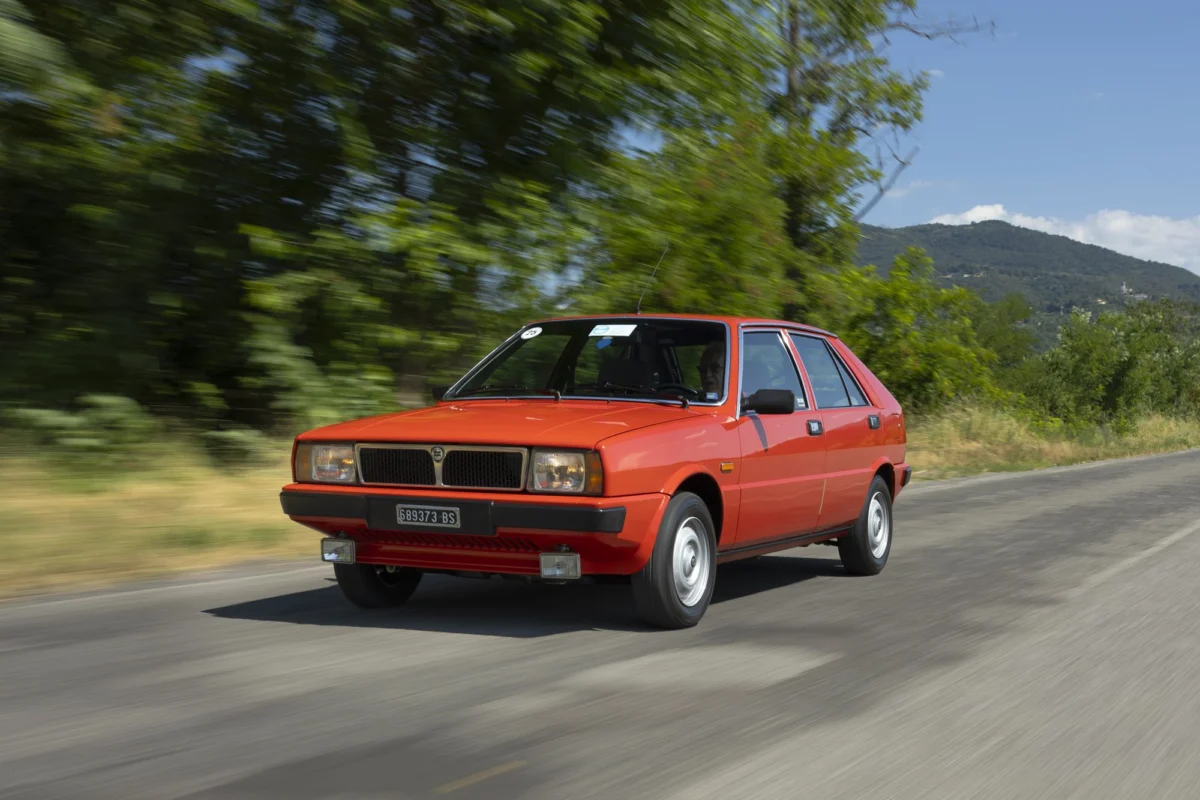
Lancia’s triumphant return materialized as the Delta—a vehicle that synthesized the traditional core values of the brand: striking, elegant design penned by the master Giorgetto Giugiaro, proven yet sophisticated engineering, and a level of construction quality that immediately set it apart from mass-market competitors.
While history would eventually cement the Delta’s legendary status through its ferocious, all-conquering rally exploits in its 4×4 iterations, its foundation was built upon everyday refinement. To truly understand the gravity of this machine, automotive historians and enthusiasts must look past the later Integrale variants and examine one of the very first production Deltas ever assembled—a pure, unadulterated entry from the dawn of its production run.
Chronology: The Road to the 1979 Frankfurt Debut
Tracing the timeline of the Delta reveals a meticulous design and development cycle deeply influenced by the changing demands of European motorists and the internal politics of the Fiat Group.
1972: Lancia officially discontinues the Fulvia hatchback, leaving a critical void in its lineup for a compact, accessible vehicle.
Mid-1970s: Giorgetto Giugiaro’s Italdesign begins conceptualizing a new two-box, five-door hatchback codenamed project "Y5." Initial styling studies explore radical rear-light layouts inspired by the 1967 Flavia Series 2.
Late 1970s (The French Clinic Test): Focus groups in France deliver a damning verdict on Giugiaro’s high-sill tailgate designs, forcing the designer to radically rework the rear fascia down to the bumper line for practical usability.
September 1979: The Lancia Delta makes its global debut at the Frankfurt Motor Show, sharing the stage with rivals like the Opel Kadett D.
Late 1979: Series production begins at the Chivasso plant at a modest rate of roughly 150 units per day.
November 1979: Deliveries trickle out to the public, quickly generating an unprecedented backlog.
Late 1979 / Early 1980: Production scales up dramatically, hitting 380 units per day as output expands to include Fiat’s historic Lingotto facility in Turin.
January 1980: The Lancia Delta achieves ultimate industry validation by winning the prestigious European Car of the Year award for 1980—a historic first and last for the Turin-based brand.
February 1982: Production at the Lingotto plant concludes, leaving Chivasso to shoulder the immense, ongoing demand for the runaway hatchback hit.
Supporting Data: Engineering, Mechanics, and Trims
A persistent myth among casual automotive enthusiasts is that the Lancia Delta was merely a cynical, badge-engineered Fiat Ritmo in a bespoke suit. A deeper technical audit proves this assumption entirely false. At the time of the Delta’s conception, cross-brand platform synergies within the fledgling Fiat empire were far less rigid, affording Lancia’s engineering department a commendable degree of mechanical autonomy.
Under the Skin: Beyond the Fiat Connection
While the Ritmo and the Delta shared fundamental roots, their physical dimensions and chassis architectures diverged significantly:
Wheelbase: The Fiat Ritmo sat on a 2.448-meter wheelbase, whereas the Lancia Delta stretched to 2.475 meters.
Suspension Geometry: The Fiat utilized a transverse-spring rear suspension layout derived from the smaller 127. In contrast, the Delta adopted an evolution of the Beta’s sophisticated MacPherson strut architecture, enhanced further with longitudinal locating arms for superior wheel control and tracking stability—a clear nod to Lancia’s upscale market positioning.
Powertrain and Performance
The engine bay did incorporate variants of the reliable Fiat single-overhead-cam powerplant (originally born as an 1,116cc unit in the 1969 Fiat 128), but Lancia’s engineers heavily modified them:
1300cc Engine (1,301 cc): Fitted with bespoke intake manifolds, a revised exhaust system, and progressive dual-choke carburetion, power jumped from the Ritmo’s 65 horsepower to a sprightly 75 horsepower. Top speed reached 155 km/h. It was offered with a choice of a four-speed or five-speed manual gearbox.
1500cc Engine (1,498 cc): Similarly massaged to produce 85 horsepower (up from 75 hp), pushing the hatchback to a respectable top speed of 160 km/h, paired exclusively with a five-speed manual transmission.
Trim Differentiation: The 4-Speed vs. The 5-Speed Range
The launch lineup comprised three distinct models: the 1300 (four-speed), the 1300 (five-speed), and the range-topping 1500 (five-speed only). Distinguishing the base four-speed model from its more expensive stablemates required a keen eye:
Exterior: The entry-level model omitted the rear window wiper (available only as an option) and rode on narrower 145-13 tires compared to the 165-13 footwear of the 1300 five-speed and 1500 variants. Furthermore, exclusive paint options such as rich brown, metallic brown, and beige were withheld from the budget model.
Interior: The base car featured simpler looped-fabric floor mats rather than true automotive carpeting. Instrumentation differed as well: the base car made do with an analog clock where the tachometer resided on higher trims, while upscale versions boasted a futuristic digital clock mounted neatly above the rearview mirror.
Official Responses and Internal Perspectives: The Giugiaro Dialogue
The creation of the Delta’s styling was fraught with creative tension, high-stakes consumer testing, and boardroom skepticism. In a revealing 2003 retrospective interview, designer Giorgetto Giugiaro opened up about the gestation of the car and the contrasting opinions within the upper echelons of Fiat management.
Giugiaro initially envisioned two daring rear-end treatments for the "Y5" project. Both featured ultra-slim, horizontal light clusters situated either just beneath the tailgate opening—echoing the design language of the 1967 Flavia Series 2—or directly beneath the rear windscreen. However, consumer clinics held in France poured cold water on these avant-garde proposals. French motorists made it abundantly clear that a two-box hatchback with such a high load-sill would be dismissed as hopelessly impractical.
Reluctantly, Giugiaro went back to the drawing board, redesigning the rear fascia to allow the tailgate opening to drop all the way down to the level of the rear bumper.
The front end presented another fascinating design evolution. The distinctive radiator grille featured a stylized Lancia shield stretching the full width of the grille—an aesthetic stroke of genius credited to Pininfarina. Giugiaro revealed that early prototypes without this shield—featuring only a giant Lancia badge floating centrally—looked elegant, but lacked the fierce brand identity the car ultimately projected.
Yet, not everyone inside the corporate hierarchy was immediately convinced of the Delta’s aesthetic purity. Giugiaro recalled a candid conversation with Fiat director Umberto Agnelli:
"Umberto Agnelli wasn’t a fan of the Delta at all because of the purity of its lines," Giugiaro recounted. "He kept comparing it to the Fiat Ritmo, which, with its shocking plastic bumpers and unconventional styling, he considered to be far more modern."
Despite Agnelli’s initial reservations, history proved Giugiaro right. Parked next to another front-wheel-drive compact debutante at the 1979 Frankfurt show—the square, utilitarian Opel Kadett D—the Lancia Delta looked effortlessly chic, bridging the gap between utilitarian hatchback practicality and bespoke Italian tailoring.
Implications: A Runaway Commercial Triumph and Paradigm Shift
Lancia’s strategic ambitions for the Delta were nothing short of audacious. Management projected an annual production volume of at least 70,000 units, representing an aggressive 45% growth trajectory for the brand as a whole.
Securing the highly coveted European Car of the Year trophy for 1980 served as the ultimate catalyst. It was the first time Lancia had captured the title—and, as history would dictate, it would also be the last. The accolade triggered an overwhelming surge in consumer demand. Factory output soared from 150 cars a day in late 1979 to 380 cars a day by mid-1980. The pressure was so intense that Lancia had to enlist Fiat’s sprawling, historic Lingotto factory in Turin to supplement the primary production lines in Chivasso until Lingotto closed its automotive operations in February 1982.
Despite this dual-factory effort, demand drastically outstripped supply. Eager buyers faced waiting lists stretching up to four months just to take delivery of their new Italian hatchback.
Perhaps the most telling implication of the Delta’s success lies in its demographic impact: 70 percent of all buyers who walked into a Lancia showroom to purchase a Delta had never previously owned a Lancia.
In one masterstroke, the Delta rescued Lancia from its lukewarm 1970s slump, redefined what a premium European hatchback could be, and laid the unshakeable psychological and structural groundwork for the fire-breathing Integrale monsters that would dominate the World Rally Championship in the decade to follow. It was, and remains, a masterclass in automotive engineering and design harmony.