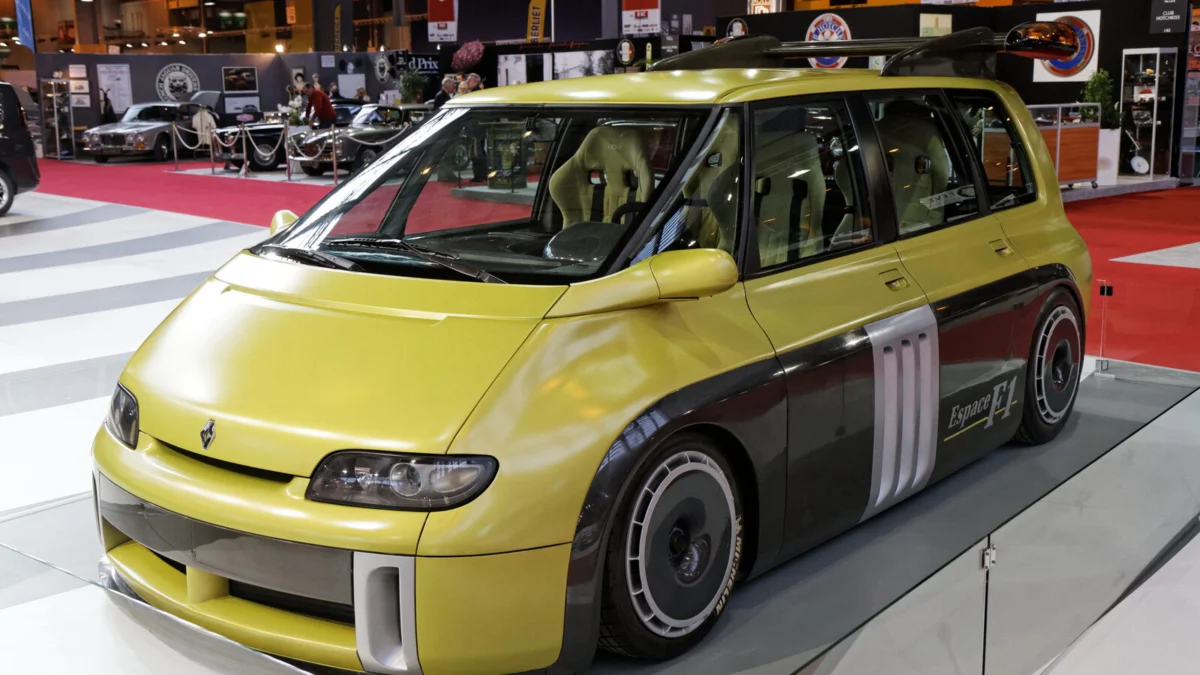
On October 16, 1994, as the curtains fell on the Paris Motor Show at the Porte de Versailles, the automotive world witnessed a collision between two incompatible universes. Amidst the sensible family saloons and the burgeoning trend of fuel-efficient diesel engines, Renault unveiled an object of pure, unadulterated engineering madness: the Espace F1.
With a Williams-Renault V10 engine screaming from the rear, encased in the silhouette of France’s most beloved family hauler, the Espace F1 remains, thirty years later, the most brilliant act of automotive iconoclasm in history. It was a vehicle that defied logic, mocked the laws of physics, and served as a thunderous testament to an era of unbridled ambition in French motorsport.
The Genesis of an Impossible Concept
To understand the audacity of the Espace F1, one must look at the climate of the early 1990s. Renault, in partnership with the engineering wizards at Matra, was enjoying a period of unprecedented dominance in Formula 1. The Williams-Renault FW15C, powered by the legendary 3.5-liter RS5 V10 engine, had propelled Alain Prost to his fourth World Championship in 1993.
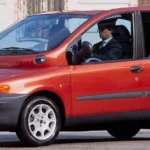
Simultaneously, the Renault Espace—the pioneer of the European minivan segment—was celebrating its tenth anniversary. Launched in 1984 with little fanfare, the Espace had become a cultural staple for French families. In a stroke of marketing genius, the leadership at Billancourt decided that the best way to honor a decade of practical, boxy transport was to marry it to the most sophisticated racing technology of the day.
The directive was simple but insane: create a vehicle that looked like a minivan but performed like a Grand Prix winner. The team at Romorantin, Matra’s historic site, did not merely swap an engine; they essentially built a full-blown carbon-fiber race car and draped a minivan body over it.
Chronology of a Mechanical Fever Dream
1994: The Shock of the Paris Motor Show
The reveal in Hall 1 of the Porte de Versailles was a masterclass in staging. The vehicle on the stand was a static show-car, but its presence was overwhelming. To the casual observer, it was an Espace II, yet it possessed a menacing, predatory stance. Its tracks were widened by thirty centimeters, and the bodywork featured aggressive lateral air scoops carved into the rear doors. The machine sat on magnesium rims wrapped in Michelin slick tires, with a massive carbon-fiber wing perched atop the roofline. It was, in every sense, a hallucination brought to life.
1995: The Year of the "Rocket-Van"
While the Paris show-car was designed to gauge public reaction, the second chassis—the "functional" prototype—was being pushed to its limits. In early 1995, the Espace F1 roared onto the tarmac of the Magny-Cours circuit in central France. With Formula 1 legends Alain Prost and Éric Bernard at the helm, the world finally saw what a minivan with 800 horsepower could do.
The performance figures were, and remain, nothing short of irrational:
- 0 to 100 km/h (62 mph): 2.8 seconds.
- 0 to 200 km/h (124 mph): 6.9 seconds.
- Top Speed: 312 km/h (194 mph).
- Braking: Capable of stopping from 300 km/h to a dead halt in just 600 meters.
Supporting Data: The Anatomy of a Beast
The Espace F1 was not a "tuned" minivan; it was a structural marvel. Beneath its carbon-fiber and Kevlar skin, the engineers utilized a chassis constructed from an aluminum honeycomb structure—the same technology used in aerospace and high-level motorsport.
The engine, the heart of the beast, was the 3.5-liter atmospheric RS5 V10. It delivered 800 horsepower at a staggering 13,800 rpm. This power was channeled through a Williams-sourced six-speed semi-automatic transmission with steering-wheel-mounted paddle shifters. The rear suspension was lifted directly from the Williams F1 car, ensuring that the minivan could handle cornering forces that would have turned a standard Espace into a heap of twisted metal.
Inside, the cabin was a masterstroke of theatrical engineering. To maintain the "minivan" spirit, four individual carbon-fiber bucket seats were installed, each equipped with six-point harnesses. The center console was replaced by a transparent casing that allowed the two rear passengers to stare directly at the engine’s air intake trumpets and exhaust manifolds. It was an interior designed not for grocery shopping, but for sensory overload.
Official Responses and Public Impact
The impact on the industry was seismic. At a time when car manufacturers were beginning to pivot toward safety, comfort, and, eventually, emissions compliance, Renault chose to celebrate excess. The public response was ecstatic. For the average father driving an Espace to the supermarket, the idea that the same silhouette could reach speeds exceeding 300 km/h was a point of immense national pride.
Renault’s management viewed the project as the ultimate brand-building exercise. By proving they could synthesize a "family car" with a "championship-winning engine," they reinforced the narrative that Renault engineering was at the absolute peak of the automotive hierarchy. It was a bold, irreverent, and utterly useless project—which is precisely why it remains an icon.
The Fate of the Two Espace F1s
A persistent myth suggests that the Espace F1 was a single, roaming prototype. In reality, history produced two distinct examples, each with a different purpose:
- The Show-Car (The Static Model): This is the version that captivated the public in 1994. It lacked the complex wiring, cooling systems, and structural reinforcements required for high-speed operation. Today, it resides in the official Renault Classic collection, tucked away in the reserves at Flins. It serves as a pristine, silent monument to the design brief.
- The Dynamic Prototype (The Runner): This is the monster that haunted the circuits of Europe in 1995. Easily identified by its modified air intakes designed to feed the V10 during full-throttle track sessions, this chassis is a testament to the "golden age" of atmospheric V10 engines. It is currently preserved at the Matra Museum in Romorantin-Lanthenay, where it remains a physical artifact of a time when engineers were allowed to dream without the constraints of corporate spreadsheets.
Implications: A Legacy of Irreverence
The Espace F1 did not lead to a production model, nor did it influence the design of future minivans. Its legacy is not found in the technical manuals of modern cars, but in the collective memory of the automotive world.
It stands as the final hurrah of a period when "brilliant madness" was encouraged. Today, in an age of electrification and stringent environmental regulations, the Espace F1 feels like a relic from a different planet. It was a project that dared to ask: "Why not?" and in doing so, achieved a level of fame that most production cars, with their millions in R&D and focus-group testing, never attain.
The Espace F1 serves as a permanent reminder of the power of passion in engineering. It represents a brief moment in time when the boundaries between the mundane and the supernatural were dissolved, leaving behind a legacy of sound, fury, and a silhouette that will forever be remembered as the fastest minivan to ever grace the earth.