

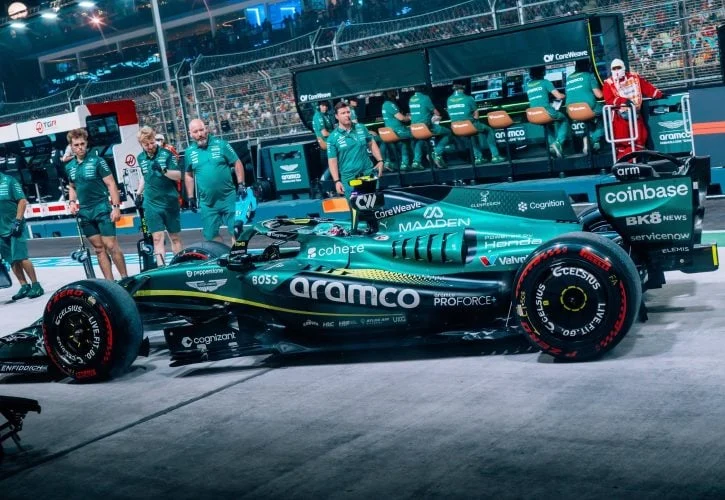
The 2026 Formula 1 season was envisioned as a new dawn for Aston Martin, a year where the synergy between a legendary driver and a powerhouse engine manufacturer would propel the Silverstone-based team into perennial contention. Instead, the reality of the season has been defined by a recurring, volatile narrative: the growing rift between Fernando Alonso and Honda.
Following a grueling Grand Prix at the Marina Bay Street Circuit in Singapore, the tension has reached a boiling point. The race, which should have been a test of tactical ingenuity, instead became a public venting ground for Alonso’s mounting frustration with his power unit. As Aston Martin languishes at the bottom of the Constructors’ Championship with a meager seven points—all of which have been earned by the Spaniard—the partnership appears to be fraying under the pressure of technical instability and misaligned expectations.
The Genesis of Discord: A Weekend of Contradiction
The friction in Singapore began long before the lights went out on Sunday. During the lead-up to the race, the atmosphere within the Aston Martin garage was palpably tense. On Saturday, Fernando Alonso demanded an immediate replacement of his turbocharger, citing a perceived defect that he claimed was hindering his performance in the free practice sessions.
However, the response from Honda’s engineering team was not one of immediate compliance, but rather one of skepticism. Shintaro Orihara, Honda’s chief engineer on the project, later revealed a significant disconnect in the diagnostic process. According to Orihara, the telemetry data did not support Alonso’s claims of a failing component. The replacement was carried out, but not as a necessary corrective measure for a confirmed mechanical failure. Instead, it was performed as an appeasement to the driver’s insistence. This discrepancy—a pilot who feels his equipment is failing him versus a manufacturer who sees no data to back up those feelings—highlights the deepening trust deficit between the two parties.
Chronology of a Meltdown: From Practice to Pit Lane
The weekend’s drama unfolded in distinct, escalating phases:
- Friday and Saturday Morning: Initial complaints regarding power delivery and turbo lag during the practice sessions. Alonso, ever the perfectionist, pushed the team to swap the hardware.
- Saturday Qualifying: Despite the engine change, the performance gain was negligible. Alonso struggled to find the rhythm required for a street circuit that demands absolute precision in throttle application.
- Sunday Race Day: The race served as the ultimate stage for the breakdown. As the race progressed, the irregular deployment of electrical energy became impossible for the veteran driver to ignore.
- The Radio Outburst: The defining moment of the weekend occurred when Alonso, battling through the humidity and technical gremlins, transmitted a scathing message over the team radio: "Haha. The energy… This engine is just so ridiculous!"
The frustration was not merely a reaction to a single lap; it was the accumulation of a season’s worth of erratic energy management that has left the team constantly on the back foot.
Technical Complexity: The 2026 Power Unit Challenge
To understand the animosity, one must understand the beast that is the 2026 Formula 1 power unit. The new regulations have shifted the focus toward a 50/50 split between internal combustion and electrical energy. This hybrid architecture requires a level of sophistication in energy recovery and deployment (ERS) that borders on artificial intelligence.
At a circuit like Singapore, which features a stop-start nature, the MGU-K and MGU-H units are under constant stress. The system must harvest energy under heavy braking and redeploy it during the brief acceleration bursts between the narrow corners of the Marina Bay circuit.
Alonso noted that the system was failing him at the most critical junctures—specifically during the restarts following Virtual Safety Car (VSC) periods. "We had so many problems with the deployment of energy," Alonso explained post-race. "It wasn’t there when I needed it. You lose positions, you lose track, and you lose the chance to fight because the car simply isn’t responding to the map we’ve set."
Official Responses: Honda’s Perspective
Honda’s response to the criticism has been a mixture of technical justification and an acknowledgment of the steep learning curve. Shintaro Orihara, representing the Japanese manufacturer, addressed the media with a measured, albeit defensive, tone.
"On this type of circuit, the difficulty is fundamentally about the energy," Orihara stated. "The power harvested varies significantly from one corner to the next, and when you are in the dirty air of another car, the thermal management and the cooling efficiency of the energy store become compromised. We are dealing with a regulation set that is incredibly complex, and we are still in the process of optimizing the software that governs these interactions."
Orihara further emphasized that the "feeling" of the driver is often at odds with the "math" of the software. While the team is working on adjusting the drivability and power availability in traffic, he underscored that modern F1 performance is no longer about raw horsepower. It is about the seamless integration of electricity and fuel—a task that, for now, Honda is failing to execute to the satisfaction of their lead driver.
Implications: A Team at the Crossroads
The implications for Aston Martin are dire. With only seven points to their name, the team is firmly anchored to the basement of the Constructors’ Championship. For a team that set out with aspirations of challenging the likes of Red Bull, Mercedes, and Ferrari, this level of performance is an existential threat.
- Driver Morale: Fernando Alonso is not a driver known for his patience. His history in the sport is littered with turbulent relationships with engine manufacturers when the results fail to materialize. If the technical issues are not resolved by the mid-season point, the risk of a public divorce between the driver and the team increases exponentially.
- Strategic Stagnation: Every resource being spent on "investigating" engine issues is a resource being taken away from aerodynamic development and chassis refinement. The AMR26 is a car that is fundamentally struggling to find balance, and the distraction of the power unit only exacerbates these design flaws.
- Manufacturer Pressure: Honda is under immense pressure to prove that their 2026 project is a viable long-term venture. If they continue to be the source of public embarrassment for a team as high-profile as Aston Martin, their reputation within the paddock will suffer, potentially scaring off future partners.
Looking Ahead: The Long Road to Recovery
As the F1 circus moves on to the next leg of the calendar, the atmosphere at Aston Martin remains one of grim determination. There are no "quick fixes" in the world of 2026 hybrid engines. The software updates, the cooling optimizations, and the calibration of the energy storage systems require time—a commodity that neither Alonso nor the team can afford.
For Fernando Alonso, the wait for a competitive package is becoming agonizing. He has often spoken of his desire to win again, but his current reality is a series of radio rants and defensive battles for positions that are, at best, inconsequential.
The partnership between Aston Martin and Honda was meant to be the cornerstone of a championship-winning era. Instead, it has become a cautionary tale of how quickly a promising project can descend into technical chaos. Whether this is merely the "teething pains" of a new regulation era or a fundamental flaw in the collaboration remains to be seen. What is certain is that in the high-stakes world of Formula 1, the clock is ticking, and the tolerance for failure is narrowing by the day.
