

By Hugues Chaussin
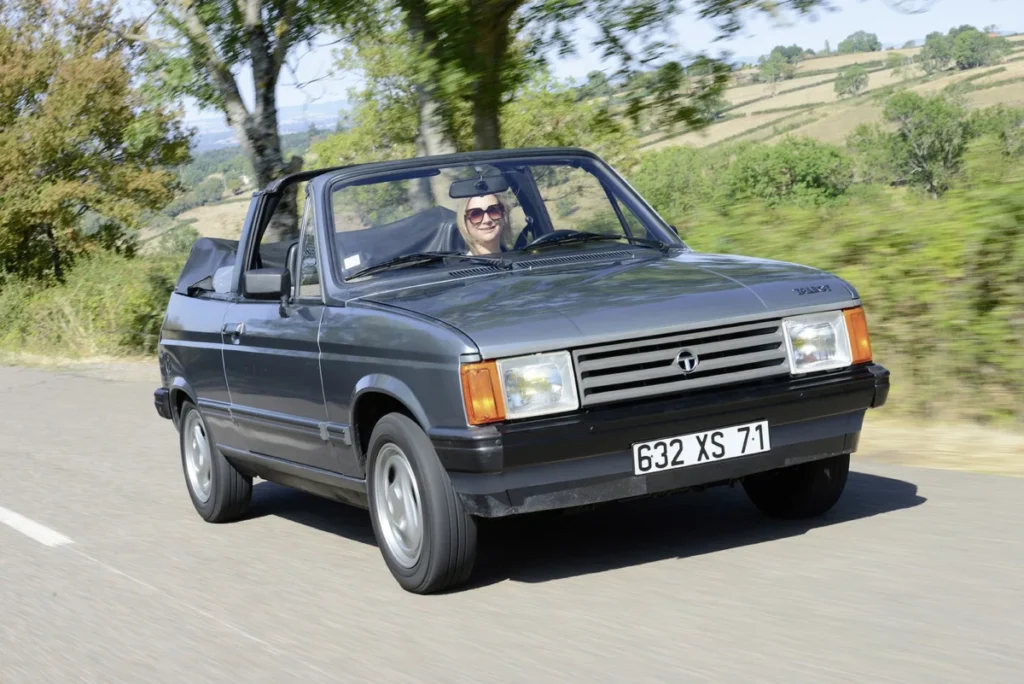
When the jovial Talbot Samba dropped its top to greet the first gentle breezes of the spring of 1982, it instantly supercharged its charm offensive. Conceived as a youthful car tailored for a vibrant, uninhibited generation, the final-born offspring of the Simca heritage looked entirely carefree. It was a vehicle designed to capture the optimism of the early 1980s. Yet, looking back through the tinted lenses of automotive history, it is a bitter irony that this breezy, sun-worshipping little convertible also served as the final curtain call for the French brand itself.
Main Facts: The Anatomy of a Forgotten French Drop-Top
The Talbot Samba Cabriolet occupies a unique, somewhat bittersweet niche in European motoring history. Based on the humble Peugeot 104 platform—much like its corporate sibling, the Citroën LN—the Samba was tasked with carrying the torch for a collapsing automotive empire. Simca had been absorbed into the Chrysler Europe umbrella, which was subsequently acquired by PSA Peugeot Citroën in 1978 and rebranded as Talbot.
The Cabriolet version, stunningly styled by the legendary Italian design house Pininfarina, debuted two years after the Samba hatchback entered the market in 1981. It was an ambitious project: turning a short, three-door supermini into a glamorous open-top four-seater without compromising its structural integrity entirely or breaking the bank.
For enthusiasts today, finding a well-preserved Samba Cabriolet is akin to unearthing a rare artifact. It represents a brief era when open-air motoring was democratized, offering working-class buyers the chance to feel the wind in their hair without paying Italian exotic or German premium prices. Yet, its production run was agonizingly brief, mirroring the turbulent corporate health of its parent company.
Chronology: The Evolution of the Samba Cabriolet (1982–1986)
During its remarkably short commercial lifespan, the Samba Cabriolet underwent a series of subtle mechanical and aesthetic evolutions as PSA tried to keep the model fresh against stiffer competition.

- Spring 1982: The grand launch. The Samba Cabriolet hits the market powered by a lively engine producing 72 horsepower, featuring a classic double-barrel carburetor. It captures the imagination of young buyers looking for affordable style.
- July 1983: A significant mechanical update is introduced. Alongside the existing 72-hp unit, PSA rolls out an 80-horsepower variant. This higher-output version achieves its extra zip by utilizing two single-body carburetors instead of the traditional double-barrel setup. For nearly a year, an unusual cohabitation of these two powerplants fills the showroom floor.
- Late 1983 – 1984: Equipment levels are upgraded. Tinted windows become standard equipment, while the folding fabric roof—initially available in parchment or black depending on the body paint—receives a proper interior lining by 1985 to improve thermal and acoustic comfort.
- June 1984: Facing rationalization pressures, the quirky engine cohabitation ends. The 72-hp variant is quietly dropped, leaving the 80-hp engine as the sole heartbeat of the Samba Cabriolet.
- Autumn 1984 (The 1985 Model Year): A wave of mid-cycle refreshes hits. The exterior decorative body side stripes are deleted, along with the chrome or plastic sill finishers. Inside, the trunk upgrades from a cheap carpet to a felt mat, and a digital clock replaces the traditional analog needle-style timepiece. Most importantly, a brand-new dashboard makes its debut—heavily inspired by the benchmark-setting Volkswagen Golf Mk1, lending the interior a more modern, structured appearance.
- Late 1985–1986: The final chapter. Production slows to a crawl as the Talbot brand is systematically phased out by PSA. Units sit on dealer lots for months before finding hesitant buyers.
Behind the Wheel of a 1985 Survivor
To truly understand the appeal and the quirks of this French convertible, one must experience a late-model survivor. Consider the example presented by enthusiast Pauline: a pristine 1985 model year Samba Cabriolet, registered fresh on October 16, 1985, in Nice. Because Talbot brand equity was rapidly evaporating by late 1985, this car likely languished on a dealership lot for several weeks before finding a home.
It left the factory loaded with period-correct options, including a striking "Burnt Bread" metallic paint finish (pain brûlé) and stunning three-oval-slot alloy wheels wrapped in 14-inch Pirelli tires.
Exterior Quirks and Packaging Realities
Walking around the car reveals the quirky packaging constraints of early-1980s supermini conversions. The bumpers, distinct headlight optics, and the impossibly tiny trunk lid—mockingly reminiscent of an interior dashboard glovebox—highlight the compromises made by Pininfarina and Talbot engineers.
Opening that minuscule trunk reveals an awkwardly shaped embrasure that turns luggage loading into a frustrating puzzle. Hard suitcases are out of the question; soft travel bags are strongly advised. Once inside, these bags are neatly concealed beneath a rigid rear parcel shelf.
Dropping the top transforms the cabin experience, but it also exposes the car’s interior packaging limitations. The rear seats are exceptionally tight. Shoulder room is minimal, and headroom with the top up is restrictive. It is a space best reserved for young children—such as our host’s daughters, Elena and Mia.
However, clever modularity redeems the cabin. Borrowing a page from the Citroën LN, the rear seats feature a 50/50 split-folding design, allowing owners to fold down just the seatbacks or the entire bench. Talbot proudly advertised a maximum cargo volume of up to 610 liters with the rear accommodations stowed, bridging the gap between a weekend cruiser and a practical runabout.

The Driving Dynamics on Burgundian Backroads
Sliding into the front seats, the pilot enjoys ample room to stretch out. Turning the ignition key awakens the eager four-cylinder engine.
Stepping behind the wheel, the immediate ergonomic impression is unconventional: the steering wheel sits noticeably low, though a driver quickly adapts to the posture. Facing the driver is the revamped 1985 dashboard. While structurally cleaner and more austere than the chaotic layouts of earlier series, a close inspection reveals the harsh reality of late-stage Simca/Talbot manufacturing: plastic trim pieces warp and ripple across the dash, a tangible reminder of the industrial decline and corner-cutting that plagued the brand’s final years.
Out on the winding country roads of Burgundy, however, these static grievances fade. The 80-horsepower engine pulls with a spirited enthusiasm that makes the car feel faster than its modest specifications suggest. Because the chassis is light and unburdened by modern safety deadweight, the Samba dances through corners with an agile, direct, and delightfully communicative steering feel. With the roof neatly stowed, the mechanical symphony of the carbureted engine mixes with the rush of the wind, delivering an unfiltered, visceral motoring experience that modern convertibles—heavier, insulated, and electronically sanitized—simply cannot replicate.
Supporting Data: Specifications and Production Context
To appreciate the market position of the Talbot Samba Cabriolet, it is vital to examine the hard data surrounding its production and mechanical specifications:
- Platform: Derived from the Peugeot 104 / Citroën LN architecture.
- Design: Pininfarina.
- Production Span: 1982–1986.
- Engine Configurations:
- 1982–1984: 1,124 cc inline-four, 72 hp (double-barrel carburetor).
- 1983–1986: 1,124 cc inline-four, 80 hp (dual single-body carburetors).
- Transmission: 4-speed or 5-speed manual (depending on the production year).
- Weight: Approximately 850 kg (dry).
- Performance: Top speed exceeding 165 km/h for the 80-hp variant.
- Total Production Volume: Approximately 13,000 to 14,000 convertible units built—making it rare today compared to its mass-produced hatchback siblings.
Official Responses and Corporate Strategy: The Fall of Talbot
The life and death of the Talbot Samba Cabriolet cannot be separated from the boardrooms of PSA Peugeot Citroën in the early 1980s. When Peugeot acquired Chrysler Europe in 1978, it inherited a sprawling, financially bleeding network of factories, legacy debts, and overlapping badge-engineered models inherited from the old Rootes Group and Simca empires.
The decision to revive the legendary "Talbot" name—a marque with deep pre-war racing pedigree—was seen by PSA executives as a bold stroke of marketing genius to unite the former Chrysler-Simca dealerships under a single banner.

The Corporate Pivot Away from Talbot
By 1983 and 1984, however, the writing was on the wall. Sales figures for Talbot models across Europe were stalling. Consumers viewed Talbot as an artificial conglomerate rather than a distinct, desirable brand. Furthermore, Peugeot was experiencing its own severe internal financial crisis and realized it was cannibalizing its own sales by maintaining two distinct volume brands (Peugeot and Talbot) competing in the same segments.
Official statements from PSA management at the time heavily hinted at rationalization. The Peugeot 205, launched in 1983, became an overnight sensation and an industrial juggernaut that demanded the entirety of the group’s financial, marketing, and manufacturing resources.
Consequently, investment in the Talbot brand dried up. Dealerships were systematically closed or converted into dual Peugeot-Citroën franchises. Models like the Samba, Alpine, and Tagora were left to wither on the vine without proper advertising support or technological upgrades.
When production of the Samba Cabriolet quietly ended in 1986, it marked the definitive end of the road for the Talbot passenger car brand. PSA executives quietly retired the badge, relegating Talbot to a historical footnote in French automotive consolidation.
Implications: The Samba Cabriolet as a Modern Classic
Decades after its quiet demise, the legacy of the Talbot Samba Cabriolet has undergone a profound rehabilitation among classic car collectors and retro enthusiasts. What was once dismissed as a desperate, cheap orphan of a failed corporate merger is now celebrated as a rare, charming icon of 1980s pop culture.
1. Market Revaluation
Because thousands of Sambas rusted away or were driven into the ground by young owners seeking cheap transportation, surviving examples—particularly high-spec 1985–1986 Cabriolets with options like alloy wheels and metallic paint—have become fiercely sought after. Clean units command steady, appreciative sums on the collector market, far exceeding their original depreciation nadir.

2. A Shift in Collector Tastes
The enthusiast community is increasingly turning away from unattainable supercar investments toward accessible, fun-to-drive "youngtimers." The Samba Cabriolet fits this niche perfectly. It is easy to maintain, mechanically straightforward (sharing parts with the ubiquitous Peugeot 104 and early 205 lines), and guarantees absolute exclusivity at local cars-and-coffee meetups where a Golf Cabriolet is a dime a dozen.
3. The Pininfarina Legacy
Design historians now view the Samba Cabriolet as an important milestone in Pininfarina’s prolific portfolio. While the Italian master is universally celebrated for styling Ferraris and Alfa Romeos, his studio’s ability to inject genuine elegance and balanced proportions into a tiny, short-wheelbase French supermini remains a masterclass in packaging design.
Ultimately, while the Talbot Samba Cabriolet played the tragic role of the final executioner’s song for a storied brand, time has proven that its design, spirit, and open-air joy deserved a much longer curtain call. Today, driving a surviving Samba is not just a trip down memory lane; it is a celebration of unpretentious motoring freedom.
