

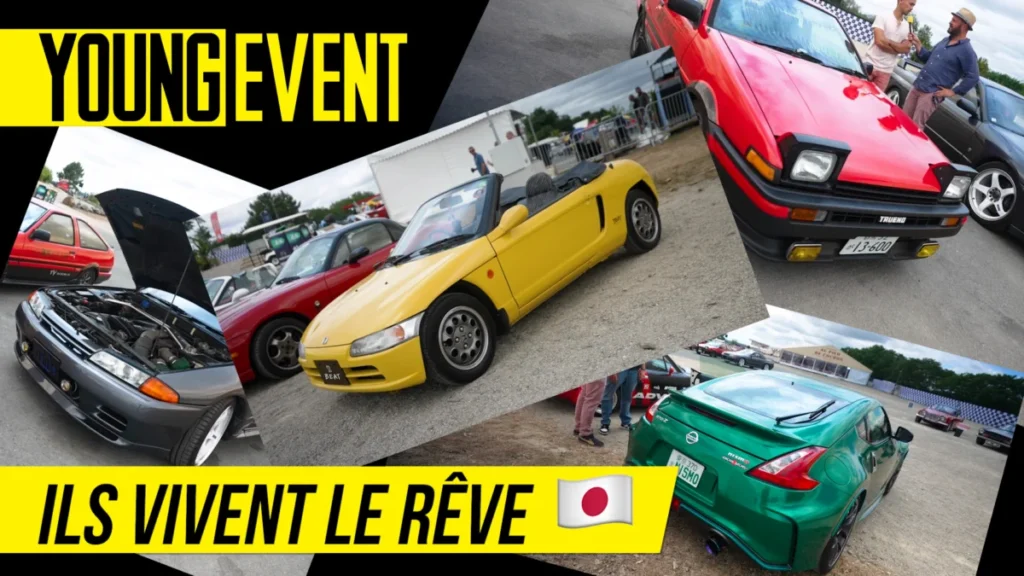
At the Le Mans Classic Legend 2026, amidst the roaring echoes of historical racing legends, a different kind of fervor was taking root. While the track saw the ghosts of European endurance racing, the paddocks played host to an entirely different cultural phenomenon: the gathering of the OttoClub. This collective, dedicated to the preservation and celebration of Japanese automotive performance, served as the backdrop for a deep-dive investigation by François-Xavier Basse into a question that has puzzled and delighted gearheads for decades: Why do Japanese sportscars remain the ultimate objects of desire?
The Phenomenon: Beyond the Metal
The fascination with Japanese Domestic Market (JDM) vehicles is not merely a product of engineering prowess; it is a holistic cultural embrace. As observed during the OttoClub meet, the community does not function merely as a car club. It acts as a lifestyle nexus, blending the technical precision of automotive engineering with the broader tapestry of Japanese culture—manga, gastronomy, and the distinctive "JDM spirit."
The appeal of these vehicles—from the legendary Nissan Skyline GT-R R32 to the nimble Toyota AE86—transcends the sum of their parts. It is a narrative of underdog victory, technological democratization, and a unique design philosophy that has shifted from utilitarianism to cult status.
Chronology of a Cultural Shift
To understand why these cars dominate the modern enthusiast landscape, one must look at the timeline of their ascension:
- The 1980s (The Foundation): Japan began moving away from economy cars toward performance-oriented platforms. The introduction of the Toyota Corolla AE86 (the "Hachi-Roku") transformed the perception of entry-level sportscars, proving that balance and weight distribution could outmaneuver raw horsepower.
- The 1990s (The Golden Era): Often cited as the peak of Japanese engineering, this decade gave birth to the "Godzilla" (Nissan Skyline GT-R), the Toyota Supra A80, and the Mazda RX-7. These cars were designed with a "no-compromise" mentality, frequently utilizing twin-turbocharging and advanced all-wheel-drive systems that embarrassed European exotics twice their price.
- The 2000s (The Digital Transition): With the rise of racing video games like Gran Turismo and pop-culture phenomena like The Fast and the Furious, a new generation was exposed to these machines. The digital representation of these cars fueled an obsession that crossed international borders.
- The 2020s (The Modern Renaissance): Today, we see the maturation of the JDM scene. Owners are no longer just "tuners" in back alleys; they are curators of automotive history. Clubs like OttoClub represent a shift toward preservation, as these machines move from "used cars" to "blue-chip investments."
Supporting Data: Why the Cult Endures
The fascination with these vehicles is rooted in tangible engineering superiority combined with emotional resonance.
Reliability as a Core Tenet
Unlike many of their European contemporaries of the 1990s, Japanese sportscars were built with an ethos of longevity. Engineering teams at companies like Honda, Nissan, and Toyota prioritized reliability even under high-stress scenarios. This allowed the "tuner" culture to flourish; enthusiasts could push these engines well beyond their factory output without fearing catastrophic failure.
The "Anonymity" of Performance
A fascinating anecdote highlighted by François-Xavier Basse involves the Nissan Skyline R32. He reveals that many owners installed custom, retractable, or easily hidden license plate brackets. Why? To avoid the prying eyes of law enforcement. This speaks to the "outlaw" nature of the JDM scene—these cars were fast, aggressive, and often pushed the boundaries of the road, creating a mystique that younger, modern cars struggle to replicate.
Accessibility and Modification
The JDM ecosystem is supported by a massive aftermarket industry. Whether it is an RB26DETT engine swap or a bespoke suspension setup for a Mazda MX-5, the platform is inherently modular. This "Lego-like" capability allows owners to imprint their personality onto the vehicle, fostering a deep, personal connection that is rarely found in mass-produced luxury vehicles.
Official Perspectives and Expert Insight
During the Le Mans Classic Legend 2026, members of the OttoClub emphasized that owning a Japanese sportscar is a "state of mind." One long-term collector noted, "When you drive an AE86, you aren’t just driving a car; you’re participating in a philosophy of efficiency and driver engagement that has been lost in the age of computerized, heavy SUVs."
Engineers who have worked on these platforms suggest that the success of the Japanese sportscar was due to a unique competitive environment. In Japan, the "Bubble Economy" of the late 80s provided manufacturers with nearly unlimited budgets to innovate. They weren’t just building cars; they were building reputations. This resulted in features—like the ATTESA all-wheel-drive system or the high-revving VTEC engines—that were years ahead of their time.
The Implications: A Future in Flux
As we look toward the future, the status of these vehicles is undergoing a profound change.
The Scarcity Principle
With the aging of the population and the stricter emission regulations worldwide, original, unmodified examples of these cars are becoming increasingly rare. This scarcity has driven prices to record highs, making them legitimate assets. However, this poses a threat to the culture: will these cars eventually become "museum pieces" that are too expensive to drive, or will the community find a way to maintain the "tuner" spirit in an era of electrification?
The Challenge of Maintenance
Maintaining a 30-year-old Japanese sportscar is no longer just about changing the oil. It involves sourcing discontinued parts, dealing with the deterioration of electronic components, and finding specialized technicians who understand the idiosyncrasies of 90s-era Japanese ECUs. The OttoClub serves as a critical resource, acting as a repository of technical knowledge that keeps these machines on the road.
The Emotional Legacy
Perhaps the most important implication of the current JDM boom is the preservation of the "analog" driving experience. In a world of autonomous driving and electric, silent motors, the visceral experience of a manual transmission, the sound of a turbo spooling, and the raw connection between the driver and the asphalt are becoming luxury experiences. These cars represent a "last stand" of the mechanical era.
Conclusion: Join the Movement
The journey through the OttoClub at Le Mans Classic Legend 2026 reveals that the obsession with Japanese sportscars is far from superficial. It is a deep-seated appreciation for a time when engineers and designers were given the freedom to create machines that were not only fast but possessed a soul.
Whether you are drawn to the aesthetic perfection of a Toyota Supra, the technical brilliance of a Skyline GT-R, or the humble, agile charm of a Mazda MX-5, these vehicles offer something modern cars cannot: a story. As the automotive world shifts gears toward a new, electrified future, these Japanese icons stand as a reminder that true performance is measured not by numbers, but by the smile on the driver’s face.
What about you? If you were to build your dream garage today, which Japanese masterpiece would take center stage? Would it be the rally-bred legend of a Subaru Impreza, or the grand-touring elegance of a Lexus SC300?
If you enjoyed this deep dive into the world of Japanese performance, consider subscribing to our channel and hitting the notification bell. We continue to document the stories of these iconic machines, ensuring that the legacy of the JDM spirit continues to thrive for generations to come.
Summary of Key Models Discussed
- Nissan Skyline GT-R (R32): The pioneer of modern electronic all-wheel drive.
- Toyota Supra (A80): The icon of the "2JZ" engine and high-horsepower potential.
- Toyota Corolla (AE86): The undisputed king of the mountain passes and drifting roots.
- Mazda MX-5: The embodiment of the "Jinba Ittai" (horse and rider as one) philosophy.
- Honda Beat: A testament to the "Kei" car culture, proving that size does not dictate fun.
