

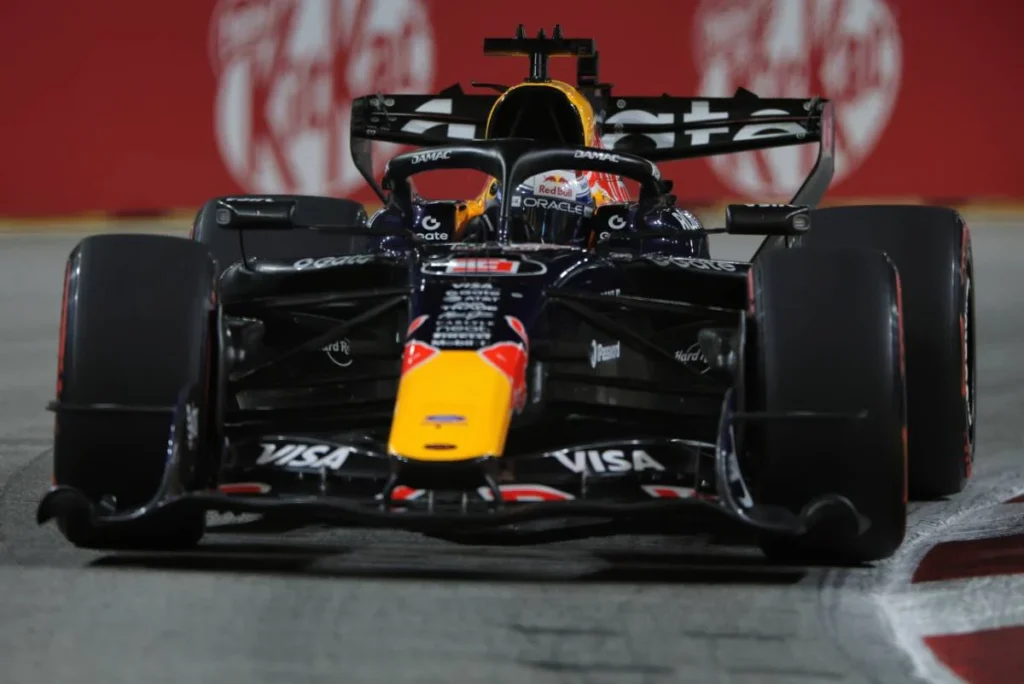
In the high-stakes, high-humidity cauldron of Singapore’s Marina Bay Street Circuit, Formula 1 witnessed a masterclass in driver intuition and strategic defiance. During the Sprint Qualifying session, Red Bull Racing’s Max Verstappen did not merely secure pole position; he dictated the methodology, forcing his team to abandon the standard operating procedure in favor of a singular, high-pressure gamble. While his rivals—George Russell and Charles Leclerc among them—opted for the safety net of multi-lap runs on soft tires, Verstappen insisted on a "one-and-done" approach. It was a choice that would prove not just effective, but emblematic of the champion’s evolving role in the cockpit.
The Chronology of a Calculated Risk
The path to the pole position for the Sprint was far from linear. Throughout the weekend, the teams had been grappling with the unique demands of the Singapore track, where tire degradation and track evolution typically favor those who cross the line as late as possible in the session.
During the initial phases of Sprint Qualifying (SQ1 and SQ2), Red Bull used the mandatory medium-compound tires as a laboratory. The team experimented with various out-lap preparations, oscillating between single-lap pushes and sequences involving multiple warm-up laps to optimize the tire surface temperature. As the session progressed into the decisive SQ3, the teams transitioned to the softest available compound. Conventional wisdom, supported by the data of the preceding sessions, suggested that two flying laps—allowing the tires to recover and the driver to find a rhythm—would be the optimal path to the front row.
However, as the cars rolled out of the pit lane for the final shootout, it became clear that Verstappen had formulated a different plan. Eschewing the conventional two-lap strategy, the Dutchman completed a solitary, maximum-attack flying lap. When he crossed the timing beam, the clock stopped at 1:31.156. It was a time that silenced the skepticism of the paddock, leaving his closest challenger, George Russell, 120 milliseconds adrift, with Charles Leclerc a further 123 milliseconds behind.
Red Bull’s Internal Debate: The Driver as Architect
The most compelling aspect of this achievement was the origin of the strategy. It was not the product of a pit-wall simulation or a late-night data review in the motorhome; it was a firm directive from the driver.
Laurent Mekies, acting as a key figure in the Red Bull organizational structure, later shed light on the tension behind the scenes. Speaking to F1TV, Mekies admitted that the team had been prepared to follow the traditional route until Verstappen intervened.
"Honestly, it was Max. He was very categorical on this point," Mekies explained. "We had performed some tests with the medium tires in SQ1 and SQ2. In SQ1, we performed a preparation lap, unlike in SQ2. Then, Max was very clear: with the soft tires, which he hadn’t used yet, he wanted to perform a single flying lap. That is exactly what he did."
This revelation highlights a growing trend in modern F1: the shift from the driver being a mere executor of a pre-planned strategy to being the final arbiter of tactical execution. Verstappen’s ability to "feel" the optimal window for the soft tire—a compound he had not even sampled in Free Practice—is a testament to his current level of confidence.
Data Analysis: Why the Single Lap Worked
The effectiveness of the single-lap strategy lies in the delicate balance of tire thermal management. At Marina Bay, the track surface is notoriously abrasive and the ambient temperatures are punishing. Pushing a soft tire for two consecutive laps creates a high risk of thermal degradation in the final sector of the circuit, where traction is paramount for the long straights.
By opting for a single, focused lap, Verstappen ensured that he was hitting the tire’s "peak performance window" precisely when the carcass was at its most structurally sound. His rivals, meanwhile, were forced to manage the tires through an out-lap and a first flyer, potentially sacrificing the integrity of the rubber for their second attempt.
The data supports the genius of the move. Verstappen’s sectors showed a high degree of consistency, with his middle sector—usually the most treacherous regarding tire overheating—remaining remarkably stable. While Russell and Leclerc struggled to bridge the gap, the raw pace of the RB machine, combined with Verstappen’s surgical precision, created an insurmountable benchmark.
Official Responses and the Paddock Perspective
The atmosphere in the paddock following the session was one of cautious admiration. For Mercedes and Ferrari, the result was a bitter pill, particularly because both teams had arguably taken the "logical" route.
When questioned about the uncertainty of the strategy, Mekies was refreshingly candid. "At that moment, you don’t know who will be right and who will be wrong," he admitted. "But we were convinced that, for us, it was the best way to approach this lap. It is always pleasant when the facts prove you right."
The consensus among analysts is that Verstappen’s confidence is currently unshakable. Having secured his first victory of the season just a week prior in Malaysia, the momentum has clearly shifted. The Dutch driver is no longer just chasing championships; he is dictating the terms of engagement.
Implications for the Sprint and Beyond
The pole position for the Sprint is more than a trophy; it is a tactical advantage. On a street circuit like Marina Bay, where the narrow confines and the lack of traditional overtaking zones make passing a monumental task, track position is the primary currency.
As the grid prepares for the 21-lap Sprint, the implications of Verstappen’s qualifying dominance are clear:
- Defensive Dominance: Verstappen holds the keys to the race. By starting at the front, he avoids the "dirty air" that ruins tire life for the chasing pack, allowing him to manage his pace relative to the threats behind.
- The McLaren Factor: With Oscar Piastri and Lando Norris locking out the fourth and fifth positions, the McLaren threat remains potent. Their race pace has been a constant thorn in the side of the top teams, and they will be looking to capitalize on any skirmish between Verstappen and Russell.
- The Title Narrative: With Lewis Hamilton starting sixth and the championship leader, Kimi Antonelli, starting seventh, the mid-field battle promises to be a chaotic affair. Any contact in the opening corners could open the door for those behind to disrupt the established order.
Conclusion: A Champion’s Intuition
The Singapore Sprint Qualifying will likely be remembered as the session where Max Verstappen ceased to be just a driver and became an extension of the engineering team. By imposing his will on the strategy, he removed the variables of team-calculated probability and replaced them with the certainty of his own talent.
As the sun sets over the Marina Bay skyline and the lights prepare to go green for the Sprint, the narrative is firmly in the hands of the Dutchman. Whether he can convert this strategic masterstroke into a race win remains to be seen, but one thing is certain: the rest of the grid now knows that when they go up against Verstappen, they are not just racing a car—they are racing a driver who is willing to gamble on his own intuition, and more often than not, winning.
The 21 laps ahead will be a test of endurance, precision, and tactical maturity. But regardless of the outcome, the qualifying session proved that in the high-speed chess match of Formula 1, the player who dares to make the unconventional move is the one who claims the crown.
