

Paris — The French National Interministerial Observatory for Road Safety (ONISR) has released its definitive accident report for 2025, painting a sobering picture of a nation struggling to break through a stubborn safety ceiling. Across metropolitan France and its overseas territories, 3,515 people lost their lives on the roads in 2025, marking a 2.4% increase compared to 2024 and a 0.5% rise over 2019, the pre-pandemic benchmark year.
While the days of pandemic-era mobility restrictions are long gone, the comparison with 2019 remains the critical barometer for traffic safety experts. Rather than resuming a downward trajectory, French road mortality has plateaued. As the death toll refuses to drop back to pre-crisis levels, safety advocates and public policy analysts are left asking a pressing question: Have French roads reached an incompressible minimum, or is systemic policy failure keeping casualties artificially high?
Main Facts: The 2025 Toll at a Glance
The definitive ONISR figures for 2025 highlight a fundamental shift in who is dying on French roads and where those accidents are happening.
- Total Fatalities: 3,515 deaths nationwide (+2.4% year-on-year; +0.5% compared to 2019).
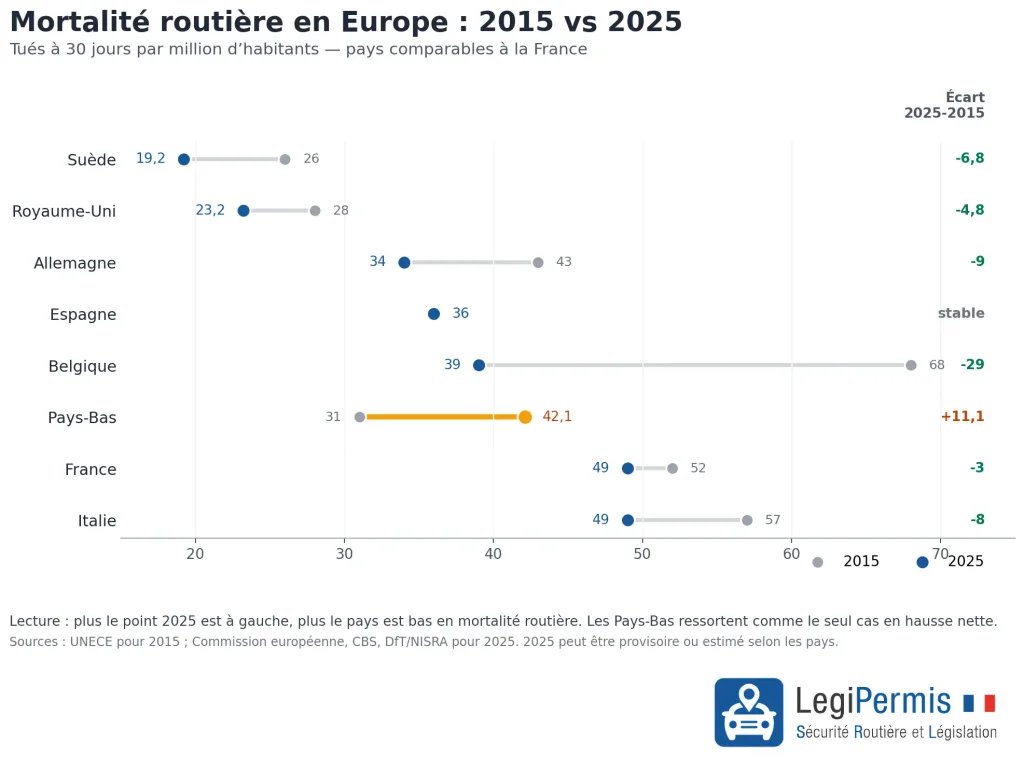
- Metropolitan Fatality Rate: Metropolitan France recorded 49 deaths per million inhabitants, trailing behind the provisional European Union average of 43 deaths per million.
- The Rural Hazard: Rural roads outside built-up areas accounted for 1,973 deaths—roughly 60% of metropolitan fatalities—experiencing an increase of 49 deaths compared to 2024.
- Shifting Demographics: While car occupants still account for the largest share of fatalities (1,543 deaths, up 25), vulnerable road users (pedestrians, cyclists, Personal Mobility Devices, and motorized two-wheelers) now constitute nearly half of all road deaths.
- The EDPM Surge: Personal Mobility Devices (primarily electric scooters) saw a staggering 75.6% increase in deaths, rising from 45 fatalities in 2024 to 79 in 2025.
- Severe Injuries and Lifelong Sequelae: ONISR estimates that 22,300 individuals will live with permanent, severe disabilities one year post-accident, with half of these victims under the age of 35.
Chronology and Context: From Pandemic Interruption to Stagnation
To understand the current crisis, transportation authorities look back past the anomaly years of 2020 through 2022—when lockdowns and remote work dramatically altered transit patterns. The real point of divergence is 2019.

- 2005–2019: A sustained, historic downward trend saw European nations, including France, slash road fatalities significantly through targeted measures like mandatory speed enforcement, harsher penalties, and vehicle safety innovations.
- 2019–2023: Following the pandemic normalization, French road safety metrics stopped improving. Instead of resuming the long-term decline observed in the 2010s, annual figures settled into a rigid plateau.
- 2024–2025: The upward tick of +2.4% in 2025 confirms that the post-2019 stagnation is not a statistical anomaly. When coupled with climbing figures for severe injuries, safety experts argue that the current framework of road policing and infrastructure design is no longer sufficient.
Supporting Data: Dissecting the Fatalities
A deeper dive into the demographic and geographic breakdown of the 2025 data reveals clear areas of vulnerability.
1. The Urban-Rural Divide
While urban traffic deaths remained virtually stable within city limits (1,031 deaths, a single-digit increase), and motorways saw a modest bump to 259 deaths (+20), the countryside remains a death trap. Non-urban roads are responsible for the bulk of the deterioration. High speeds, poor visibility, absence of separated bike lanes, and unforgiving roadside obstacles (such as trees and ditches) leave drivers and pedestrians with virtually zero margin for error.
2. Vehicle Categories in Metropolitan France (2025 vs. 2024)
| User Category | 2025 Deaths (Metropolitan France) | Change vs. 2024 |
|---|---|---|
| Car Occupants | 1,543 | +25 |
| Motorized Two-Wheelers | 697 | -23 |
| Pedestrians | 503 | +47 |
| Cyclists | 235 | +11 |
| EDPM (Scooters, etc.) | 79 | +34 |
Note: Car occupants represent 47% of total deaths, dropping below the majority threshold for the first time as non-car users claim a larger share of the overall toll.
3. The Exploding Danger of Personal Mobility Devices (EDPM)
Once viewed as a harmless urban micro-mobility trend, electric scooters and similar personal devices have become a major safety concern. From just 10 deaths in 2019, EDPM fatalities climbed to 45 in 2024 and exploded to 79 deaths in 2025—a 75.6% jump in a single year. Concurrently, severe injuries involving EDPMs reached roughly 1,200 (+39%).

4. Pedestrians and the Senior Vulnerability
Pedestrian deaths reached 503, driven heavily by an aging demographic. More than one out of every two pedestrians killed was aged 65 or older. Alarmingly, pedestrian fatalities are no longer confined to dense urban centers; rural pedestrian deaths are climbing due to unlit roads and the absence of sidewalks.
5. Age Brackets and Gender Disparities
- The Young and the Teens: While the 18–24 age bracket remains heavily exposed with 528 deaths (96 per million inhabitants), the sharpest warning flag of 2025 applies to adolescents. 14-to-17-year-olds accounted for 133 deaths—an increase of 39 over the previous year. Nine out of ten adolescent victims were male. Children aged 0–13 also saw an increase, with 58 deaths (+12).
- The Male Overrepresentation: Men remain disproportionately responsible for and affected by road tragedies. In 2025, 2,523 men died on metropolitan roads compared to 740 women. Men accounted for 77% of fatalities, 75% of severe injuries, and 83% of drivers presumed responsible for fatal crashes.
Official Responses and Underlying Causes
ONISR data points directly to persistent behavioral factors among drivers deemed at fault in fatal collisions:
- Speed: Excessive or inappropriate speed remains the leading primary cause of fatal accidents.
- Alcohol and Narcotics: Driving under the influence occupies the second major tier of culpability.
- Single-Vehicle Accidents: A staggering 42% of metropolitan deaths (1,381 people) occurred in accidents involving no third party—typified by sudden losses of control, rollovers, or running off the road.
- Innocent Victims: The data highlights that safety is rarely entirely within an individual’s control. In metropolitan France, 3,37% of those killed (1,216 people) were not presumed responsible for the accidents that took their lives. Of these innocent victims, 53% were vulnerable road users and 33% were vehicle passengers.
Overseas Territories (Outre-mer)
In France’s overseas departments and collectivities, 252 people died on the roads in 2025 (+13). Motorized two-wheelers accounted for 91 deaths (over a third of the total). Long-term regional data (2021–2025) underscores basic safety compliance failures: 27% of killed two-wheeler riders were not wearing a helmet, and 52% of vehicle occupants killed were not wearing a seatbelt.
Implications: A European Reality Check
When benchmarked against the rest of Europe, France’s stagnation places it in a defensive posture. Over the past decade, countries like the UK, Sweden, and Germany have continued to see gradual reductions in road deaths, while Belgium has achieved dramatic drops. Conversely, the Netherlands has experienced a worrying rise in cycling fatalities, and France and Spain have settled into an unyielding plateau.

With 49 deaths per million inhabitants, France sits above the EU average of 43. The 2025 audit sends a clear message to policymakers: legacy enforcement campaigns centered strictly on automobile drivers are no longer enough.
As urban micro-mobility expands, rural infrastructure crumbles under maintenance backlogs, and vulnerable populations—such as seniors and teenagers—bear the brunt of the violence, France’s road safety strategy requires a fundamental redesign. Protecting the user who shares the road without the steel cage of a car is no longer a peripheral concern; it is the central challenge of modern French traffic policy.
