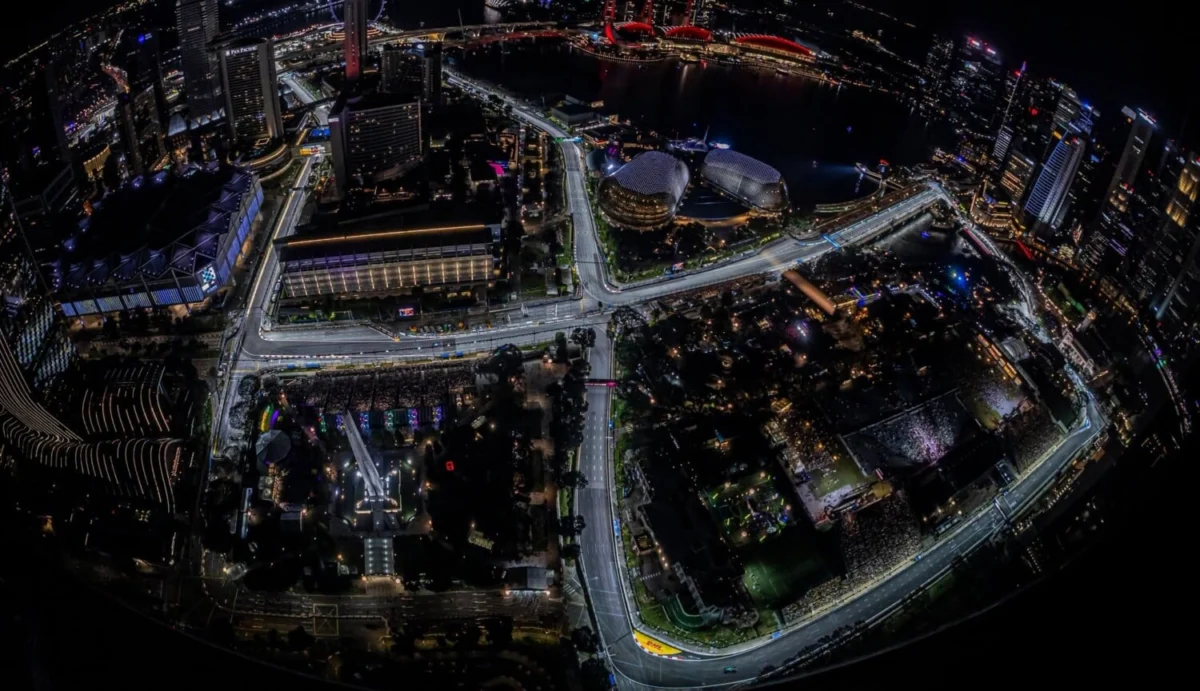
The Formula 1 circus arrives at the iconic Marina Bay Street Circuit for the 2026 Singapore Grand Prix, but the spotlight is shifting away from the championship battle and toward the sky. Meteorologists are monitoring a complex weather pattern that threatens to turn one of the calendar’s most grueling races into a chaotic strategic minefield. With the convergence of two distinct moisture-laden air masses, the weekend—particularly the critical Saturday sessions—is shrouded in uncertainty.
The Meteorological Threat: A Convergence of Elements
The primary concern for the FIA and team strategists is the unusual interaction of two weather fronts. Data suggests that one cell is encroaching from the west, originating over the Indian Ocean, while a secondary, potent system is pushing in from the east, sweeping across the Gulf of Thailand.
When these two systems converge directly over the Singapore island on Saturday, the probability of precipitation spikes to 70%. Unlike the localized, brief tropical showers typical of the region, this synoptic-scale event threatens to deliver sustained rainfall. For teams, this represents a logistical nightmare: the transition between the dry, high-grip conditions of Friday and the potentially saturated, low-visibility environment of Saturday night will demand near-perfect adaptability from drivers and engineers alike.
Weekend Chronology: A Three-Day Weather Rollercoaster
Friday, October 9: The Calm Before the Storm
The weekend begins with a deceptive sense of normalcy. Friday’s schedule, which includes Free Practice and the Sprint Qualifying sessions, is expected to remain largely dry. With only a 30% risk of localized showers, teams will likely maximize their time on track to gather telemetry on tire degradation.
However, "dry" does not mean "easy." Ambient temperatures are forecasted to hover between 26°C and 32°C. More significantly, the asphalt at Marina Bay—a track known for its abrasive surface—is projected to reach temperatures as high as 55°C during the afternoon. These thermal loads will force teams to push their tire management programs to the absolute limit, as excessive sliding on the street circuit’s tight corners could lead to premature graining or overheating of the Pirelli rubber.
Saturday, October 10: The Sprint of Uncertainty
Saturday is the day circled in red by team principals. The Sprint race, scheduled for 17:00 local time (11:00 CEST), is now a high-risk event. Meteorologists warn that the convergence of the two aforementioned weather cells will likely peak during the afternoon.
If the track is drenched, the Sprint will become a survival test. Marina Bay is notoriously unforgiving, with its narrow lanes and proximity to concrete barriers leaving zero margin for error. The subsequent Grand Prix Qualifying session at 21:00 local time remains equally precarious. Even if the heavy rain subsides by nightfall, the track will likely be "green" and slippery, potentially reshuffling the grid and throwing the form book out the window.
Sunday, October 11: The Grand Prix Gamble
As the main event approaches, the atmosphere remains unstable. While the core of the storm system is predicted to migrate south, the residual humidity—expected to hit 83% at the time of the 20:00 start—leaves the door open for sudden, erratic downpours. The risk of rain for Sunday is currently pinned between 30% and 40%, keeping the pit walls on high alert for "inter-changeable" conditions.
Supporting Data: The Physics of Marina Bay
The challenge of the 2026 Singapore Grand Prix extends beyond just water on the track. The environmental factors inherent to this circuit provide a unique technical test for the current generation of F1 cars.
The Thermal Challenge
With track temperatures expected to hit 55°C on dry segments, the thermal degradation of the tires is a critical performance variable. High temperatures cause the rubber to become "greasy," leading to a loss of mechanical grip. Teams are currently simulating various downforce configurations to ensure the cars remain stable through the high-speed sections while protecting the tires during the heavy braking zones into Turn 1 and the complex chicane areas.
The Humidity Factor
For the drivers, the physical toll is immense. While the thermometer may show 32°C, the dew point and high humidity mean the "real feel" temperature will climb toward 38°C. Inside the cockpit, where temperatures can exceed 50°C, drivers can lose up to 3kg of body weight in fluids during a race. The mental fatigue caused by this environment significantly increases the likelihood of driver error during the final ten laps of the Grand Prix.
Aerodynamic Impact: The Southerly Wind
Throughout the weekend, a consistent wind from the south is expected. This creates a challenging headwind on the run down to the first corner. For the 2026-spec cars, which rely heavily on sophisticated underbody aerodynamics and energy deployment, this headwind complicates the braking points and corner entry speeds. Drivers will have to constantly adjust their brake bias to account for the gusty conditions, which can reach 25 km/h, adding another layer of complexity to an already difficult street track.
Official Perspectives: Navigating the Chaos
While no team has issued a formal complaint, the sentiment in the paddock is one of cautious preparation.
"We are preparing for every scenario," said a senior technical director from one of the front-running teams. "Singapore is always a race of attrition. When you add a 70% chance of rain into the mix, it stops being about raw pace and starts being about risk management and timing. The Saturday Sprint will be our primary diagnostic tool; we need to see how the car behaves in the wet before we finalize our setup for the Sunday race."
The FIA Race Director has also signaled that they will be strictly monitoring the visibility levels on Saturday evening. Given the artificial lighting system at Marina Bay, heavy rain can create significant glare, which, combined with spray, may necessitate the use of the Safety Car to ensure driver safety.
Strategic Implications: Who Gains, Who Loses?
The uncertainty of this weekend creates significant opportunities for the midfield teams.
- The Tactical Advantage: Teams that excel in "wet-to-dry" transitions—often determined by how quickly they can switch between tire compounds and adjust brake cooling—will have a distinct advantage.
- Qualifying Prowess: If qualifying is held on a drying track, the ability to find "clear air" and generate tire temperature at the right moment will be the difference between a front-row start and being knocked out in Q1.
- The Championship Standings: For the leaders, a wet race is a liability. The potential for a "non-finish" due to a collision on the damp, narrow streets of Singapore could effectively neutralize a points lead, bringing the competition closer together as the season enters its final quarter.
Conclusion: A Weekend of Resilience
As the cars are readied for the Singapore Grand Prix, the weather remains the ultimate wildcard. The 2026 season has already proven to be a battle of technical innovation, but this weekend will test the human element of the sport. Whether it is the physical endurance of the drivers under the stifling humidity or the strategic brilliance of the engineers calculating the crossover point from slicks to intermediates, the Marina Bay Street Circuit is poised to deliver a spectacle of tactical warfare.
Fans, teams, and organizers alike are bracing for a weekend where the weather—not just the machinery—will dictate the outcome. As the saying goes in the Singapore paddock: "You don’t just race the other drivers; you race the environment." This weekend, the environment seems more determined than ever to have the final say.