

PARIS — In the fast-evolving landscape of the global automotive industry, efficiency, adaptability, and cost reduction are the holy trinity of survival. As legacy automakers navigate the bumpy road toward a fully electrified future while grappling with fluctuating consumer demand, manufacturing agility has never been more critical. Enter Stellantis, the sprawling multinational automotive conglomerate formed by the merger of PSA Group and FCA.
Unveiled quietly during the rollout of the aggressive FastLane 2030 strategic plan, the STLA One platform is rapidly transitioning from a corporate blueprint into a tangible industrial reality. Making a splash at the Mondial de Paris (Paris Motor Show), several brands within the Stellantis stable pulled the covers off striking new concepts built entirely on this fresh architecture. Designed to underpin more than 30 distinct models across multiple mainstream brands, STLA One is poised to become the beating heart of Stellantis’ European and global product offensive well into the next decade.
1. Main Facts: Decoding the STLA One Architecture
At its core, the STLA One platform is designed to plug a crucial gap in the manufacturer’s modular toolkit. Until now, Stellantis has structured its multi-energy vehicle offerings around heavier and larger architectures, notably the STLA Medium and STLA Large platforms. While these bases excel in the compact SUV and executive segments, they lack the cost-efficiency and packaging optimization required for smaller, high-volume city cars and hatchbacks.
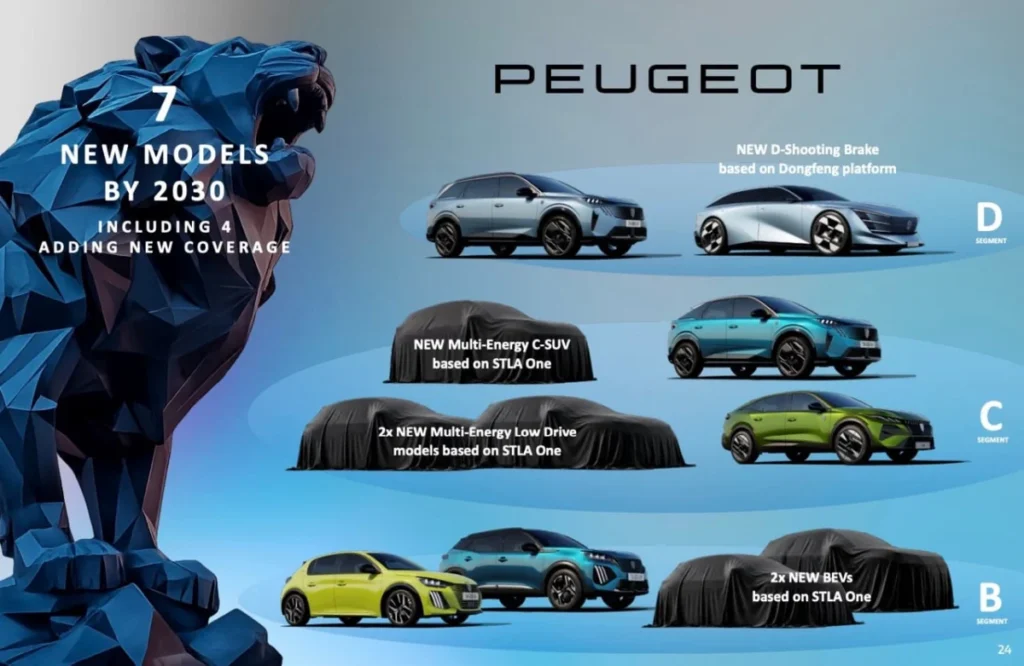
The STLA One changes this dynamic entirely. Derived from existing evolutionary bases but heavily modernized, the platform boasts exceptional modularity. It is engineered from the ground up to span the B, C, and D segments. This broad spectrum means the platform can effortlessly accommodate everything from nimble urban subcompacts and traditional hatchbacks to family-focused compact cars and spacious SUVs.
A True Multi-Energy Approach
Perhaps the most significant selling point of the STLA One platform in the current automotive climate is its multi-energy flexibility. Unlike pure-play EV platforms that struggle to remain profitable amid a slowing adoption curve for battery-electric vehicles (BEVs), STLA One embraces powertrain diversity.
- 100% Electric (BEV): Fully optimized for pure battery power, offering competitive ranges and fast-charging capabilities.
- Electrified Thermal Engines: Capable of housing mild-hybrid and full-hybrid internal combustion engine setups, ensuring that Stellantis can cater to markets where infrastructure or consumer budgets still favor liquid fuels.
By leveraging this multi-energy strategy, Stellantis is insulating itself against the volatility of the EV transition. The group has confirmed that multiple hybrid models utilizing the STLA One architecture will hit the market by 2030, offering consumers a seamless bridge between traditional and electric driving.
2. Chronology: From FastLane 2030 to the Paris Motor Show
Understanding the trajectory of the STLA One platform requires tracing a timeline that highlights Stellantis’ rapid execution speed under CEO Carlos Tavares and his executive team.
- May 2026 (The Announcement): During the global unveiling of the FastLane 2030 strategic plan, Stellantis executives first teased the arrival of the STLA One platform. Positioned as a masterclass in platform consolidation, the architecture was presented as a critical tool to slash production costs and streamline assembly lines across European factories.
- October 2026 (The Paris Motor Show Debut): Marking its first major public-facing milestone, the Mondial de Paris served as the launchpad for the platform’s public debut. Stellantis didn’t just talk theory; it brought hardware. Peugeot stole headlines by unveiling two distinct concept vehicles—the E-T16 Concept and the high-performance RCZ Vision—both riding on the STLA One matrix, proving the platform’s extreme versatility from day one.
- Late 2026 – Early 2027 (Pre-Production Phase): Engineering sign-offs and factory retooling ramp up across key European production hubs to prepare for assembly line integration.
- 2027 (Commercial Launch): The official commercial rollout of the platform, spearheaded by the brand’s highest-volume hatchback.
- 2030–2035 (Full Deployment & Scale): The rollout of over 30 distinct models across the B, C, and D segments, culminating in a targeted production output of two million units annually by 2035.
3. Supporting Data and Industrial Roadmap
To appreciate the sheer scale of the STLA One initiative, one must look at the numbers. Stellantis is playing a high-stakes game of volume and cost amortization.

The Volume Target
Stellantis has boldly projected that vehicles built on the STLA One platform will account for two million units produced annually by the year 2035. To put this into perspective, this single architecture will represent a massive share of the conglomerate’s total European output.
Model Rollout Schedule
The deployment of the STLA One platform will happen in calculated waves, prioritizing high-volume volume-sellers before cascading into niche and upper-segment vehicles:
- The Pioneer (2027): The undeniable honor of inaugurating the STLA One platform goes to the future Peugeot E-208. As one of Europe’s best-selling electric subcompacts, the E-208 will test the platform’s production scalability and real-world efficiency under immense public scrutiny.
- The German Cousin: Hot on the heels of the Peugeot E-208 will be its platform-sharing sibling, the next-generation Opel Corsa. By pooling resources between Peugeot and Opel, Stellantis ensures immediate economies of scale.
- Italian Flair: Further down the timeline, the next iteration of the Lancia Ypsilon is expected to transition to the STLA One base, securing the brand’s long-term product viability following its recent revival.
- The Compact Step-Up (Segment C): Moving up a size category, the Peugeot 308 and Opel Astra will adopt the STLA One architecture. In these applications, the platform’s multi-energy capability will shine brightest, offering buyers a choice between high-efficiency hybrids and pure electric powertrains.
- The SUV Heavyweights (Segment D): In an even more ambitious horizon, future generations of the wildly popular Peugeot 3008 and 5008—alongside their technical equivalents from sister brands—are slated to transition to this versatile base.
4. Official Responses and Industry Reactions
The automotive press and industry analysts have responded to the STLA One unveiling with a mixture of admiration for Stellantis’ industrial pragmatism and cautious curiosity regarding brand differentiation.
During the press days at the Paris Motor Show, Peugeot’s design and engineering teams were eager to showcase how the STLA One platform permits striking exterior proportions without compromising interior packaging. The Peugeot E-T16 Concept drew rave reviews for reimagining the spirit of the legendary 205 Turbo 16 for the electric age, while the RCZ Vision—a muscular, 500-horsepower sports coupe concept—proved that a shared platform does not have to spell the death of emotional, driver-focused design.
Industry insiders note that STLA One is Stellantis’ ultimate weapon against margin erosion. By reducing the number of disparate legacy platforms inherited from the Fiat Chrysler and PSA mergers down to a streamlined, highly standardized family of global architectures (STLA Small/One, Medium, Large, and Frame), the company is slashing R&D expenditures significantly.
“With STLA One, we are not merely building a car; we are building an industrial ecosystem,” noted a high-ranking Stellantis manufacturing strategist on the sidelines of the Paris exhibition. “Complexity is the enemy of profitability in modern automotive manufacturing. This architecture allows us to build vastly different vehicles on the exact same line, adapting to market demand overnight whether the customer wants a battery, a hybrid, or a traditional engine.”
5. Implications: What STLA One Means for Consumers and the Market
The ripple effects of the STLA One rollout will be felt across the entire European automotive ecosystem, altering everything from showroom pricing to workshop repair bills.
For the Everyday Consumer
- More Competitive Pricing: Because STLA One heavily reduces component commonality costs and simplifies manufacturing complexity, Stellantis can pass these savings on to the consumer. This is crucial for democratizing electric mobility, particularly in the bruised B-segment where entry-level price points under €25,000 are fiercely contested.
- True Freedom of Choice: In an era where many automakers are forcing customers down the purely electric path—sometimes to the detriment of sales—Stellantis’ multi-energy approach ensures that buyers living in regions with underdeveloped charging infrastructures can still purchase brand-new models equipped with efficient hybrid powertrains.
- Elevated Design and Technology: As demonstrated by the Peugeot concepts in Paris, the flexibility of the STLA One platform allows for shorter overhangs, better cabin space utilization, and integration of next-generation software-defined vehicle (SDV) architectures.
For the Automotive Market
- Pressure on Competitors: Rivals such as the Volkswagen Group, Renault, and Ford will be forced to watch closely. While competitors have struggled with software delays and expensive, inflexible dedicated EV platforms, Stellantis is deploying a pragmatic, high-volume strategy that balances immediate profitability with long-term carbon-reduction goals.
- The Rise of "Super-Platforms": The industry-wide shift toward universal multi-energy matrices like STLA One signals the definitive end of bespoke platforms for low- and mid-tier models. For Stellantis, the gamble is immense: if the platform hits its target of two million units by 2035, the conglomerate will solidify its position as one of the most profitable and cost-efficient automotive empires in the world.
As the countdown to 2027 begins and the first production-ready Peugeot E-208 rolls off the line, the automotive world will be watching to see if STLA One truly delivers on its promise of being Stellantis’ ultimate industrial magic trick.
