

Last updated: September 21, 2026
The recreational use of nitrous oxide—commonly known as laughing gas—has evolved from a festive trend into a severe public safety hazard, particularly on the roads. For years, authorities have struggled to bridge the gap between catching motorists inhaling the substance behind the wheel and establishing airtight legal proof of impairment.
Now, a new wave of legislative measures, localized policing initiatives, and scientific investigations are shifting the landscape. While public authorities are actively funding studies to validate breath-testing devices for nitrous oxide, the road to nationwide enforcement remains complex. Balancing roadside detection with legal accountability requires navigating a web of medical facts, evolving traffic laws, and a strict adherence to evidentiary standards.
Main Facts: The Intersection of Laughing Gas and Road Safety
Nitrous oxide is no longer just a substance of concern at music festivals or private parties; it has increasingly bled into the routine duties of traffic police. The core issue facing law enforcement is twofold: detecting the chemical presence of the gas in a driver’s system and proving that its physiological effects compromise the ability to drive safely.
Unlike alcohol, which has a well-established blood-concentration threshold linked directly to driving impairment, or traditional narcotics that leave long-lasting metabolites in bodily fluids, nitrous oxide presents unique pharmacological challenges. It is rapidly eliminated from the body, meaning that standard blood or urine tests often fail to capture the immediate window of intoxication unless specialized, real-time testing is employed.
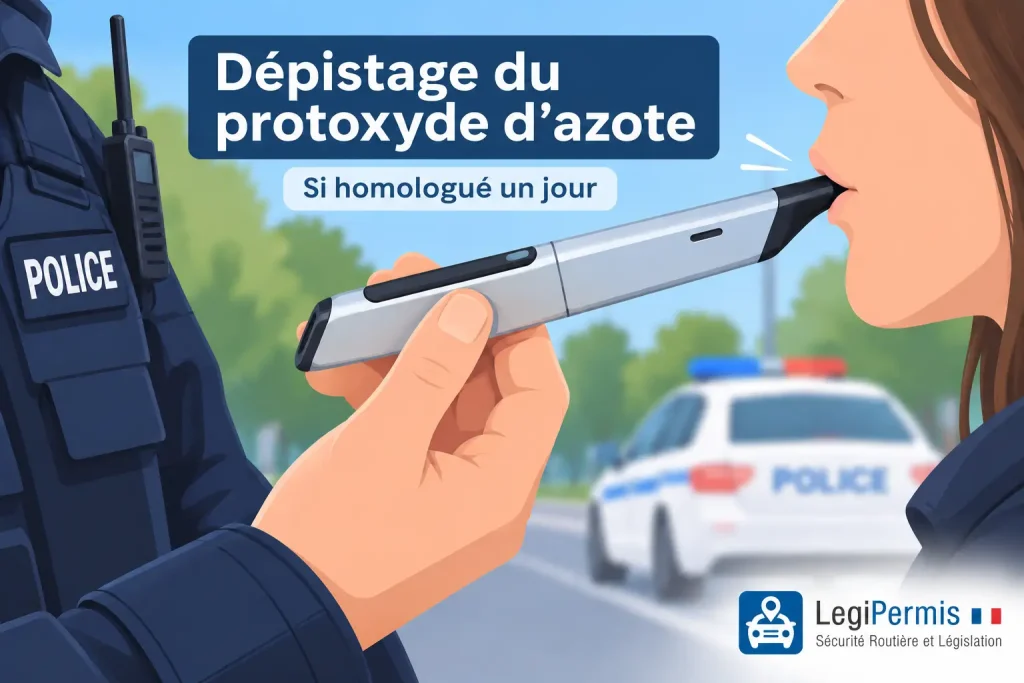
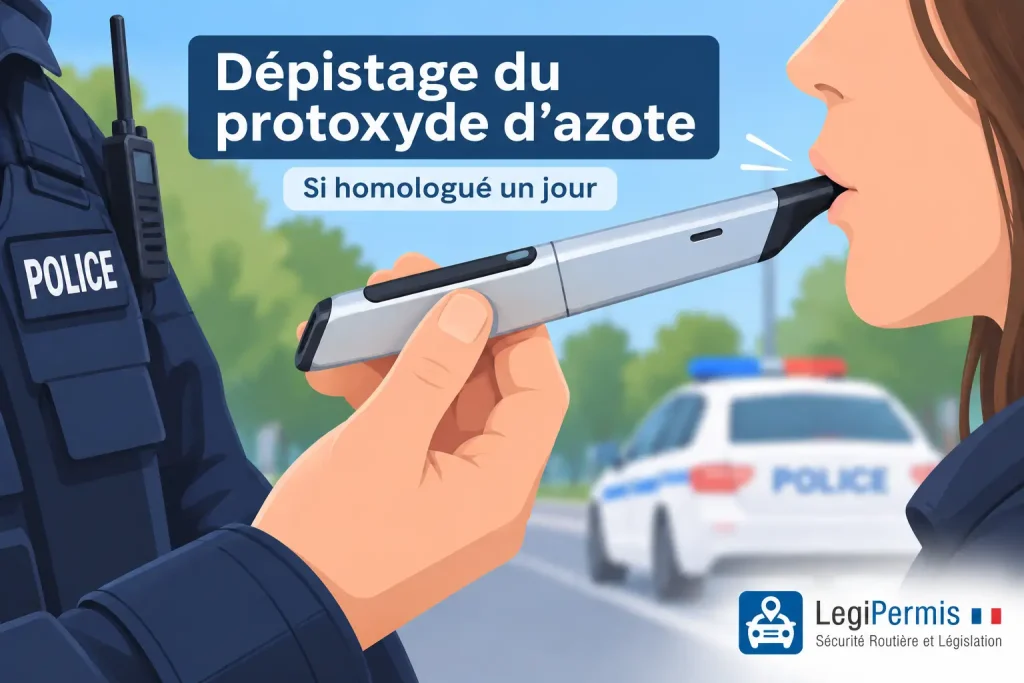
To counter this, innovators and municipal authorities have looked toward breath-analysis technology—devices conceptually similar to standard ethylometers used for alcohol screening. However, the leap from detecting a molecule in an exhalation sample to securing a conviction in a court of law requires rigorous scientific backing.
- The Core Challenge: Detecting exposure to nitrous oxide is scientifically distinct from measuring acute driving impairment or establishing a statutory traffic infraction.
- The Legal Framework: Recent legislative overhauls have criminalized the recreational inhalation of the gas and introduced broad penalties for driving under the influence of psychoactive substances, though specific administrative hurdles remain.
- The Local Pioneers: Some French municipalities, frustrated by the pace of national standardization, have already begun deploying early-generation detection tools on the ground.
Chronology of Events and Legislative Milestones
The regulatory framework surrounding nitrous oxide has accelerated dramatically over the past two years, culminating in major policy shifts in mid-2026. Understanding how enforcement has reached its current state requires tracking a precise timeline of scientific discoveries, municipal initiatives, and national legislation.
2023–2025: The Regulatory Foundation
- January 2024: Building upon a ministerial decree from July 19, 2023, strict commercial limits take effect across France. The sale of nitrous oxide is restricted to cartridges containing a maximum of 8.6 grams, packaged in boxes of no more than 10 units per transaction. Larger commercial formats are entirely barred from consumer retail.
- January 23, 2025: A study published in the scientific journal Scientific Reports examines 24 healthy volunteers, demonstrating that nitrous oxide can be reliably detected in exhaled air samples collected in bags up to 60 minutes following inhalation. This provides the foundational proof-of-concept that breath analysis for the gas is viable.
- Late 2025: Lawmakers draft increasingly stringent proposals as the social cost of nitrous oxide abuse becomes undeniable. The exposé des motifs for proposed legislation notes a concerning rise in road fatalities linked to the substance.
August 2026: A Turning Point for Enforcement
- August 18, 2026: Parliament passes the landmark "RIPOST" law (Law No. 2026-733), which fundamentally restructures the legal treatment of nitrous oxide and general psychoactive substance consumption while driving.
- August 20, 2026: Article L3611-4 of the Public Health Code enters into force, making the recreational inhalation of nitrous oxide an explicit criminal offense. Simultaneously, Article L237-1 of the Highway Code introduces a new framework for motorists driving under the influence of listed psychoactive substances.
- August 20, 2026: The municipality of Cannes wastes no time, equipping its municipal police force with three specialized nitrous oxide breath detectors, launching active roadside trials.
- August 24, 2026: The City of Cannes officially communicates its operational deployment of the breath-testing units, generating national media coverage and placing pressure on the central government to clarify its stance.
- August 25, 2026: The advocacy group PROTOSIDE publishes a press release urging caution, demanding independent scientific validation of breath detectors to prevent false positives and flawed roadside interpretations.
September 2026: Clarifications from the Senate
- September 10, 2026: In response to formal inquiries at the Senate, the Ministry of the Interior confirms that the Road Safety Delegation (DSR) is actively co-financing scientific validation studies for exhaled-air nitrous oxide detectors. However, the Ministry clarifies that this financial backing does not equate to an immediate nationwide rollout, mandatory equipment standardization, or an established operational calendar for all national police forces.
- September 10, 2026: In a parallel response, the Ministry of Health notes that the specific executive decree establishing the official list of targeted psychoactive substances under Article L237-1 is still being drafted, and that nitrous oxide is not yet explicitly inscribed on that specific administrative list.
- September 21, 2026: Current legal and administrative statuses are consolidated, marking the present state of a fast-moving enforcement paradigm.
Supporting Data and Statistical Realities
Assessing the true danger of nitrous oxide on the road is hindered by a lack of historical, exhaustive tracking data compared to well-documented problems like drunk driving or cannabis use. Nevertheless, institutional reports and safety barometers paint a worrying picture of a growing crisis.
Fatality and Incident Metrics
- Road Safety Infolettre (April 2026): The French Road Safety Directorate reported at least 7 road deaths linked directly to nitrous oxide consumption since the beginning of 2026. These figures represent confirmed specific cases rather than an exhaustive national census.
- ONISR Barometer (March 2026): The National Interministerial Road Safety Observatory (ONISR) recorded 674 traffic fatalities in metropolitan France between January and March 2026. Due to differing reporting perimeters, establishing an exact percentage attributable solely to laughing gas remains statistically complex.
- Historical Comparisons: Parliamentary files from 2025 cited approximately 12 deaths tied to the gas, a sharp increase from just 3 deaths recorded in 2023.
- Serious Incidents: Senate Report No. 416 cited estimates from the association 40 Millions d’Automobilistes, pointing to over 450 serious road incidents involving nitrous oxide in 2025. Experts emphasize that "serious incidents" denote dangerous driving events, near-misses, or non-fatal crashes rather than confirmed mortalities.
Scientific Reliability of Exhaled-Air Detection
The scientific foundation for breath testing rests heavily on experimental data. The Scientific Reports study from January 2025 proved that N2O molecules remain traceable in human respiration for up to an hour after use. However, scientists and independent bodies like PROTOSIDE warn that:
- The presence of the gas in breath confirms exposure or recent inhalation, but it does not automatically quantify the exact degree of cognitive impairment.
- Environmental contamination—such as residual gas leaking from discarded cartridges inside a vehicle cabin—could theoretically confound raw ambient air readings if breath-sampling apparatuses are not properly calibrated.
Official Responses and Institutional Stances
The institutional response to the nitrous oxide phenomenon involves a delicate balancing act between urgent political demands for crackdown measures and the patient, methodical pace of scientific validation and administrative rulemaking.
The Ministry of the Interior and Road Safety
The Ministry has embraced a pragmatic approach. By funding validation studies through the Road Safety Delegation (DSR), the government is laying the groundwork for future standardized equipment. However, government officials have been careful to temper public expectations. The Ministry’s September 10, 2026 Senate response explicitly clarified that financial support for research does not equal an immediate, nationwide procurement program, nor does it mean that any commercial breathalyzer currently on the market possesses official national homologation for court-admissible penal procedures.
Local Authorities: The Cannes Initiative
While national authorities move cautiously through bureaucratic and scientific channels, local leaders are seizing the initiative. The city of Cannes views local experimentation not as a violation of national procedure, but as a necessary grassroots response to local delinquency. By deploying detectors on August 20, 2026, Cannes has positioned itself as a testing ground for urban police forces seeking tangible tools to curb dangerous driving habits during tourist seasons.
Public Health Agencies (ANSM and ANSES)
Health watchdogs, including the National Agency for the Safety of Medicines and Health Products (ANSM) and the French Agency for Food, Environmental and Occupational Health & Safety (ANSES), have repeatedly sounded the alarm. Beyond the immediate risk of traffic accidents caused by disorientation, dizziness, sudden loss of consciousness, and asphyxia, health authorities emphasize the dangers of cumulative neurological damage. Chronic inhalation of nitrous oxide inactivates vitamin B12, leading to severe spinal cord degeneration, peripheral neuropathy, and irreversible paralysis—health risks that compound the immediate dangers of operating a motor vehicle.
Legal and Practical Implications for Motorists
The legal framework established by the August 2026 RIPOST law creates a multi-layered system of penalties. For motorists, it is vital to distinguish between general drug possession laws, specific public health infractions, and specialized traffic offenses.

1. The General Offense of Recreational Inhalation
Under Article L3611-4 of the Public Health Code (active since August 20, 2026), inhaling nitrous oxide outside of a strictly medical context is classified as a misdemeanor.
- Penalties: Up to 1 year of imprisonment and a €3,750 fine.
- Fixed Penalties (Amende Forfaitaire Délictuelle): Standardized fines of €500 (reduced to €400 if paid promptly, or increased to €1,000 for late payment) can be applied under penal procedures.
- Context: This offense applies universally—whether the individual is a driver, a passenger, or simply walking down the street. It does not inherently trigger a driver’s license point deduction on its own.
- Aggravated Cases: If inhalation occurs while on duty within public authorities, public services, or specific safety-sensitive transport sectors, penalties skyrocket to 5 years in prison and a €75,000 fine.
2. The Nuance of the New Road Traffic Offense (Article L237-1)
The introduction of Article L237-1 of the Highway Code created a dedicated road offense for driving after the voluntary, diverted, or excessive consumption of listed psychoactive substances.
- The Crucial Catch: The law explicitly dictates that the substance must appear on an official list established by a decree issued by the Conseil d’État.
- Current Status: As confirmed by the Ministry of Health in September 2026, the executive decree formalizing this list is still under drafting, and nitrous oxide has not yet been formally inscribed upon it. Consequently, prosecutors cannot currently rely on Article L237-1, I, 3° to secure convictions specifically for nitrous oxide under this exact heading.
- Alternative Sanctions: This administrative gap does not grant motorists immunity. Police can still penalize drivers for recreational inhalation (under public health laws), for failing to maintain control of their vehicle (Article R412-6 of the Highway Code, resulting in a second-class contravention and vehicle immobilization), or for public intoxication if behavioral impairment is manifest.
3. Comprehensive Sanctions Under the Psychoactive Driving Framework
Once the administrative listing process is finalized and applied to relevant substances, the statutory penalties associated with Article L237-1 represent the heavy arm of the law:
| Sanction or Measure | Statutory Provision (Highway Code) |
|---|---|
| Prison Term | Up to 3 years (maximum baseline, excluding aggravating factors). |
| Financial Fine | Up to €9,000 (maximum baseline, excluding aggravating factors). |
| License Point Deduction | 6 points deducted (half of the standard 12-point maximum). |
| Judicial Suspension | Up to 5 years, without partial suspension options. |
| Judicial Cancellation | Permanent revocation possibility, barring application for a new license for up to 5 years. |
| Administrative Retention | Immediate police retention of the license if consumption is reasonably suspected. |
| Administrative Suspension | Mandatory preliminary suspension ordered by the Prefect. |
| Impoundment | Vehicle immobilization and provisional impoundment under specific authorization. |
- Probationary License Warning: For young drivers operating under a probationary license with an initial balance of 6 points, a single infraction resulting in a 6-point deduction triggers immediate license invalidation (invalidation pour solde nul). This requires retaking both the theoretical and practical driving exams from scratch.
4. Future Legislative Horizon: February 1, 2027
Motorists and the general public should note that regulatory tightening is set to intensify further. Starting February 1, 2027, French law will transition from mere restriction of sale formats to a near-total general ban on the possession, transport, cession, and offering of nitrous oxide for individuals.
- Access will be restricted exclusively to verified professional categories defined by decree.
- The baseline criminal penalty for illicit possession will double to 2 years in prison and a €15,000 fine, with fixed administrative fines rising to €800.
Conclusion
The crusade against nitrous oxide behind the wheel sits at a fascinating crossroads of rapid technological innovation and deliberate legal process. While municipalities like Cannes demonstrate an eagerness to police the roads using early breath-detection prototypes, national institutions are moving with measured caution to ensure that science and jurisprudence align.
For motorists, the message is unequivocal: the absence of a nationwide, standardized roadside breathalyzer test for nitrous oxide does not equal a legal vacuum. With severe public health penalties already active, upcoming administrative decrees on the horizon, and the looming total ban scheduled for February 2027, combining laughing gas with driving has never carried higher legal, financial, and physical risks.
