

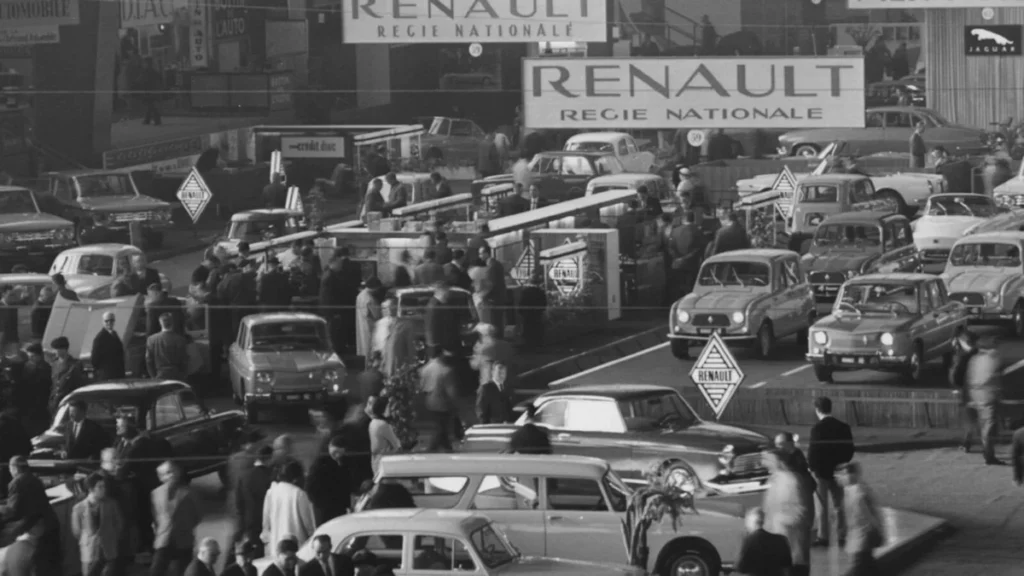
On October 14, 1962, the 49th Paris Motor Show drew its final curtain at the Porte de Versailles. As the sirens wailed to signal the evacuation of the exhibition halls, the atmosphere was thick with the scent of motor oil, new upholstery, and the palpable shift of a nation in motion. With 844,000 visitors having walked through the gates over eleven days, the event marked far more than a simple trade fair; it was the definitive end of the "Grand Palais era" and the baptism of France into the age of mass-market automotive consumerism.
This transformation was embodied by two vehicles that would define the decade: the pragmatic, revolutionary Renault 8 and the ethereal, performance-focused Alpine A110. Together, they signaled that the automobile was no longer a luxury for the urban elite, but a fundamental pillar of the French middle-class lifestyle.
The Great Migration: From Opulence to Industrial Efficiency
For over six decades, since 1901, the Paris Motor Show had been synonymous with the opulent architecture of the Grand Palais. The setting was one of chandeliers, gilded ironwork, and polished parquet floors. To the Parisian elite and the traditionalist press, the move from the prestigious Champs-Élysées to the utilitarian, cavernous hangars of the 15th arrondissement was viewed as nothing short of a logistical heresy.
Throughout the summer of 1962, the corridors of power and the automotive boards were filled with anxiety. Critics argued that the Porte de Versailles would be a disaster; they feared that the transit infrastructure—specifically the Metro Line 12—would be overwhelmed and that the boulevards of the Maréchaux would grind to a permanent halt under the weight of traffic.
However, when the doors opened in early October, the reality dismantled the skepticism. As Le Monde noted on October 5th, while the traffic congestion at the southern gates did indeed test the patience of commuters, the new exhibition space offered a tool for industry that was finally suited to the modern age. At the Grand Palais, the constraints of space had forced organizers into desperate architectural contortions, preventing the display of modern, large-scale structures and relegating industrial and commercial vehicles to secondary sites.
At the Porte de Versailles, the usable surface area doubled overnight. The aisles widened, the booths breathed, and for the first time, manufacturers could display their entire catalogues in a rational, expansive layout. This was not just a move; it was a mirror reflecting the economic metamorphosis of the Trente Glorieuses—the thirty-year post-war economic boom.
Chronology of a Turning Point
- 1901–1961: The Golden Age of the Grand Palais. The Paris Motor Show serves as a high-society event, blending art, fashion, and technology in the heart of the city.
- Summer 1962: Intense debate within the automotive industry regarding the "heresy" of moving to the periphery.
- October 4, 1962: Official opening at the Porte de Versailles. Public curiosity outweighs elitist criticism.
- October 5, 1962: Media reports acknowledge the superior logistical capacity of the new venue.
- October 14, 1962: Closing day. 844,000 visitors recorded. The R8 and Alpine A110 emerge as the stars of the exhibition.
- Post-1962: The Paris Motor Show establishes the Porte de Versailles as its permanent, modern home, cementing its role in the mass democratization of the car.
The Renault 8: Democratizing Innovation
On the vast floor of the Renault stand, the star of the show was undoubtedly the Renault 8. Introduced to succeed the aging Dauphine, the R8 was a masterclass in modern, angular design. Its "plunging" front hood and sharp lines represented a departure from the rounded, soft aesthetics of the 1950s.
Technically, however, the R8 was a revelation for a mass-produced vehicle. It featured four-wheel disc brakes as standard equipment—a luxury feature that had previously been reserved for high-performance sports cars. Coupled with the new, robust "Sierra" four-cylinder engine (later known as the Cléon-Fonte) mounted in the rear, the R8 was a reliable, spirited, and accessible machine. It was the perfect car for the new French family, capable of navigating suburban streets and the burgeoning network of toll motorways with equal ease.
The Alpine A110: A "Sorcerer’s" Masterpiece
Just a few meters away from the industrial might of the Renault display, a small Norman manufacturer was quietly rewriting the future of motorsport. Jean Rédélé, the founder of Alpine, unveiled the definitive version of his latest creation: the Alpine A110.
Replacing the smaller A108, the A110 was a masterwork of lightweight design. Using a polyester and fiberglass body over a tubular steel chassis, the car stood at an astonishingly low height of just 1.13 meters. Rédélé, sensing the shift in the market, had made a brilliant strategic move: he utilized the mechanical components, running gear, and the new disc brakes of the Renault 8.
The result was a car that possessed an incredible power-to-weight ratio. Visitors who crowded around the Alpine stand were witnessing the birth of a legend that would eventually dominate the world of international rallying throughout the 1970s. It was the ultimate "David" to the R8’s "Goliath," and yet, they were brothers in engineering.
Data and Demographics: The Success of Mass Consumption
The numbers from the 1962 Salon provide an objective measure of the era’s success. With 844,000 entries over eleven days, the exhibition proved that the hunger for personal mobility was universal.
| Metric | 1962 Exhibition Data |
|---|---|
| Duration | 11 Days |
| Total Attendance | 844,000 |
| Key Venue Change | Grand Palais → Porte de Versailles |
| Main Innovation | Mass adoption of 4-wheel disc brakes |
| Cultural Shift | Car as a necessity vs. Car as a luxury |
The shift in venue from the Grand Palais to the Porte de Versailles allowed for a 100% increase in usable space. This expansion facilitated the display of heavy machinery, commercial utility vehicles, and family sedans side-by-side, mirroring the social restructuring of France. The working class, now benefiting from paid holidays and the rise of suburban housing, viewed the car as a tool of freedom. The Salon had successfully transitioned from a boutique display for the bourgeoisie into a cathedral of the industrial revolution.
Official Responses and Industry Implications
At the time, the Union des Chambres Syndicales de l’Industrie Automobile (the organizers) faced immense pressure. Official statements in the days following the event focused heavily on the "success of the logistics."
Industry leaders, including executives from Renault and Peugeot, remarked that the "rationalization of space" allowed for better communication with the public. Marketing departments began to shift their focus from technical specifications to "lifestyle integration"—the car as the centerpiece of family leisure.
The success of the 1962 show also marked the beginning of a deeper, more formalized relationship between major manufacturers and niche performance specialists. The "Renault-Alpine" synergy became the blueprint for high-performance sub-brands that we still see today. By providing the mechanical foundation for Rédélé’s sports cars, Renault proved that it was committed not just to volume, but to the cultural prestige of French engineering.
Conclusion: The Legacy of a Cold October
When the turnstiles stopped at the Porte de Versailles on that Sunday evening in October 1962, the industry knew there was no going back. The nostalgia for the chandeliers of the Grand Palais was quickly eclipsed by the sheer efficiency and popularity of the new venue.
The 49th Salon de l’Auto did more than showcase new models; it validated the economic direction of the nation. By marrying the mass-market accessibility of the Renault 8 with the aspirational performance of the Alpine A110, the French automotive industry had successfully executed its own "mue" (molting). It had shed its old skin of artisanal exclusivity and emerged as a titan of industrial production.
The Porte de Versailles would remain the home of the Paris Motor Show for decades to come, standing as a monument to the moment when France stopped looking back at its history and started driving toward its future.
Extra Insight: How the R8 "Muscle" Built the Berlinette
The success of the Alpine A110 is inextricably linked to the R8. Jean Rédélé had previously struggled with the limitations of the "Ventoux" engine found in the Dauphine, which suffered from overheating and a lack of power. When Rédélé obtained early technical specifications for the "Cléon-Fonte" engine destined for the R8, he acted with lightning speed. He modified the rear cradle of his chassis to accommodate the 956cc engine, which was then tuned by legendary "sorcerers" like Amédée Gordini. By combining this engine with the Lockheed disc brakes from the R8, Rédélé turned a 560kg shell into a precision instrument. This act of industrial scavenging and mechanical ingenuity did more than just create a fast car; it established a partnership that would eventually lead to the 1973 World Rally Championship title, proving that the best innovations often come from the perfect marriage of a mass-market workhorse and a racing spirit.
