
It is the silent guardian of our highway commutes and the unsung hero that shields us from the dreaded accumulation of speeding tickets. For millions of drivers worldwide, the cruise control system is a convenience taken for granted—a flick of a steering-wheel switch that allows for a moment of physical respite during long-distance travel. Yet, behind this ubiquitous piece of automotive technology lies a story of irony, perseverance, and brilliance. The cruise control was not birthed in the sterile halls of a massive automotive conglomerate, but in the mind of a blind engineer, exasperated by the erratic driving habits of his own chauffeur.
The Intuition of a Sightless Visionary
The history of automotive automation begins with Ralph Teetor, a man whose life was defined by the paradox of his condition. Blinded at the age of five following a workshop accident, Teetor possessed an uncanny mechanical aptitude and an "absolute ear" for engineering. He did not need sight to visualize complex mechanisms; he felt them in the flow of power and the vibration of steel.
In the late 1930s, while riding as a passenger in a car driven by his attorney, Teetor found himself in a state of growing agitation. His driver suffered from a common, albeit annoying, affliction: he would slow down while engaged in conversation, only to reflexively accelerate once he returned his focus to the road. This constant, rhythmic "stop-and-go" motion created a nauseating inconsistency in speed. For Teetor, whose lack of sight heightened his sensitivity to movement, this lack of steady velocity was not just annoying—it was an inefficient use of the machine. He reasoned that if a human could not maintain a constant speed due to distractions, a mechanical governor surely could.
In 1945, after years of tinkering in his home workshop, Teetor filed the patent for what would eventually become the modern cruise control.
Chronology: From Concept to Consumer Convenience
The journey from Teetor’s frustration to a global automotive standard was a multi-decade evolution:
- 1945: Ralph Teetor files the primary patent for his speed-control device.
- August 22, 1950: Teetor files a secondary, refined patent, cementing the mechanical design of the "Speedostat."
- 1958: Chrysler becomes the first manufacturer to offer the device, rebranded as "Auto-Pilot," on its Imperial model line.
- 1960s: Cadillac adopts the technology, popularizing the term "Cruise Control."
- 1990s: Mitsubishi introduces the world to the first iteration of Adaptive Cruise Control (ACC).
- 1999: Mercedes-Benz introduces Distronic on the S-Class, bringing radar-based cruise control to the mainstream luxury market.
- 2010s-Present: The integration of "Stop & Go" technology and semi-autonomous driving aids becomes standard in mid-range vehicles.
The Mechanics of Control: How It Works
The Mechanical Era: The Speedostat
Teetor’s original invention, the "Speedostat," was a masterpiece of analog engineering. It did not rely on computers, as they did not exist in the consumer automotive space. Instead, it utilized a vacuum-operated piston connected to the throttle linkage. When the driver reached a desired speed, the mechanism would lock the throttle in place. If the vehicle began to exceed that speed, the piston would exert physical pressure against the accelerator pedal, pushing back against the driver’s foot—a tactile warning that the car had surpassed its set limit.
The Digital Era: The ECU Revolution
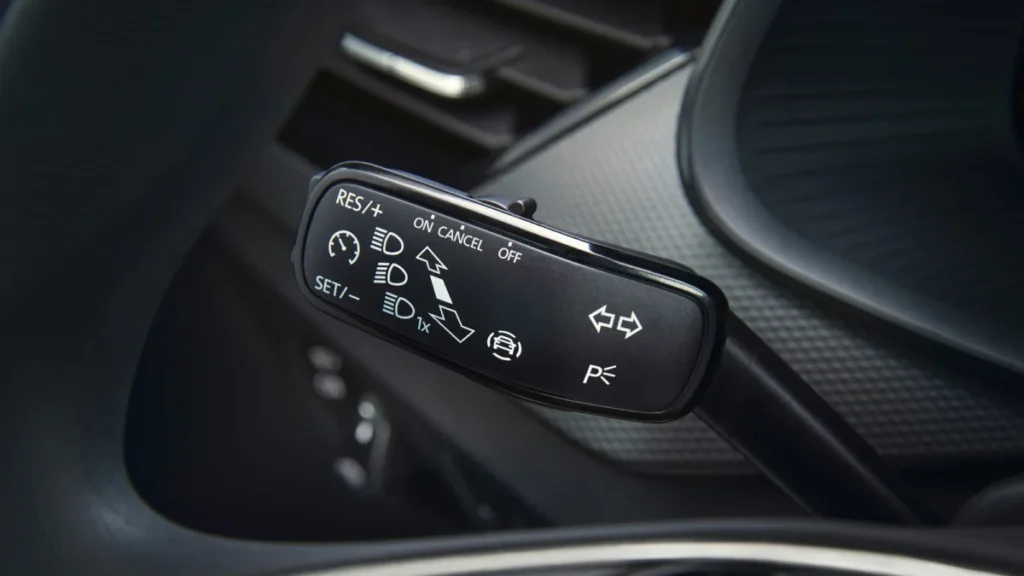
Modern cruise control is a marvel of electronic precision. When a driver presses the "SET" button, the vehicle’s Engine Control Unit (ECU) assumes command. The ECU monitors the vehicle’s speed via wheel-speed sensors and dictates the throttle body’s position electronically (Drive-by-Wire). It continuously calculates the air-to-fuel ratio to maintain the target velocity, adjusting for inclines and headwinds in milliseconds. The system is designed with a "fail-safe" logic: any input from the brake pedal, the clutch (in manual transmissions), or the driver’s own override immediately disengages the system.
The Evolution of the Adaptive Cruise Control (ACC)
The traditional cruise control had one fatal flaw: it was "dumb." It maintained speed regardless of the environment, forcing the driver to disengage the system the moment traffic slowed down. This changed in the mid-1990s.
The birth of the Adaptive Cruise Control (ACC) represented a paradigm shift in road safety. By utilizing radar sensors mounted behind the front grille, the car could now "see" the vehicle in front. The system calculates the distance and the relative speed of the lead vehicle. If the lead car slows, the ACC automatically reduces the throttle or applies the brakes to maintain a safe, pre-set distance. Once the path is clear, the system restores the car to its original cruising speed.
Supporting Data and Industry Impact
The impact of cruise control on modern travel is quantifiable. Studies from the U.S. Department of Transportation have indicated that steady-speed driving, facilitated by cruise control, can improve fuel efficiency by as much as 7% to 14% on highways. By minimizing the rapid acceleration and deceleration cycles that waste fuel, the system serves as an early, primitive form of energy conservation.
Furthermore, the integration of ACC has had a demonstrable effect on traffic flow. "Phantom traffic jams"—those waves of brake-lights that propagate through highway traffic—are often caused by the reactionary driving of humans. ACC systems react faster and more smoothly than humans, helping to dampen these waves and potentially increasing the capacity of highways.
Official Responses and Safety Implications
Automotive safety regulators have historically maintained a neutral stance on cruise control, emphasizing that it is a convenience feature, not a safety feature. The National Highway Traffic Safety Administration (NHTSA) has long cautioned that cruise control should never be used in inclement weather, such as rain or snow. The danger lies in the potential for hydroplaning: if the wheels lose traction, the cruise control may attempt to compensate by increasing power, leading to a loss of control that a human driver would immediately detect.
Industry leaders like Mercedes-Benz and Volvo have championed the shift toward "Intelligent Cruise Control," which integrates GPS data and speed-limit recognition cameras. This ensures that the cruise control doesn’t just maintain speed, but adheres to the local legal limits, effectively acting as a "co-pilot."
Implications for the Future of Autonomous Driving
Ralph Teetor’s invention was the first step toward the "Hands-Off" era of driving. The progression from the mechanical Speedostat to the sensor-laden ACC serves as the blueprint for current autonomous driving systems. Today’s sophisticated ADAS (Advanced Driver Assistance Systems) are, in essence, descendants of Teetor’s original concept: they are systems designed to remove the fallibility of human behavior from the act of driving.
Teetor, who was inducted into the Automotive Hall of Fame in 1976, lived to see his invention become standard equipment across the globe. He never drove a car himself, yet he shaped the driving experience for billions. His story serves as a profound reminder that the most significant technological advancements often stem from the simplest, most human frustrations. Whether he was considering the names Controlomatic or Touchomatic before settling on the practical branding suggested by Cadillac, Teetor understood that technology’s primary goal should be to assist human intent, not to complicate it.
As we move toward a future of fully autonomous vehicles, we owe a debt to the blind engineer who, while unable to see the road, clearly saw a better way to travel it.
