

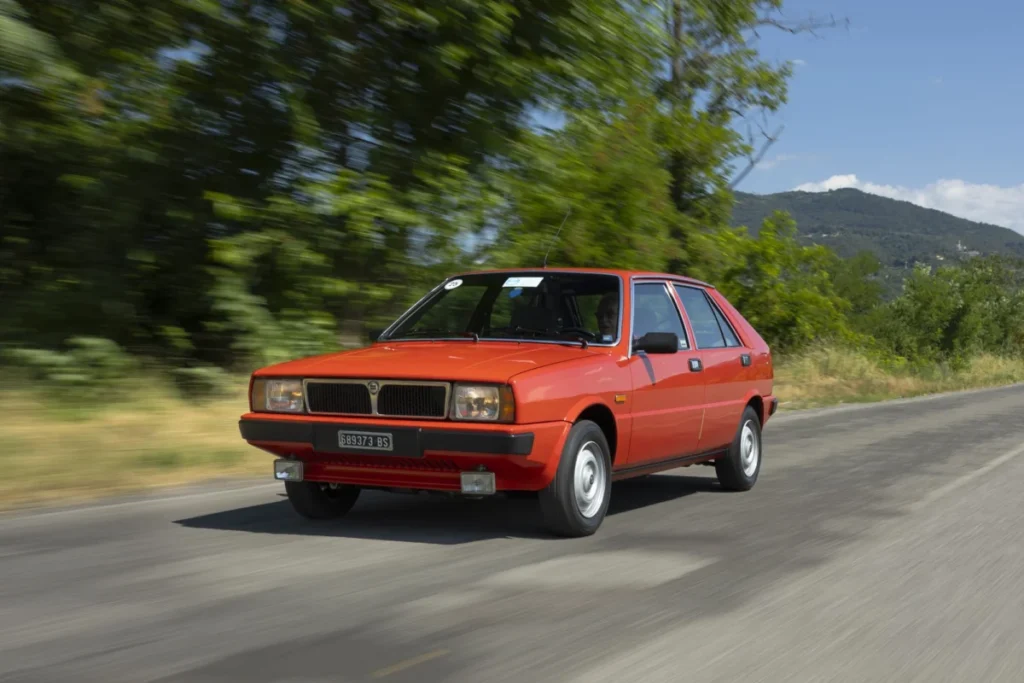
Introduction: A New Dawn for a Legendary Brand
In the autumn of 1979, the automotive landscape was shifting. Following a turbulent decade marked by the lukewarm reception of the Beta and Gamma models—cars that struggled to capture the quintessential spirit of the brand—Lancia found itself at a crossroads. Seven years after the discontinuation of the iconic Fulvia, the Italian manufacturer was determined to reclaim its foothold in the compact car segment. The solution was the Lancia Delta, a vehicle that would not only define a generation but also cement Lancia’s status in the annals of motorsport history.
Far from being a mere exercise in badge engineering, the Delta was a masterclass in Italian design and technical refinement. With a sophisticated silhouette penned by the legendary Giorgetto Giugiaro, the Delta represented a harmonious blend of elegance, proven mechanical prowess, and superior build quality.
The Genesis: Defying the "Synergy" Myth
A common misconception among automotive historians is that the Delta was essentially a "Fiat Ritmo in a tuxedo." While the two vehicles shared a parent company, the design philosophy behind the Delta was fundamentally different. During the late 1970s, the rigid "synergy" policies that would later homogenize the Fiat group had not yet taken full root. Consequently, Lancia’s engineering team enjoyed an enviable level of autonomy.
Technical Divergence
The structural differences were profound. While the Fiat Ritmo utilized an wheelbase of 2.448 meters, the Lancia Delta was stretched to 2.475 meters. Furthermore, whereas the Ritmo relied on a cost-effective, antiquated transverse spring rear suspension—inherited from the Fiat 127—the Delta adopted a sophisticated McPherson strut system derived from the Beta. However, the Delta refined this further, incorporating longitudinal arms that provided superior handling and chassis rigidity, reflecting Lancia’s premium market positioning.

The Engine Suite
The only significant crossover between the two brands lay under the hood. The Delta utilized the 1.3-liter and 1.5-liter powerplants, which were evolutions of the reliable mono-cam engine that debuted in the 1969 Fiat 128. However, Lancia’s engineers worked their magic: by integrating specific intake manifolds, a bespoke exhaust system, and dual-choke carburetors, they coaxed 75 hp from the 1,301cc unit and 85 hp from the 1,498cc version, pushing top speeds to 155 km/h and 160 km/h, respectively.
Design Evolution: The Giugiaro Touch
Giorgetto Giugiaro’s design for the Delta was a response to the seismic shift caused by the Volkswagen Golf. Lancia sought to create a car that was more refined, more "chic," and distinctly more Italian.
The Battle for the Hatchback
Giugiaro’s initial sketches featured a high-threshold trunk design, a common stylistic trope of the era that aimed to prioritize structural rigidity and aesthetics over raw utility. However, market testing in France proved disastrous; consumers demanded a practical, usable hatchback. Against his artistic instincts, Giugiaro redesigned the rear to allow the hatch to open down to the bumper line, creating a vehicle that was as functional as it was elegant.
The "Shield" Signature
The front fascia was perhaps the most distinctive element. While the early "Y5" prototypes were elegant, they lacked the brand identity that Lancia’s management demanded. Pininfarina’s influence led to the iconic wide, stylized Lancia shield, which integrated seamlessly into the grille. This addition, while subtle, transformed the car from a generic compact into a unmistakable member of the Lancia family.

Market Positioning and The "Agnelli" Skepticism
Interestingly, the project was not universally loved within the corridors of power at Fiat. In a 2003 interview, Giugiaro recalled that Umberto Agnelli was initially unimpressed by the Delta. Agnelli, enamored with the aggressive, "shocking" styling of the Fiat Ritmo, felt the Delta was too clean and too conservative.
History would prove him wrong. When the two vehicles were unveiled at the Frankfurt Motor Show, the public reaction was starkly divided. The Ritmo was seen as radical, but the Delta was seen as sophisticated. Compared to the contemporary Opel Kadett D, the Delta was undeniably the more refined choice, appealing to a demographic that valued aesthetic restraint and superior road manners.
Chronology: From Launch to Legend
- 1979 (Autumn): Official launch of the Lancia Delta. The initial lineup consists of the 1300 (4-speed), 1300 (5-speed), and 1500 (5-speed).
- 1980: The Delta is crowned the "European Car of the Year," the first and only time Lancia would achieve this accolade.
- 1980 (Peak Production): Production ramps up from 150 units per day to 380 units per day. The Lingotto plant is mobilized to assist the Chivasso factory to meet overwhelming demand.
- 1982 (February): Cessation of production at the Lingotto facility.
- The Rally Era: The Delta would eventually evolve into the 4WD and Integrale monsters, securing its place as the most successful rally car in history.
Supporting Data: The Anatomy of Success
The market segmentation of the Delta was calculated to perfection. The entry-level 1300 4-speed served as the volume driver, differentiated from its more expensive siblings by the absence of a rear wiper, narrower 145-13 tires, and a minimalist cabin featuring an analog clock rather than a tachometer.
The upscale versions, conversely, offered a digital clock mounted above the rearview mirror and higher-quality upholstery, signaling to the consumer that they were purchasing a luxury compact. The strategy worked: 70% of Delta buyers were "conquest" customers—individuals who had never owned a Lancia before. This influx of new blood proved that Lancia’s attempt to bridge the gap between mass-market utility and premium comfort had succeeded.

Official Responses and Internal Dynamics
The success of the Delta forced a rapid expansion of production capabilities. The waiting time for a new car consistently exceeded four months, a testament to the brand’s revitalized desirability. Internally, the success of the Delta shifted the power dynamics within the Fiat Group. It proved that Lancia, even under the corporate umbrella, could maintain a distinct engineering identity that commanded a price premium.
Implications: The Legacy of a Design Icon
The implications of the Delta’s launch extend far beyond the sales figures of the early 1980s. By proving that a compact car could offer the prestige of a larger sedan, the Delta essentially paved the way for the "premium hatchback" segment that dominates the modern European market.
Its clean, angular lines have aged with a grace that few of its contemporaries can claim. While the Ritmo has largely faded into the obscurity of budget-conscious history, the Delta has transitioned into a highly sought-after classic. The "pure" design that Umberto Agnelli once doubted is now cited by design schools worldwide as a prime example of functional minimalism.
In conclusion, the Lancia Delta was more than just a car; it was a defiant statement of intent. It proved that in the face of corporate consolidation and standardized manufacturing, excellence could still be found in the details—in the specific tune of an engine, the placement of a grille, and the stubborn refusal to compromise on the brand’s heritage. For those who own a piece of that history today, the Delta remains the ultimate symbol of a time when Lancia truly led the way.
