

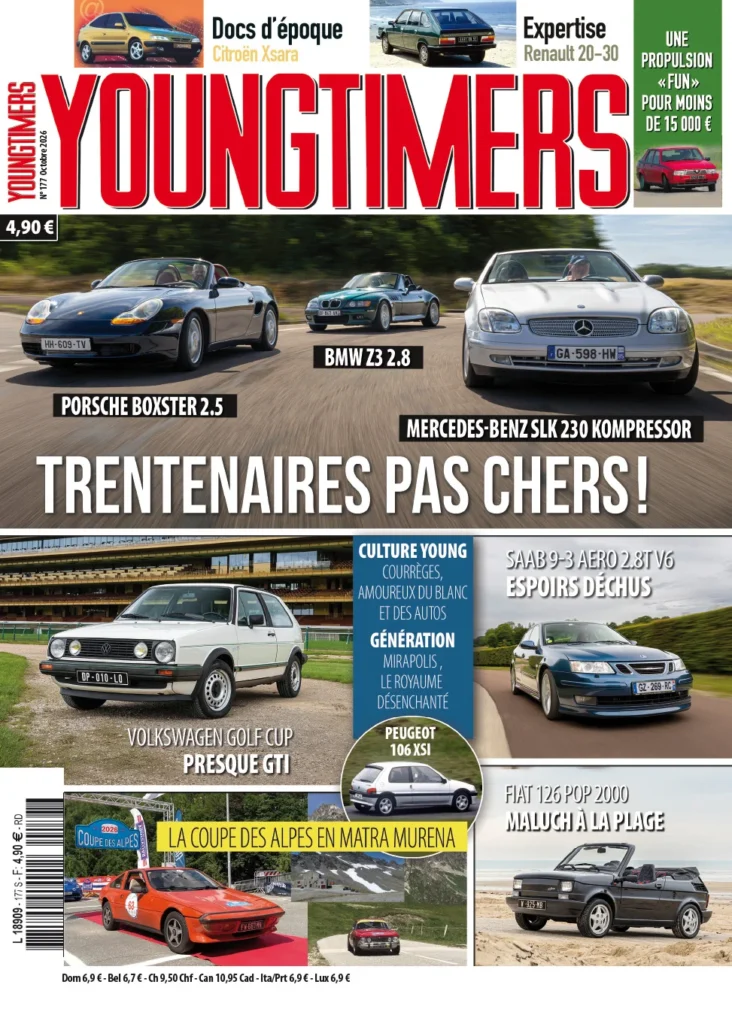
Main Facts: A Celebration of Late 20th-Century Automotive Culture
For enthusiasts of modern classic cars—vehicles that bridge the gap between vintage charm and modern reliability—the arrival of a new edition of Youngtimers magazine is always a major event. Published on September 30, 2026, Issue #177 hits newsstands and digital storefronts with an eclectic, nostalgia-inducing lineup that speaks directly to the hearts of Gen X and Millennial petrolheads.
At the core of this October 2026 issue is a high-octane comparative dossier celebrating the legendary trio of late-1990s affordable roadsters: the BMW Z3 2.8, the Mercedes-Benz SLK 230 Kompressor, and the Porsche Boxster 2.5. These three open-top drivers defined the turn of the millennium, offering accessible luxury, rear-wheel-drive dynamics, and distinct design philosophies that continue to captivate collectors today.
Beyond the headline-grabbing roadster shootout, the 177th edition of Youngtimers casts a wide net across automotive history, featuring everything from motorsport icons like the Volkswagen Golf Cup and a spirited Alpine road trip in a Matra Murena, to quirky daily drivers and forgotten gems such as the Fiat 126 Pop 2000, the Saab 9-3 Aero 2.8T V6, the Peugeot 106 XSI, the executive hatchbacks Renault 20 and Renault 30, and the ubiquitous Citroën Xsara.
Priced identically for newsstand buyers and online orderers—with the added bonus of free shipping—Issue #177 reaffirms Youngtimers’ status as the premier European authority on the cars we grew up with, lusted after, and can still realistically park in our garages.
Chronology: The Evolution of the "Youngtimer" Phenomenon
To understand why Issue #177 resonates so deeply with contemporary car enthusiasts, it is helpful to look back at the trajectory of the "youngtimer" movement and the evolution of the vehicles featured in this month’s summary.
The 1970s–1980s: The Genesis of Innovation and Quirky Engineering
- Late 1970s (Renault 20 & 30): Introduced as flagship fastbacks, the Renault 20 and 30 represented French ambition in the executive sector. Utilizing the PRV (Peugeot-Renault-Volvo) V6 engine in the R30, these cars introduced hatch practicality to a segment usually dominated by austere three-box sedans.
- Early 1980s (Matra Murena): A masterclass in mid-engine packaging, the Matra Murena featured a unique three-abreast front seating arrangement and a fiberglass body over a galvanized steel chassis, making it a star of endurance rallies like the Coupe des Alpes.
The 1990s: The Hot Hatch Revolution and the Roadster Renaissance
- Early 1990s (Peugeot 106 XSI): As emissions regulations tightened, Peugeot kept the hot hatch dream alive. The 106 XSI delivered a featherweight chassis coupled with sharp handling, setting the stage for the legendary 106 Rallye and GTI models.
- 1996–1997 (The Holy Trinity of Roadsters):
- 1996: Mercedes-Benz shocks the world with the SLK 230 Kompressor, introducing the world to the modern Vario-roof retractable hardtop.
- 1996: Porsche launches the Boxster 2.5, utilizing a purpose-built water-cooled flat-six engine mounted mid-ship, single-handedly saving the brand from financial ruin.
- 1997: BMW unleashes the Z3 2.8, following up on its cinematic GoldenEye debut with a silky-inline-six powerplant that transformed the roadster into a true driver’s car.
The 2000s: Turbocharging and Millennium Transitions
- Millennium Era (Fiat 126 Pop 2000 & Saab 9-3 Aero 2.8T V6): While Fiat bid farewell to its air-cooled rear-engine heritage with special millennial editions like the 126 Pop, Saab pushed forced-induction performance into the mainstream, culminating in the ferocious 2.8-liter turbocharged V6 powerplants that defined the twilight years of the Swedish marque.
Supporting Data: Specifications of Issue #177’s Headliners
To provide a clearer picture of the engineering marvels dissected in Youngtimers Issue #177, we examine the baseline performance and mechanical characteristics of the issue’s marquee features:
| Vehicle Model | Production Years | Engine Type | Displacement | Power Output | Drivetrain | Notable Characteristic |
|---|---|---|---|---|---|---|
| BMW Z3 2.8 | 1997–2000 | Inline-6 (M52) | 2,793 cc | 192 hp | FR (Front-Engine, Rear-Wheel Drive) | Classic long-hood, short-deck proportions; iconic straight-six soundtrack. |
| Mercedes SLK 230 Kompressor | 1996–2004 | Supercharged Inline-4 | 2,295 cc | 193 hp | FR | Pioneering Vario retractable hardtop combining coupe security with roadster freedom. |
| Porsche Boxster 2.5 | 1996–1999 | Water-cooled Flat-6 | 2,480 cc | 204 hp | MR (Mid-Engine, Rear-Wheel Drive) | Exceptional handling balance derived from a clean-sheet mid-engine architecture. |
| Saab 9-3 Aero 2.8T V6 | 2006–2012 | Turbocharged V6 | 2,792 cc | 250–280 hp | FF (Front-Engine, Front-Wheel Drive) | Effortless mid-range torque and distinctive Scandinavian aeronautical styling cues. |
| Peugeot 106 XSI | 1992–1996 | Naturally Aspirated Inline-4 | 1,360 cc | 95–100 hp | FF | Featherlight curb weight (~850 kg) offering pure, unfiltered analog feedback. |
Editorial Insights and Perspectives
While the magazine review outlines the mechanical subjects of Issue #177, the broader automotive commentary surrounding the publication highlights a cultural shift in how enthusiasts view cars from the 1990s and 2000s.
Industry analysts note that vehicles from this era occupy a "sweet spot" in the collector market. Unlike pre-war or 1950s classics that often require specialized knowledge and trailering to events, 1990s youngtimers can be driven regularly on modern highways, kept in standard suburban garages, and maintained without requiring an engineering degree—yet they retain the mechanical purity that modern cars have largely engineered away.
Furthermore, the inclusion of motorsport-adjacent features, such as the Volkswagen Golf Cup tracking and the grueling Coupe des Alpes tackled by a Matra Murena, emphasizes that youngtimers are meant to be driven, not merely polished at static car shows. Editorial teams at Youngtimers have consistently advocated for the active preservation of everyday classics, arguing that a well-traveled Citroën Xsara or Peugeot 106 holds just as much cultural weight as an exotic supercar.
Implications: The Rising Value and Future of Youngtimers in the 2020s
The publication of Youngtimers Issue #177 arrives at a critical juncture for the collector car market. Several long-term implications stem from the resurgence of interest in late-20th-century vehicles:
1. Market Appreciation for 1990s Roadsters
As pristine examples of the BMW Z3 2.8, Mercedes SLK 230, and Porsche Boxster 2.5 are featured in enthusiast press, market values are expected to stabilize on an upward trajectory. For years, these cars suffered from depreciation curves that landed them in the hands of owners who deferred maintenance. Today, finding a clean, un-modified example has become increasingly difficult, driving up prices for well-documented specimens.
2. The Shift Away from Digital Fatigue
Modern cars are heavily reliant on touchscreens, driver-assistance nannies, and complex electronic architectures that can become obsolete or expensive to repair. The enduring popularity of magazines like Youngtimers proves that drivers are experiencing digital fatigue. Cars like the Saab 9-3 Aero or the Peugeot 106 XSI offer tactile steering feel, mechanical throttles, and an emotional connection that modern vehicles struggle to replicate.
3. Accessibility of Print Media in the Digital Age
The commercial strategy behind Youngtimers—offering the magazine via traditional newsstands while simultaneously providing a friction-free online ordering experience with free shipping—demonstrates a sustainable model for enthusiast journalism. By lowering logistical barriers for collectors living outside major metropolitan areas, publications ensure that car culture continues to thrive across generations.
Youngtimers Issue #177 is available now in kiosks across France and via the official Youngtimers online boutique for fans looking to dive deep into the analog glory of late-century motoring.
