

MIAMI, FLORIDA — For motorsport enthusiasts and collectors of stock car racing history, few names carry the gravitational pull of Dale Earnhardt, Inc. (DEI). Founded by the legendary seven-time NASCAR Cup Series champion Dale Earnhardt Sr., the powerhouse organization became synonymous with fierce competition, meticulous preparation, and iconic liveries that dominated the mid-2000s stock car landscape.
Now, a tangible piece of that golden era of NASCAR is heading to the open market. Currently offered on dealer consignment in Miami, Florida, is a Generation 4 Chevrolet Monte Carlo race car built by DEI. Boasting a rich provenance that ties it directly to some of the biggest names in modern stock car racing—including Dale Earnhardt Jr. and Martin Truex Jr.—this purpose-built road course machine represents a fascinating intersection of elite engineering, team heritage, and vintage motorsport accessibility.
Equipped with a snarling 358-cubic-inch SB2 V8 engine, a four-speed manual transmission, and period-correct road-racing modifications, the car is accompanied by a verified Certificate of Authenticity (CoA) from DEI. While it lacks a traditional vehicle identification number (VIN) and cannot be registered for street use, its eligibility for Historic Sportscar Racing (HSR) events means its retirement from competitive racing is far from permanent.

Main Facts: Anatomy of a DEI Road Course Contender
At its core, this offering is far more than a mere display piece or cosmetic tribute; it is a genuine, heavily engineered professional race car manufactured during the height of DEI’s operational dominance.
Chassis and Exterior Aerodynamics
The car features a fiberglass and sheet-metal body styled after the iconic Chevrolet Monte Carlo, draped over a robust Generation 4 tubular steel chassis. Unlike standard oval-track stock cars of its era, this chassis was specifically configured for road course competition—a discipline that demands heightened agility, sophisticated braking capabilities, and superior balance to handle both left- and right-hand turns under heavy braking and acceleration.
The exterior is finished in a striking black and yellow livery bearing the #8 and adorned with official Bass Pro Shops and Tracker Boats graphics, a visual package famously campaigned by Martin Truex Jr. during the 2005 racing season. Truex’s signature decals are prominently featured over the side windows, authenticating its visual ties to the driver.

Practical racing elements abound. The exterior package includes:
- Hood and trunk safety pins for rapid pit-stop access.
- NACA ducts strategically placed for cooling and airflow management.
- A specialized windshield wiper motor essential for wet-weather road course racing.
- Windshield and rear window steel safety straps to prevent blowout at high speeds.
- Side-exit exhaust outlets that emit the unmistakable roar of an unrestricted small-block Chevrolet.
- A right-hand-side fuel filler configured for rapid endurance-style refuelers.
- A high-mount rear brake light required for visibility in road-racing packs.
- A traditional rear spoiler designed to stabilize the rear end through sweeping high-speed corners.
Powertrain and Drivetrain
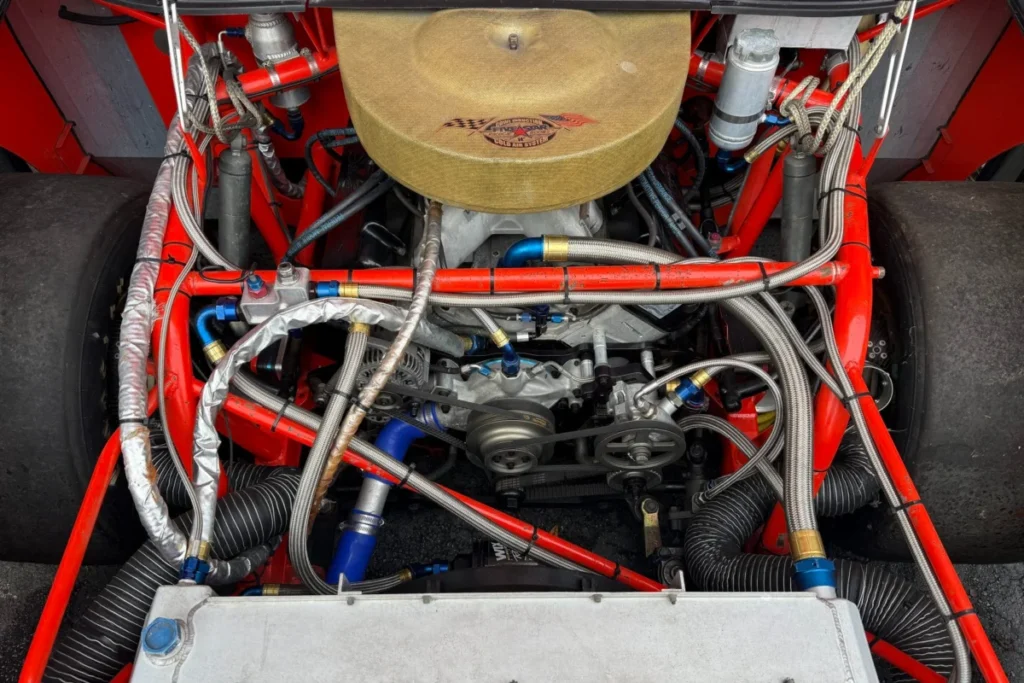
Lurking beneath the louvered hood is the beating heart of the machine: a legendary 358-cubic-inch SB2 (Small Block 2) V8 engine built entirely in-house by Dale Earnhardt, Inc. Developed initially by Chevrolet and NASCAR teams to rival dominant powerplants, the SB2 is renowned for its high-revving capabilities and prodigious horsepower output.
This particular engine breathes through a high-performance four-barrel carburetor mounted to a Wilson/GM aluminum intake manifold. Thermal management is handled by a heavy-duty aluminum radiator and dedicated oil cooler, while spent gases are evacuated through custom tubular headers. Adding a poignant touch of personalization, the aluminum valve covers are embossed with raised signatures of the "Intimidator" himself, Dale Earnhardt.

Power is channeled to the rear wheels via a traditional four-speed manual transmission shifted via a Wehrs Machine single-rail shifter. Spark management is controlled by a dual MSD ignition system, with control boxes neatly secured on the passenger-side floorboard.
Cockpit and Safety Equipment
Stepping inside the orange-painted interior reveals a cockpit designed purely for function, safety, and driver endurance. The driver is held securely in place by a fixed-back ButlerBuilt composite racing seat equipped with integrated head restraints, paired with a multi-point Simpson harness.
Additional cabin safety and operational features include:

- A comprehensive, integrated roll cage painted to match the interior floors.
- A side window safety net.
- A built-in fire-suppression system.
- A MOMO steering wheel wrapped in black microsuede, accented with a vibrant yellow centering stripe for quick visual reference.
- A custom dashboard layout featuring an array of toggle switches, critical driver switchgear, and an integrated shift light.
- AutoMeter instrumentation centered around a prominent 10,000-rpm tachometer, accompanied by five auxiliary analog gauges monitoring oil pressure, water temperature, fuel pressure, and voltage. (True to its racing nature, the car features neither a speedometer nor an odometer.)
Footwork and Braking
To scrub speed effectively on twisty road circuits, the Monte Carlo relies on a serious braking setup featuring four-wheel discs with high-end AP Racing calipers, supported by dedicated cooling ducts to mitigate brake fade under grueling track conditions. The car rolls on black 15-inch Bassett steel wheels accented with red pinstriping, wrapped in wide 10.0/27.0-inch Hoosier F-45 racing slicks designed to maximize mechanical grip.
Chronology: A Timeline of Provenance and Ownership
The history of this specific Chevrolet Monte Carlo is well-documented through team records, physical verification, and official certification.
- 2005 Season: The car is campaigned under the DEI umbrella, carrying the iconic #8 Bass Pro Shops/Tracker Boats colors. According to the selling dealer and accompanying documentation, it was driven in competition by Martin Truex Jr. for Chance 2 Motorsports—a joint NASCAR Busch Series venture co-owned by Dale Earnhardt Jr. and Kelley Earnhardt Miller—under the watchful eye of crew chief Kevin “Bono” Manion.
- August 25, 2005: Just weeks after the conclusion of the final road course race of the 2005 NASCAR season, official paperwork is processed. A Certificate of Authenticity is signed and issued by Dale Earnhardt, Inc., permanently recording the chassis’s heritage and competitive pedigree.
- 2013: The current consigning owner acquires the race car, preserving it in a private collection for over a decade before placing it on the market.
- Present Day: Offered via a dealer consignment in Miami, Florida, accompanied by the original DEI CoA copy and a formal bill of sale.
Supporting Data: Specifications at a Glance
| Category | Specification Details |
|---|---|
| Vehicle Type | NASCAR Generation 4 Road Course Race Car |
| Make / Model | Chevrolet Monte Carlo |
| Builder | Dale Earnhardt, Inc. (DEI) |
| Engine | 358ci SB2 V8 (Built by DEI) |
| Induction | Four-barrel carburetor, Wilson/GM intake manifold |
| Transmission | Four-speed manual with Wehrs Machine single-rail shifter |
| Ignition | Dual MSD ignition system |
| Chassis | Gen-4 tubular steel space frame (Road course setup) |
| Brakes | Four-wheel discs with AP Racing calipers and cooling ducts |
| Wheels & Tires | 15” black Bassett steel wheels with Hoosier F-45 slicks |
| Interior Safety | ButlerBuilt seat, Simpson harness, integrated roll cage, fire system |
| Instrumentation | AutoMeter 10k-rpm tachometer, auxiliary analog gauges |
| Associated Drivers | Dale Earnhardt Jr., Martin Truex Jr. |
| Associated Crew Chief | Kevin “Bono” Manion |
| Documentation | DEI Certificate of Authenticity (dated August 25, 2005), Bill of Sale |
| Legal Status | Non-street-legal; lacks VIN and title |
Official Responses and Historical Context
The significance of Generation 4 stock cars—particularly those emerging from elite shops like Dale Earnhardt, Inc.—cannot be overstated among motorsport historians. During the late 1990s and mid-2000s, DEI was a cultural and competitive monolith in American stock car racing. Vehicles constructed during this era represent the pinnacle of mechanical, carbureted NASCAR technology before the widespread adoption of standardized "Car of Tomorrow" (COT) platforms and modern electronic fuel injection.

While formal corporate comments from modern automotive manufacturers are absent regarding vintage privateer transactions of this nature, industry insiders and vintage racing organizations have increasingly embraced retired stock cars. Organizations like Historic Sportscar Racing (HSR) and the Sportscar Vintage Racing Association (SVRA) have created dedicated run groups that welcome ex-NASCAR Cup and Busch Series machines.
Motorsport preservationists note that cars built for road course duties—such as this Monte Carlo—require far less conversion work for road-racing circuits than their oval-track counterparts, which typically feature asymmetrical chassis setups optimized exclusively for left-hand turns. By retaining its road-course geometry, AP Racing brakes, and dedicated endurance features (such as windshield wipers and right-side fuel fills), this Monte Carlo remains turn-key ready for track-day enthusiasts seeking authentic vintage racing thrills.
Implications: The Collector Market for Ex-DEI Machinery
The appearance of this ex-DEI Chevrolet Monte Carlo on the open market carries several notable implications for collectors, vintage racers, and the broader automotive hobby:

1. The Preservation of Garage-Era NASCAR History
As modern top-tier motorsports become increasingly computerized and tightly controlled, the raw, mechanical nature of mid-2000s NASCAR machinery continues to appreciate in romantic appeal. Fans and collectors who grew up watching the fierce battles between Earnhardt Jr., Truex Jr., and their contemporaries view these physical artifacts as irreplaceable connection points to a bygone era of stock car racing.
2. Viability in Historic Racing
Unlike museum-bound static displays, cars of this caliber retain functional utility. Because the vehicle is eligible for HSR events, its next owner faces a choice: preserve it as a static centerpiece in a private collection, or unleash its 358-cubic-inch SB2 V8 on legendary road courses like Road America, Watkins Glen, or Sebring. The presence of professional-grade endurance components makes the latter option entirely practical.
3. Valuation and Documentation
In the collector car market, provenance is everything. The inclusion of a verified Dale Earnhardt, Inc. Certificate of Authenticity—dated directly to the period of its active competition and signed mere weeks after the season’s final road race—provides a layer of pedigree that insulates the vehicle against common authenticity concerns plaguing tribute or clone race cars.

While the car lacks a traditional title or street legality—transferring ownership via a standard bill of sale—this is standard operating procedure for elite competition vehicles. For buyers seeking pure, unfiltered American V8 horsepower wrapped in the legendary black-and-yellow livery of Dale Earnhardt’s racing empire, this Monte Carlo stands ready to write its next chapter on the asphalt.
