

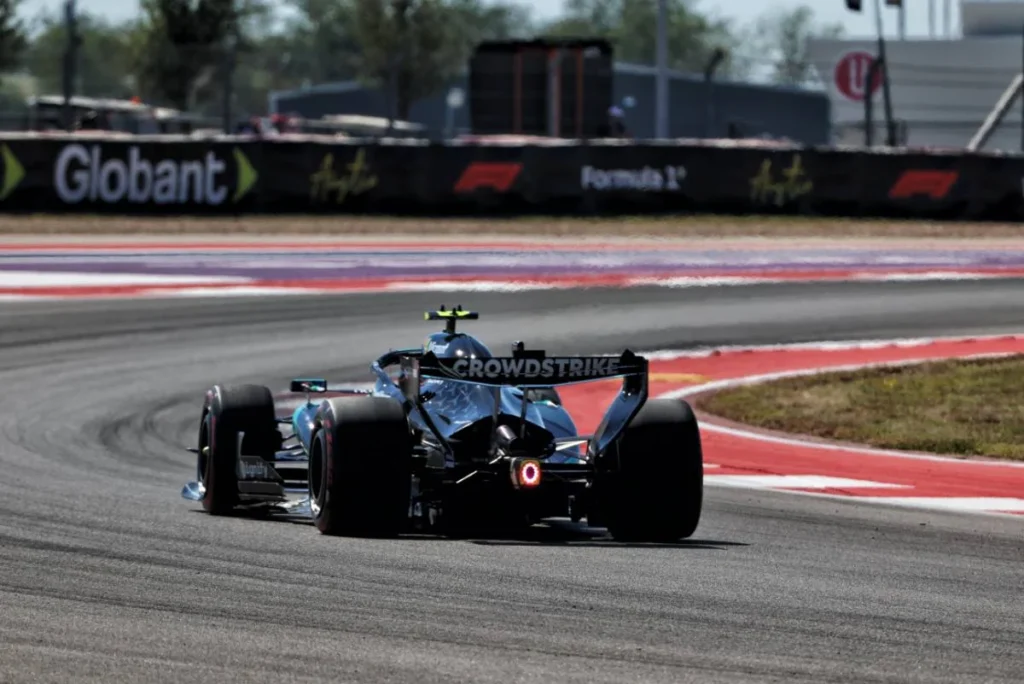
The Formula 1 paddock descended upon the high-stakes, technical challenge of the Circuit of the Americas (COTA) this weekend, and for the Mercedes-AMG Petronas F1 Team, the narrative was one of calculated progress. While the Silver Arrows did not dominate the timesheets in a headline-grabbing display of raw speed, their performance during Friday’s practice sessions told a more nuanced story. By focusing on long-run consistency and refining their latest aerodynamic upgrade package, Mercedes has positioned itself as a legitimate dark horse in what is shaping up to be a ferocious four-way battle for supremacy.
The State of Play: A Promising Start in Texas
As the sun beat down on the undulating Texas asphalt, Mercedes began their weekend with a clear objective: understanding the impact of their latest technical developments. The W17, now featuring a unified specification across both cars, demonstrated a marked improvement in balance and tire management compared to the initial setup used during the morning’s Free Practice 1 (FP1).
For the team, the primary takeaway from Friday was not the individual lap times, but the trajectory of the car’s behavior. Both Kimi Antonelli and George Russell noted that while the car was far from perfect in the opening hour, the subsequent adjustments made by the engineering team allowed for a significant step forward by the time FP2 concluded. This ability to react and refine the setup in real-time is a hallmark of a team that has regained its developmental momentum.
Chronology of a Productive Friday
The day began with a degree of friction. In FP1, the W17 struggled to find a consistent operating window, with both drivers complaining of a lack of balance that made attacking the technical sector of the COTA layout a difficult proposition. The car felt nervous, struggling with the high-speed changes of direction that define the first sector of the track.
However, the turnaround in FP2 was tangible. Antonelli, who secured the second-fastest time in the second session, was quick to credit the team’s diagnostic work between the sessions. "We didn’t have the best start in FP1," the Italian rookie reflected. "The balance was quite far off, but we made some meaningful changes for the afternoon. It was a good step forward, and the car felt much more responsive."
For George Russell, the day was more of a mixed bag. Finishing fifth overall, the Briton was fast, but his rhythm was hampered by external factors. After having a competitive lap time deleted for exceeding track limits—a common occurrence given the strict policing of the COTA kerbs—Russell suffered a minor error in the first sector on his subsequent attempt. Despite the lack of a "perfect" headline lap, Russell remained bullish about the car’s direction, confirming that the upgrades introduced are performing exactly as the simulations predicted.
Supporting Data: The Aerodynamic Gains
The success of this weekend hinges on the new aerodynamic package, which was first trialed with encouraging signs at the Singapore Grand Prix. By bringing both cars to the same specification, Mercedes has effectively streamlined its R&D process. There is no longer a "split-development" approach; the data gathered by Antonelli is now directly applicable to Russell’s car, and vice versa.
The data from the long runs—where fuel loads are high and the cars are tested for race-day degradation—paints a picture of a razor-thin margin between the top four teams. According to performance analysts, the gap between the lead Ferraris, the Red Bull of Max Verstappen, the McLarens, and the Mercedes duo is often measured in the single-digit tenths of a second. This indicates that the race will likely be won not just by pure power, but by the team that can best manage its tires over the 56-lap distance.
Official Perspectives: The Strategy of Tire Preservation
Bradley Lord, Mercedes’ Deputy Team Principal, provided critical insight into the team’s strategic focus for Sunday. He highlighted the third sector of the Circuit of the Americas as the "make or break" zone for the entire race weekend.
"If you can keep your rear tires alive and functioning correctly through that final sector, it opens up the entire strategic playbook," Lord explained. "The track is incredibly demanding on the rear axle. If you burn them up early, you lose your ability to push, and you become a sitting duck. We are seeing a hierarchy that is incredibly compressed, and we’re talking about one or two tenths of a second separating the front-runners. It is going to come down to the wire."
Lord’s comments underscore a shift in F1 philosophy: in an era of such tight competition, the ability to protect the rear end of the car—which is notorious for overheating at Austin—will be the deciding factor in whether a driver can mount an overtake or defend a position in the closing stages of the Grand Prix.
Implications: The Title Race and Team Dynamics
Amidst the technical discussions, the elephant in the room remains the championship standings. With the season entering its final act, the prospect of an Antonelli title charge has become a point of intense media scrutiny. However, the Mercedes hierarchy is keen to keep expectations grounded.
"We aren’t looking at the math right now," Lord stated when asked about the possibility of clinching the title this weekend. "Mathematically, there are scenarios, but they require things to happen that are out of our control—specifically, George finishing ninth or lower. That isn’t a scenario we want to see. We are focused on maximizing our points and ensuring both drivers have the equipment to fight for the win."
The team is clearly prioritizing internal harmony and performance maximization over the pursuit of a specific championship narrative. By focusing on the "here and now"—the intricacies of the COTA track and the specific setup needs of the W17—Mercedes is attempting to insulate its drivers from the mounting pressure of the title fight.
Looking Ahead: The Challenge of Qualifying
As the team prepares for Saturday’s qualifying session, the margin for error remains virtually non-existent. Russell’s Friday experience serves as a cautionary tale: track limits at COTA are unforgiving, and the density of the grid means that a single mistake, or a minor imbalance in sector one, can be the difference between starting on the front row or buried in the mid-pack.
Mercedes has proven that the W17 has the pace. The upgrades have provided the downforce and stability necessary to challenge the current leaders. However, the true test will be whether they can translate the pace found in the long runs into the high-intensity, one-lap dash of qualifying.
The team enters Saturday with a sense of cautious optimism. The car is fundamentally sound, the drivers are confident, and the technical package is delivering on its promise. If the team can maintain its focus on tire preservation and execute a clean qualifying performance, the prospect of a Mercedes victory in Austin is not just a hope, but a tangible possibility.
In a season that has defied expectations, the Silver Arrows have found their rhythm at the perfect time. Whether this momentum is enough to bridge the final gap to the championship frontrunners will be determined under the intense Texas heat this Sunday. For now, the message from the Mercedes garage is clear: they are back in the fight, and they are here to challenge for every point on the table.
