Beyond Hydrogen: Inside Toyota’s Radical Experiment to Power Cars with Ammonia
Ammar Sabilarrohman
October 15, 2026 • 7 MIN READ
Main Facts: The Ammonia Breakthrough in Automotive Engineering
The automotive industry has long grappled with the inherent contradictions and infrastructural bottlenecks of hydrogen mobility. While hydrogen offers zero tailpipe emissions and rapid refueling, it remains encumbered by a trifecta of hurdles: prohibitive manufacturing costs, high technological complexity, and an almost entirely absent global distribution network. Consequently, many legacy automakers—most notably Stellantis, which shuttered its hydrogen fuel cell operations—have scaled back or abandoned their ambitions in this sector.
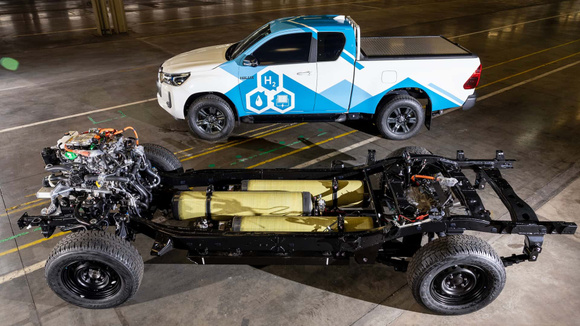
Yet, a stubborn vanguard comprising brands like Hyundai, BMW, and Toyota continues to swim against the current. Toyota, in particular, refuses to let the hydrogen dream die. Rather than retreating, the Japanese automotive giant is pushing the envelope even further, exploring radical alternatives to overcome the single greatest obstacle plaguing hydrogen vehicles: high-pressure, expensive, and structurally constrained storage tanks.
Toyota’s answer to this dilemma is as unorthodox as it is fascinating: using ammonia ($textNH_3$) as a chemical carrier to transport hydrogen safely and efficiently, then cracking it on board to feed a modified internal combustion engine.
Instead of burning ammonia directly—an approach tested by a handful of startups that severely compromises engine efficiency and creates toxic byproducts—Toyota has engineered a sophisticated onboard catalytic cracker. This system breaks down liquid ammonia into its constituent elements (nitrogen and hydrogen) before the hydrogen is ever introduced to the combustion chambers. By leveraging a modified three-cylinder Daihatsu engine, Toyota is attempting to forge a middle ground: retaining the mechanical reliability and familiarity of traditional internal combustion while eradicating carbon dioxide ($textCO_2$) emissions from the tailpipe.
Chronology: The Evolution of Toyota’s Alternative Fuel Strategy
To understand how Toyota arrived at an ammonia-powered internal combustion engine, it is necessary to trace the chronology of the brand’s relentless pursuit of alternative energy vectors over the past three decades.
1990s – The Genesis of Hybrid and Fuel Cell Research: Toyota initiates serious research into zero-emission powertrains, culminating in the development of the Toyota Prius hybrid in 1997. Concurrently, engineers begin parallel development on Polymer Electrolyte Membrane (PEM) fuel cells.
2014 – The Commercialization of Hydrogen: Toyota launches the Mirai, one of the world’s first mass-produced hydrogen fuel cell electric vehicles (FCEVs). Despite critical acclaim for its engineering, the Mirai struggles commercially due to a catastrophic lack of hydrogen refueling infrastructure and the high cost of carbon-fiber high-pressure storage tanks.
2021 – The Combustion Alternative: Recognizing that fuel cells are not universally viable for all vehicle segments, Toyota pivots toward hydrogen combustion engines. The company enters a modified Corolla fueled by compressed hydrogen in Japanese endurance racing series to test the limits of thermal hydrogen engines under extreme stress.
2023–2024 – The Regulatory and Economic Squeeze: Stricter global environmental regulations and mounting economic pressures force competitors like Stellantis to abandon hydrogen projects. Meanwhile, consumer adoption of FCEVs stagnates, and the lifespan and safety certification costs of high-pressure hydrogen tanks become increasingly burdensome.
Late 2024–Present – The Ammonia Pivot: Seeking a way to bypass the extreme containment requirements of gaseous or liquid hydrogen, Toyota engineers turn their attention to ammonia. By utilizing a compact catalytic cracker integrated into a lightweight kei-car engine platform, Toyota initiates preliminary bench-testing of an ammonia-to-hydrogen cracking powertrain.
Supporting Data: The Chemistry and Mechanics of the Ammonia Powertrain
The logistical nightmares of storing pure hydrogen at pressures reaching 700 bar are well-documented. Hydrogen atoms are the smallest in the universe, making them prone to embrittling metallic tanks and leaking through microscopic fissures. Ammonia, by contrast, is a compound composed of one nitrogen atom and three hydrogen atoms ($textNH_3$). It is liquid at relatively modest pressures (around 10 bar at room temperature) or at temperatures below -33°C at atmospheric pressure. This makes it vastly easier and cheaper to store and transport than pure hydrogen.
How the Toyota System Operates:
Onboard Storage: Ammonia is stored in liquid form within tanks that require significantly less reinforcement and lower pressures than traditional 700-bar hydrogen tanks.
Thermal Catalytic Cracking: During cold starts, an electric heating element brings a dedicated catalytic converter up to an operating temperature of approximately 250°C. Once the engine is running, waste heat from the exhaust maintains this temperature naturally.
The Chemical Separation: As liquid ammonia passes through the heated catalyst, it decomposes entirely into its base elements:
$$text2NH_3 rightarrow textN_2 + text3H_2$$
Combustion: The pure hydrogen gas ($textH_2$) extracted from the ammonia is immediately fed into a modified 658 cm³ three-cylinder engine sourced from subsidiary Daihatsu. The nitrogen ($textN_2$) is safely vented into the atmosphere (where it naturally makes up roughly 78% of ambient air).
Emissions Profile: Because the fuel source entering the combustion chamber is exclusively hydrogen, the engine produces zero $textCO_2$ emissions.
Despite these technical achievements, the thermodynamic and physical realities present steep efficiency trade-offs. Converting electricity into green hydrogen, combining that hydrogen with nitrogen to synthesize ammonia, transporting it, and then cracking it back into hydrogen on board the vehicle incurs significant round-trip energy losses.
Official Responses and Industry Perspectives
Reactions across the global automotive sector to Toyota’s ammonia experiment range from cautious scientific fascination to outright skepticism regarding commercial viability.
A senior powertrain engineer close to Toyota’s research division, speaking on condition of anonymity, defended the company’s long-term vision:
"We cannot put all our eggs in the battery-electric basket, nor can we surrender to the infrastructural dead-end of pure hydrogen tanks. Ammonia is an abundant global commodity used heavily in agriculture. By developing a catalytic cracker that operates within the confines of an ordinary internal combustion architecture, we are proving that the underlying mechanics of the automobile can be salvaged while achieving deep decarbonization."
Conversely, market analysts and rival manufacturing executives point to the glaring logistical void. A spokesperson for a major European automotive group noted:
"The refueling infrastructure for battery-electric vehicles is expanding, albeit slowly. The infrastructure for hydrogen is microscopic. The infrastructure for ammonia as a consumer automotive fuel? It does not exist, outside of specialized industrial chemical plants and ports. Asking consumers to pump a toxic, pungent chemical like ammonia into personal passenger cars is an insurmountable consumer-acceptance hurdle."
Environmental watchdogs have also raised valid concerns. While burning extracted hydrogen yields zero carbon emissions, handling ammonia—a hazardous, corrosive, and toxic substance—presents unprecedented safety risks in the event of a vehicular collision. A localized rupture of an ammonia tank would pose immediate toxicological hazards to passengers and first responders, far exceeding the risks associated with gasoline or even high-pressure hydrogen, which rapidly dissipates into the upper atmosphere.
Implications: The Future of Mobility and Industrial Realities
Toyota’s exploration of ammonia-cracking internal combustion engines carries profound implications for the future of global transportation, energy policy, and industrial manufacturing.
1. The Survival of Internal Combustion
For enthusiasts and traditionalists, Toyota’s research represents a potential lifeline for the internal combustion engine (ICE). By demonstrating that a conventional three-cylinder block can run cleanly on hydrogen extracted from a liquid chemical carrier, Toyota is keeping the mechanical soul of the automobile alive in a post-fossil-fuel world.
2. Heavy-Duty vs. Passenger Car Applications
While passenger cars fueled by ammonia remain a distant, highly speculative pipedream, the industrial and heavy-duty sectors may tell a different story. Maritime shipping and heavy freight locomotives are already actively investigating ammonia as a primary marine and rail fuel because centralized refueling depots at commercial ports and industrial rail yards bypass the retail distribution nightmare of consumer gas stations. Toyota’s technological breakthroughs in catalytic cracking could easily find their first true commercial home not in a Daihatsu kei-car, but in heavy commercial transport.
3. The Economic and Infrastructural Barrier
Ultimately, the grand vision of an ammonia-powered society faces monumental macroeconomic hurdles. Producing "green" ammonia requires green hydrogen (itself produced via water electrolysis using renewable electricity), which must then be synthesized via the Haber-Bosch process—an energy-intensive industrial procedure. Adding multiple conversion steps to an energy chain inevitably degrades overall well-to-wheel efficiency.
Toyota’s ammonia initiative is a masterclass in out-of-the-box engineering. It successfully solves the nightmarish storage and transport constraints of pure hydrogen by leveraging a stable chemical carrier. Yet, as brilliant as the chemistry and mechanical packaging may be, the industrial reality remains stark. Without billions of dollars in new chemical refining infrastructure, specialized distribution networks, and stringent safety frameworks, the ammonia car will remain a fascinating scientific experiment confined to Toyota’s advanced R&D laboratories for many years to come.