

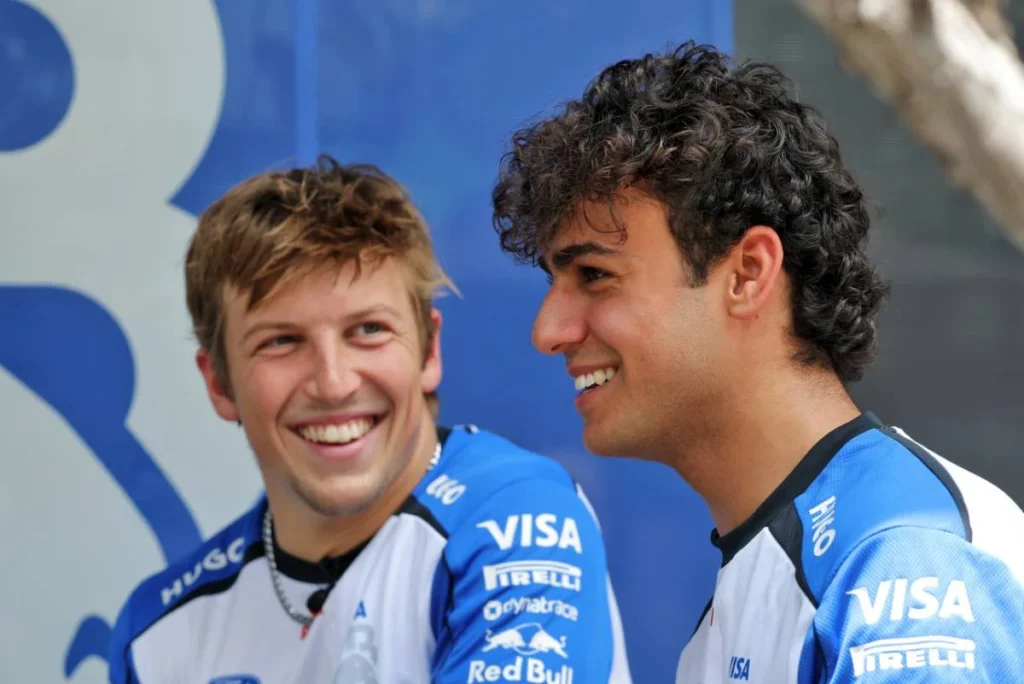
The Circuit of the Americas (COTA) in Austin, Texas, is renowned for its undulating tarmac, technical complexity, and the unique challenges it presents to both machine and driver. During the qualifying session for this year’s United States Grand Prix, the Racing Bulls (VCARB) team showcased more than just raw technical pace. While their VCARB 03 chassis proved to be a formidable contender throughout the weekend, it was an unorthodox, altruistic strategic maneuver that dominated the paddock conversation.
In a display of pure team synergy, Liam Lawson voluntarily opted to abandon his final flying lap in Q3, effectively gifting his teammate, Arvid Lindblad, the opportunity to maximize his own position. This decision, though counter-intuitive for a driver chasing personal glory, was a calculated move to mitigate the damage caused by a pre-existing engine penalty hanging over the young Briton.
The Context: A Race Against the Grid
The narrative began well before the cars hit the track on Saturday. Arvid Lindblad, showing immense potential in his debut season, found himself facing a five-place grid penalty due to the installation of additional power unit components. In the ruthless theater of Formula 1, where every millisecond dictates the starting order, such a setback is often catastrophic.
Racing Bulls recognized that for Lindblad to have any hope of salvaging a points-scoring position on Sunday, he needed to start as high up the order as possible, even before the penalty was applied. The engineering and strategic brain trust at the Italian outfit formulated a contingency plan: if both VCARB 03 machines managed to fight their way into the top ten—the final shootout of Q3—Lawson would sacrifice his own run to prioritize his teammate.
The plan was not merely theoretical. As the dust settled on the final session, the reality of the grid penalty became the primary driver of team behavior. Lawson’s decision to stay in the garage during the final moments of Q3 was a rare, high-stakes example of prioritizing the team’s collective outcome over individual accolades.
Chronology of a Strategic Shift
The journey to this moment was characterized by a series of impressive sessions. Lawson had been the benchmark for the team throughout the weekend. His efficiency was particularly notable in Q1, where he demonstrated exceptional car management by advancing to the next stage using only a single set of tires. This conservation of rubber not only set the tone for his own performance but also afforded the team a tactical cushion for the remainder of the qualifying hour.
As the session progressed, both drivers showed remarkable consistency, securing their spots in the final ten. It was at this juncture that the pre-arranged strategy shifted into gear. While other teams were burning through fresh soft compounds in a frantic bid for pole, the VCARB garage remained focused on a different metric.
"We had decided that if both cars reached Q3, given Arvid’s penalty, I wouldn’t run," Lawson explained in the post-session media briefing. "Even if we qualified ahead of some of the front-running cars, the reality is that we aren’t truly racing them on Sunday. We needed to ensure that Arvid started as high as he possibly could to give him the best chance of recovering from the penalty."
By opting not to set a time in Q3, Lawson finished tenth, while Lindblad secured ninth. Once the five-place grid penalty is applied to Lindblad’s classification, he will drop to the fourteenth position. Conversely, Lawson will inherit the ninth-place starting spot, effectively moving up the grid while carrying a fresh set of tires that remained untouched during the final segment of qualifying.
Supporting Data and Performance Analysis
The performance of the VCARB 03 throughout the qualifying sessions suggests that the team has made significant strides in their aerodynamic and mechanical balance. The ability to push through Q1 with minimal rubber usage is a testament to both the car’s inherent efficiency and the drivers’ ability to extract maximum grip from the COTA surface.
For Lindblad, the session was a journey of self-discovery and resilience. By his own admission, the weekend had been an uphill struggle. "I was slower than Liam all weekend," the Briton admitted. "In Q1, he was eight or nine tenths of a second faster than me. It was a massive gap to close. But the beauty of this sport is that it only matters when the lights go out in the final segment. I managed to put everything together when it counted, hit my marks, and extracted the maximum potential from the car."
The telemetry from the session validates Lindblad’s claim. His progression through the corners, particularly the high-speed change of direction in the first sector, showed a marked improvement compared to his earlier runs. This improvement, coupled with the strategic sacrifice from his teammate, provides a compelling case for the team’s current upward trajectory.
Official Responses and Team Dynamics
The decision to bench a driver during the most critical part of a qualifying session is rarely taken lightly. It requires a high level of trust between the two drivers and a unified vision from the pit wall.
Lawson’s reflections on the incident highlight a maturity often missing in the hyper-competitive world of single-seater racing. While he acknowledges the personal frustration of not being able to showcase his full pace—having felt he had the potential to challenge higher up—he remains pragmatic. "It is a shame, because I had built up such momentum," Lawson said. "I had tires saved, and I felt like we had a genuine chance at a stronger position. But the team’s objective is to score as many points as possible. If sacrificing my final run helps us achieve a higher collective result, it is the right thing to do."
The team’s leadership echoed this sentiment, emphasizing that the focus is on the championship standings rather than individual grid positions. By ensuring Lindblad starts from a more favorable position despite his penalty, they are effectively protecting their race strategy for Sunday.
Implications for Sunday’s Grand Prix
As the paddock prepares for the race, the implications of this qualifying strategy are twofold.
First, there is the "Lawson Advantage." By not running in Q3, the New Zealander enters the Grand Prix with a tire bank that is in significantly better condition than his rivals who participated in the full shootout. With a race pace that looked promising during Friday’s long-run simulations, Lawson is perfectly positioned to hunt for a top-eight finish. The tactical usage of his fresh rubber could prove decisive in the final stint of the race, where tire degradation at COTA is notoriously high.
Second, there is the "Lindblad Recovery." Starting from fourteenth is far from ideal, but as the young Briton noted, the Circuit of the Americas is a track that rewards bravery and precise braking. With long DRS zones and the iconic, wide-entry Turn 1, overtaking is a genuine possibility. Lindblad’s optimism is not unfounded; he has shown he can extract pace under pressure, and he will be eager to prove that his ninth-place qualifying performance was no fluke.
Conclusion: A Culture of Collaboration
The events at the U.S. Grand Prix highlight a maturing culture within the Racing Bulls team. In an era where the "number one driver" dynamic often overshadows team cohesion, the VCARB approach offers a refreshing alternative. By viewing their two-car entry as a single strategic unit, they have maximized their chances of success in a highly competitive midfield.
Sunday’s race will be the ultimate test of this philosophy. Whether or not this sacrifice yields points, the team has already achieved a victory in terms of internal morale and strategic sophistication. Lawson’s willingness to step back and Lindblad’s ability to step up serve as a blueprint for how a team can navigate the complexities of modern Formula 1 regulations.
As the cars line up on the grid, the focus will undoubtedly shift from the politics of qualifying to the intensity of the race. However, for those watching closely, the story of the U.S. Grand Prix will remain one of calculated sacrifice, team-first mentality, and the relentless pursuit of progress. Racing Bulls are not just racing against the clock; they are racing with a strategy that balances the needs of the individual with the ambitions of the team. Whether that balance pays off in the form of a double-points finish remains to be seen, but one thing is certain: they have arrived in Texas prepared to fight as one.
