

The history of Formula 1 is often written in the ink of heroic deeds and the sweat of championship battles. Yet, perhaps the most profound chapter in the sport’s lore was written not by a triumph of speed, but by an act of deliberate, calculated withdrawal. On October 24, 1976, amidst the mist-shrouded slopes of Mount Fuji, Niki Lauda made a decision that transcended the pursuit of a world title. By walking away from his Ferrari cockpit in the face of a literal deluge, the Austrian icon redefined the relationship between the driver, the machine, and the lethal business of professional motor racing.
The Setting: A Deluge at the Foot of the Mountain
The Fuji Speedway, a track carved into the marshy, unforgiving terrain at the base of Japan’s iconic volcano, was not merely wet on that Sunday in October; it was submerged. As storm clouds swallowed the peak and descended upon the circuit, the main straight—a 1.5-kilometer stretch of asphalt—transformed into an inland sea. Sheets of water cascaded across the track, forming stagnant pools of such depth that track sweepers worked in futile circles, unable to stem the tide.
By mid-afternoon, the fog rolling in from the Pacific Ocean had reduced visibility to less than fifty meters. Yet, in the pits, the engines roared in a discordant, ominous chorus. Bernie Ecclestone, then orchestrating the nascent global television rights for the Formula One Constructors’ Association (FOCA), found himself locked in a high-stakes standoff with the Japanese broadcaster TBS. The stakes were absolute: the grandstands were overflowing, sponsors had invested fortunes, and the climax of the season-long duel between Niki Lauda and McLaren’s James Hunt demanded a conclusion before the global lens.
Chronology of a Crisis: The 1976 Fuji Grand Prix
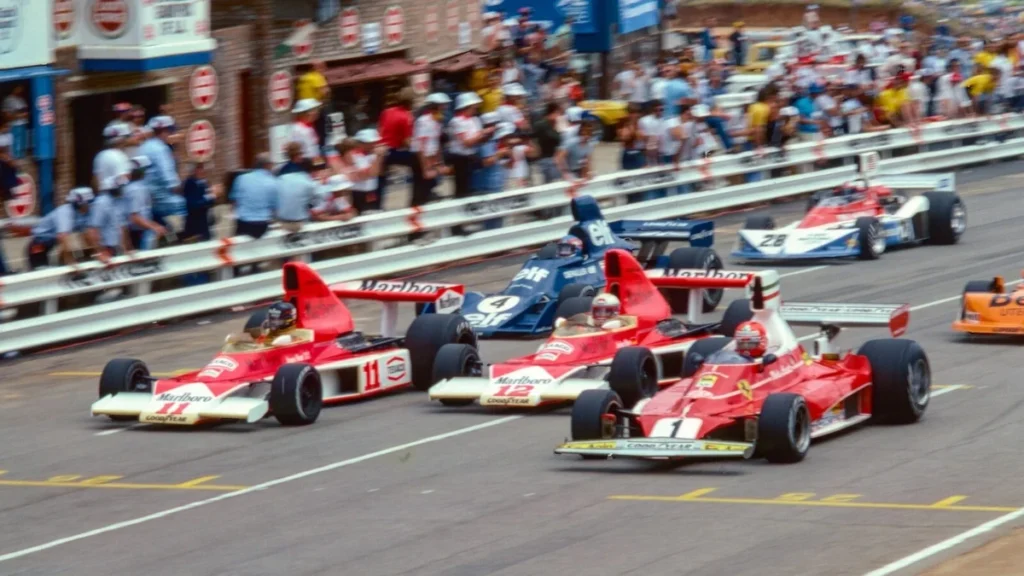
The tension began long before the engines ignited. In the early morning hours, the drivers gathered in the circuit’s prefab structures, a rare moment of unified consensus among the gladiators of the era. Led by Lauda, Hunt, Emerson Fittipaldi, and Carlos Pace, the cohort agreed upon a silent pact: they would start the race to satisfy the television obligations and the spectators, but after a lap or two, they would pull into the pits in unison, effectively forcing the hand of race control to call a red flag.
However, as the lights turned green, the pact dissolved under the pressure of competition. Mario Andretti’s Lotus and James Hunt’s McLaren M23 surged into the first turn with reckless abandon, creating a blinding wall of spray that enveloped the field. Teddy Mayer, the McLaren team principal, recognized the moment of truth. Seeing the race proceed despite the lethal conditions, he signaled Hunt to stay out. The world championship was on the line, and the British driver, trailing by three points, needed every position he could secure.
For Lauda, sitting in his Ferrari 312 T2, the situation was far more visceral. Only eighty-four days earlier, he had received the last rites in a Mannheim hospital, his body ravaged by third-degree burns following his harrowing crash at the Nürburgring. While his return to racing at Monza had been a testament to human willpower, Fuji presented a physiological barrier he could not overcome. The skin grafts taken from his thighs to reconstruct his face had failed to restore his tear ducts. Without the ability to blink, his eyes were perpetually exposed to the moisture, and under his visor, the mixture of his own breath and the fine mist created a milky fog that blinded him.
The Refusal: A Man Against the Machine
By the second lap, Lauda was submerged in the spray, unable to discern the track from the surrounding guardrails. At speeds exceeding 250 km/h, his Ferrari’s flat-12 engine struggled to breathe, its intake scoops gulping water and causing intermittent ignition failures, while the car floated in a constant state of aquaplaning. The Austrian, who had stared death in the face at the Nürburgring, refused to play Russian roulette.
He steered his scarlet machine into the pits. As his mechanics rushed forward, expecting a tire change or a mechanical fix, Lauda remained motionless. He methodically unbuckled his six-point harness, removed his steering wheel, and stepped out of the cockpit.
Daniele Audetto, the Ferrari sporting director, and the legendary engineer Mauro Forghieri descended upon him, desperately trying to save face before the international media. They pleaded with him to claim an electrical fault, a convenient lie to explain his retirement. Lauda’s response was ice-cold and final: he discarded his helmet and stated, "The track is a lake. It is madness. My life is worth more than a title." Shortly thereafter, Emerson Fittipaldi and others followed suit, choosing safety over the spectacle.
The Fallout: The Wrath of the Commendatore
While James Hunt fought through the chaos to finish third—securing the title by a single, agonizing point—Lauda was already on his way to Tokyo. Sitting in the back of a sedan, he listened to the race’s conclusion on the radio alongside his wife, Marlene, entirely devoid of bitterness.
The true seismic shock, however, occurred in the hallowed halls of Maranello. For Enzo Ferrari, the 81-year-old patriarch, the prancing horse was an object of veneration that surpassed human limitations. To the "Commendatore," Lauda’s withdrawal was not an act of survival; it was an act of treason. By the following morning, Ferrari had already reached out to Carlos Reutemann, effectively replacing the reigning champion.
Though Lauda would return to win the championship with Ferrari in 1977, the bridge had been burned. His eventual departure from the team before the season’s end was the final act of a man who had proven that even the most powerful automotive empire could not own his mortality.
Supporting Data: The Technical Failure of 1976
The tragedy of the Fuji disaster was compounded by the limitations of the era’s technology. In 1976, Goodyear provided only one specification of rain tire. Unlike modern tires, which feature deep, directional drainage channels capable of clearing over 60 liters of water per second, the tires of the mid-70s featured primitive block patterns on a near-flat tread.
The track surface at Fuji exacerbated the danger. Built with an older generation of asphalt lacking porous drainage, the water had nowhere to go. At speeds as low as 160 km/h, the cars were effectively sledding on a liquid film. Furthermore, as the rain subsided in the final third of the race, the soft-compound tires on the drying line began to disintegrate. James Hunt himself was nearly a victim of this; a front tire disintegrated at full speed just four laps from the finish, a chilling reminder of the fragility of the equipment that the organizers had forced the drivers to push to the limit.
Implications: A New Era for Driver Safety
The events at Fuji served as a brutal, necessary awakening for the sport. Lauda’s stance became the catalyst for the professionalization of safety standards in Formula 1. It marked the moment the "gladiatorial" era began to give way to the "professional" era, where drivers were no longer mere pawns in a commercial game but participants with the agency to demand safe working conditions.
In the decades that followed, the influence of Lauda’s decision resonated through every safety improvement—from the development of circuit-specific drainage and high-tech rain tires to the empowerments of the Grand Prix Drivers’ Association (GPDA). By choosing his life over a trophy, Niki Lauda didn’t just walk away from a race; he saved the sport from its own worst impulses. He reminded the world that the most important victory is the one that allows you to live to race another day.
