

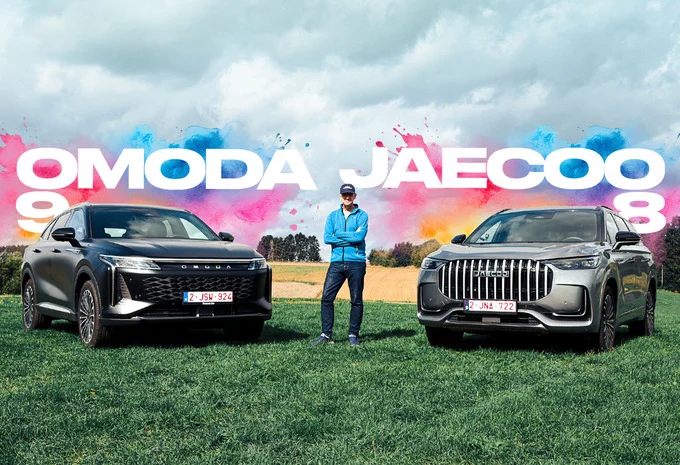
The landscape of the European automotive market is undergoing a seismic shift. For decades, the D-SUV segment—dominated by stalwarts from Germany, Japan, and South Korea—has been considered the fortress of the established order. However, the 2026 arrival of the Omoda 9 and Jaecoo 8, the spearheads of Chinese industrial giant Chery, signals a new, aggressive phase in the global automotive arms race. In this comprehensive analysis, we put these two siblings to the test, evaluating whether their high-tech, high-value proposition is enough to dethrone the industry incumbents.
1. Main Facts: A Shared Pedigree, Two Distinct Missions
At the heart of the Omoda 9 and Jaecoo 8 lies a sophisticated, shared technical foundation. Both vehicles measure approximately 4.80 meters in length, placing them squarely in the heart of the D-SUV segment. They utilize an advanced plug-in hybrid (PHEV) architecture, featuring a high-voltage battery system and permanent all-wheel drive (AWD) as standard.
While they share a DNA pool, Chery has clearly delineated their market roles:
- The Omoda 9 is marketed as a "lifestyle" SUV-coupe. It focuses on aerodynamic aesthetics, digital-first ergonomics, and a high-performance output designed to capture the attention of tech-savvy, design-conscious buyers.
- The Jaecoo 8 adopts a more "statutory" and robust approach. With its boxier silhouette, it is positioned as a serious family hauler, capable of accommodating seven passengers, aimed at the traditional SUV market that prioritizes utility and presence over sloping rooflines.
2. Chronology: The Rapid Ascent of Chery
The emergence of Omoda and Jaecoo in Europe is not a coincidence; it is the culmination of a decade-long strategic pivot by Chery.
- 2023: Chery announces its intent to penetrate the European market with specific, brand-differentiated strategies.
- 2024: Pilot testing of the PHEV platforms occurs across various European climates to ensure "European-grade" handling and thermal management.
- 2025: Official certification for European road use is granted, with the unveiling of the production-ready Omoda 9 and Jaecoo 8 at major international motor shows.
- 2026: Commercial launch in the Benelux region and wider Europe, marking the first time these models face direct competition from the likes of Volkswagen, Hyundai, and Toyota.
3. Design and Practicality: Style vs. Utility
The Exterior Philosophy
The Omoda 9 leans into the current trend of the "sporty coupe-SUV." Its sloping roofline, flush door handles, and aggressive front-end lighting signature give it a futuristic, almost concept-car aesthetic. It is a vehicle designed to be seen.
Conversely, the Jaecoo 8 is a masterclass in "rugged sophistication." Its vertical front grille and squared-off rear end evoke a sense of permanence and security. Where the Omoda 9 is a runway model, the Jaecoo 8 is an executive sedan built for the wilderness.
Interior Ergonomics and Quality
Entering the cabin, the "cheap Chinese import" stigma evaporates instantly. Both models utilize a blend of premium materials—soft-touch plastics, high-grade neoprene, and synthetic leather—that rivals, and in some cases surpasses, the entry-level premium offerings from Europe.
The digital cockpit is the centerpiece. Both vehicles feature massive, high-definition curved displays that integrate infotainment, vehicle telemetry, and climate control. The Omoda 9’s interface is slightly more fluid, reflecting its "tech-first" DNA, whereas the Jaecoo 8 offers a more tactile experience with physical shortcuts that will appeal to traditionalists.
4. Supporting Data: The PHEV Performance Matrix
The powertrain shared by both models is a marvel of efficiency. The 1.5-liter turbocharged engine is paired with a powerful electric motor, delivering a combined output of 537 hp in the Omoda 9 and 429 hp in the Jaecoo 8.
Performance Comparison:
| Feature | Omoda 9 (PHEV) | Jaecoo 8 (PHEV) |
|---|---|---|
| Combined Power | 537 hp | 429 hp |
| Drivetrain | AWD | AWD |
| Seating Capacity | 5 | 7 |
| Suspension | Sport-tuned | Comfort-tuned |
| Base Price | €52,900 | €54,900 |
On the road, the transition between electric and combustion power is seamless. The regenerative braking system is well-calibrated, avoiding the "grabby" feel that plagues many early-generation hybrids. The silence in the cabin is particularly impressive, thanks to extensive sound-deadening measures in the wheel arches and firewall.
5. Official Responses and Industry Context
In statements provided to Moniteur Automobile, Chery representatives emphasized that their goal is not merely to compete on price, but to "redefine the value proposition."
"We are offering a level of standard equipment that our European competitors reserve for their top-tier trim levels," says a brand spokesperson. "When a customer buys an Omoda 9, there are no ‘hidden’ costs for essential features like heated seats, heads-up displays, or advanced driver-assistance systems (ADAS). Everything is included."
This "all-in" pricing strategy has sent shockwaves through the market. When compared to a Volkswagen Tayron eHybrid, the price gap is startling—up to €15,000 for a similarly equipped vehicle. This pricing strategy has placed established manufacturers in a defensive position, forcing them to justify their premiums through brand heritage and resale value.
6. Implications for the Market
The arrival of the Omoda 9 and Jaecoo 8 marks the end of the era where Chinese vehicles were viewed as inferior. The implications for the European automotive landscape are twofold:
- Pressure on European Margins: Established manufacturers can no longer rely on the "price-to-feature" ratio to protect their market share. They must either lower prices or significantly enhance the technology packages in their mid-tier models.
- The Shift in Consumer Perception: By proving that Chinese engineering can meet the rigorous demands of European consumers—concerning both driving dynamics and material quality—Chery has cleared the path for a wave of new Chinese entrants.
Pros and Cons: A Summary
Points of Excellence:
- Value Proposition: Unbeatable feature-to-price ratio.
- Powertrain: Smooth, powerful, and capable of significant electric-only range.
- Build Quality: Exceptional fit and finish that challenges premium European standards.
- Comfort: Outstanding noise insulation and suspension tuning.
Points of Concern:
- Brand Maturity: Lack of established dealer networks compared to traditional marques.
- Resale Value: The long-term depreciation curve remains an unknown variable for consumers.
- Software Complexity: While impressive, the heavy reliance on digital interfaces may alienate older demographics.
7. Final Verdict
So, which should you choose?
If your life involves ferrying large groups, hauling sports equipment, or tackling long-distance family road trips, the Jaecoo 8 is the logical choice. Its extra seating capacity and robust build provide a sense of utility that the Omoda 9 simply cannot match.
However, for the majority of buyers, the Omoda 9 stands as the more compelling overall package. It is not only €2,000 cheaper but feels more coherent in its design and user interface. It captures the essence of what a modern, electrified SUV should be: fast, connected, and undeniably stylish.
The 2026 Omoda 9 and Jaecoo 8 are more than just new cars; they are a warning. The competition has arrived, and it is significantly better—and cheaper—than anyone anticipated. The European giants would be wise to take note; the dragon has not only entered the building, it has sat down at the head of the table.
