The Urban Revolution Returns: Smart Unveils the All-Electric #2 at the Paris Motor Show
Asep Darmawan
October 12, 2026 • 6 MIN READ
PARIS — Thirty years after the automotive world was introduced to an audacious concept that would fundamentally alter how we navigate the concrete jungle, Smart is going back to its roots. At the Paris Motor Show, the brand has officially pulled the covers off the Smart #2, a purely electric, ultra-compact two-seater designed to pick up precisely where the iconic Fortwo left off, albeit infused with three decades of technological advancement.
In an era where automotive landscapes are increasingly dominated by bloated SUVs and oversized crossovers, Smart’s latest offering feels both like a nostalgic throwback and a radical act of urban rebellion. It is a genuine two-seater designed explicitly for the city, engineered to conquer the tightest parallel parking spaces and weave through congested metropolitan arteries where everything else fails.
Main Facts: The Rebirth of a Micro-City Icon
The philosophy driving the Smart #2 is pure, unadulterated minimalism paired with maximum spatial efficiency. Measuring a mere 2,750 millimeters in length, the #2 remains faithful to the core DNA of the original Fortwo. Its wheels are pushed out to the absolute corners of the chassis, maximizing interior volume while retaining an infinitesimal footprint.
Design and Aesthetics
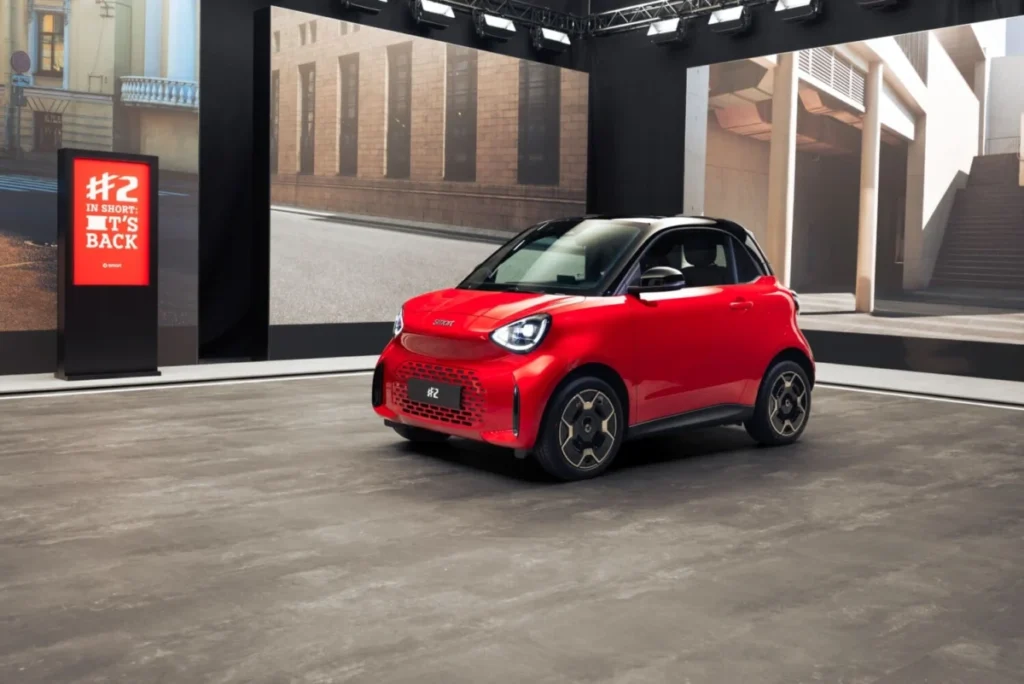
Visually, the #2 honors the heritage that made the Fortwo instantly recognizable across the globe. It retains the signature two-tone body scheme featuring a contrasting safety cell, complemented by friendly, rounded headlamps and a playful stance.
A standout feature is the Split Tailgate—a clever two-piece rear hatch allowing drivers to open just the glass upper section or the entire trunk depending on their cargo needs. In its launch colorway, dubbed "Laser Red," the vehicle pairs a vibrant red body with a contrasting black roof, giving the micro-car a mature yet undeniably youthful posture.
Interior Innovations
Inside, the cabin prioritizes digital clarity and ergonomic ingenuity. The dashboard houses a central 10.1-inch infotainment touchscreen, complemented by an 8.8-inch digital instrument cluster directly in front of the driver. Connectivity is comprehensive, featuring standard 4G, Wi-Fi, and Bluetooth, backed by an impressive eight-year connectivity package included out of the box.
Among its most charming interior details is the "Smart Pillar"—a dedicated integration zone on the dashboard engineered for mounting small objects and everyday gadgets, keeping them within arm’s reach during transit.
Chronology: Thirty Years of Evolution
To understand the magnitude of the Smart #2’s debut, one must look back at the trajectory of the brand and the changing tides of urban mobility.
1996–1994 (Conception): The micro-car concept originates through a partnership between Swatch founder Nicolas Hayek and Mercedes-Benz, aiming to bring watch-like customization and extreme compactness to personal transport.
1998 (The Launch): The original Smart City Coupé (later renamed the Fortwo) debuts in Europe, creating an entirely new automotive segment and polarizing opinions with its radical proportions.
2007–2014 (Generational Shifts): The second and third generations of the Fortwo arrive, introducing electric variants that gradually build a cult following among urban commuters seeking zero-emissions parking solutions.
2019 (The Pivot): Daimler and Chinese automotive giant Geely form a 50-50 joint venture, shifting the brand’s focus toward premium electric crossovers (yielding the larger #1 and #3 models) and seemingly spelling the end for the ultra-compact micro-car.
2026 (The Return): At the Paris Motor Show, Smart reverses course on its exclusive SUV strategy, proving that the market still desperately needs a dedicated two-seat city car. The Smart #2 breaks cover, combining Geely-era EV architecture with classic Smart proportions.
Supporting Data & Technical Specifications
Beneath its friendly exterior, the Smart #2 is a sophisticated piece of modern engineering. It is built upon an entirely new, proprietary platform known as the ECA (Electric Compact Architecture), tailored specifically for ultra-compact applications.
Powertrain and Performance
Motor Configuration: Rear-mounted electric motor delivering 60 kW (81 horsepower) and 130 Nm of torque to the rear wheels. This layout is a rare find in the modern micro-car segment, paired with wider rear tires for enhanced grip.
Battery & Range: Equipped with a 35.8 kWh LFP (Lithium Iron Phosphate) battery pack integrated neatly into the vehicle’s floor, yielding a targeted WLTP mixed-cycle range of 290 kilometers (approx. 180 miles).
Charging Capabilities: Supports DC fast charging up to 65 kW, allowing a 10% to 80% charge replenishment in just 20 minutes. AC home charging is rated at 11 kW. Furthermore, the vehicle supports V2L (Vehicle-to-Load) functionality, enabling users to power external electrical devices directly from the car.
Suspension: A groundbreaking five-link rear suspension setup—virtually unheard of in a vehicle of this size. Combined with the low center of gravity provided by the floor-mounted battery, it promises uncompromised ride stability across both urban cobblestones and highway stretches.
Trim Levels and Equipment
Europe will see the #2 launch across three core trim levels—Pure, Pure+, and Premium—alongside a limited launch edition:
Pure: Far from basic, it includes V2L, Pilot Assist, adaptive cruise control, and full LED headlights with automatic high beams as standard equipment.
Pure+: Adds the 11 kW AC onboard charger and heated driver’s seat.
Premium: Elevates luxury with a panoramic glass roof, synthetic leather heated seats, a Sennheiser 7-speaker premium audio system, and extended two-tone exterior color palettes.
Couture Edition: A strictly limited run of 999 units across Europe. It features Atelier White matte paint, a Platinum Gold roof, 16-inch Lyra wheels with gold accents, serialized badging, and a bespoke interior trim. Standard ADAS across all versions includes blind-spot monitoring.
Official Responses and Industry Perspectives
The resurrection of the two-seater format is a calculated strategic gamble for the brand, albeit one backed by strong consumer demand from urban loyalists.
"The smart #2 is much more than just an addition to our lineup," remarks Wolfgang Ufer, CEO of Smart. "It marks the return of a true icon, completely re-engineered for the realities of modern metropolitan environments. The fundamental idea of effortless urban mobility has not changed; however, the technology driving it has advanced by thirty years."
Industry analysts note that while the micro-car segment has faced profitability challenges in the past, the maturity of LFP battery supply chains and shared architectures within the Geely-Mercedes ecosystem finally make a car of this size economically viable as an electric vehicle.
Market Implications and Competitive Landscape
As Smart prepares to open order books following the Paris exhibition, pricing details remain under wraps. Given the vehicle’s extensive standard safety kit, advanced connectivity suite, and the brand’s upscale positioning under its German-Chinese joint venture, industry watchers expect the ticket price to sit comfortably above traditional, budget-focused generalist city cars.
The Loneliness at the Top: Competition
Paradoxically, the Smart #2 currently has no direct competitors.
With the discontinuation of the electric Fortwo and the Toyota iQ long out of production, no other major manufacturer currently produces a dedicated two-seater of this length. Instead, the #2’s peripheral rivals consist of larger, four-door electric city hatchbacks:
Fiat Grande Panda
Citroën ë-C3
Renault 5 E-Tech
Hyundai Inster
While all of these alternatives offer significantly more interior volume and seating capacity for four passengers, none of them possess the ability to slip perpendicularly into impossibly tight parallel parking spaces or navigate narrow alleyways quite like the Smart #2. For city dwellers plagued by parking scarcity, Smart has delivered precisely what was missing: the city car, reborn for the electric age.