Published: July 23, 2026
Topic: Road Safety, Automotive Insurance, Automated Traffic Enforcement (FVA)
Main Facts
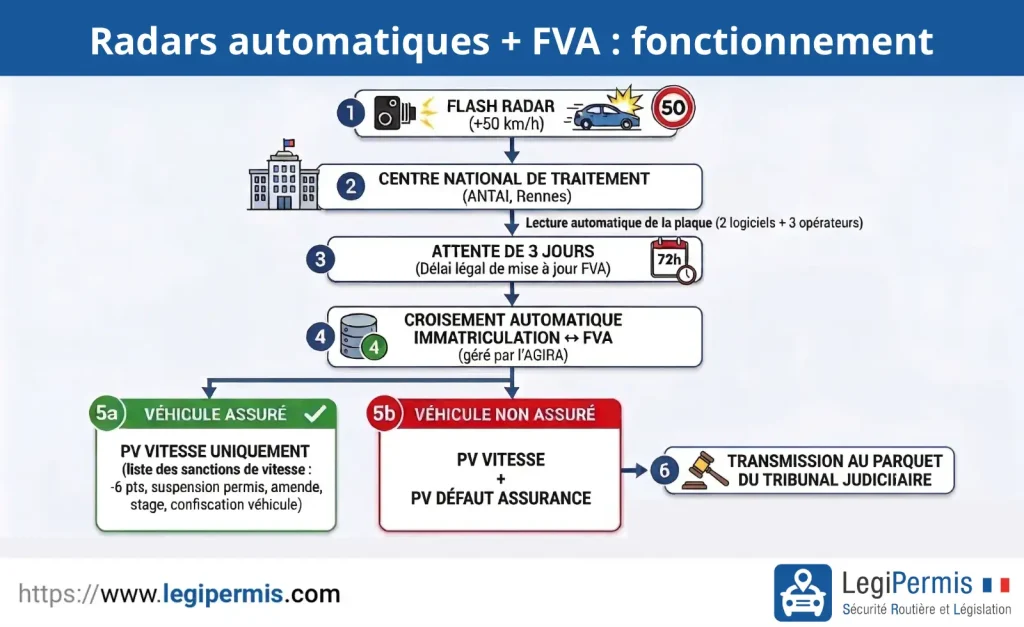
Since February 16, 2026, French automated speed cameras have been actively cross-referencing vehicle registration data with the national insurance database—the Fichier des Véhicules Assurés (FVA). In practice, this enforcement mechanism is currently triggered when a vehicle is flashed for a major speeding offense: specifically, an excess speed of at least 50 km/h over the legal limit, calculated using the adjusted speed after applying technical error margins.
When a vehicle is flagged under these conditions, the system checks whether it appears in the FVA. If the vehicle is absent from the database, it creates an immediate administrative suspicion of driving without insurance. However, authorities emphasize that this absence does not constitute definitive proof of a finalized offense or an automatic double sanction. Instead, it acts as a trigger for subsequent legal and administrative reviews handled by the public prosecutor’s office.
Vehicle owners now have direct access to verify their registration status in the FVA following an official decree issued on January 30, 2026. Because the traditional green insurance vignette was phased out on April 1, 2024, digital verification through the FVA has become the standard method for establishing compliance on French roads.
Chronology and Legal Milestones
Understanding how automated insurance checks became a reality on French roads requires tracing a decade-long legislative and operational timeline:
- November 18, 2016: The creation of the Fichier des Véhicules Assurés (FVA) is formally established under Law No. 2016-1547, managed by AGIRA (Association pour la Gestion des Informations sur le Risque en Assurance).
- December 28, 2016: Decree No. 2016-1955 explicitly includes driving without insurance in the list of infractions that can be detected via automated surveillance systems (Article R. 130-11 of the Highway Code).
- July 17, 2023: During the Interministerial Road Safety Committee (CISR), broad objectives regarding technological integration and the crackdown on uninsured driving are reinforced.
- April 1, 2024: The physical green insurance sticker (carte verte) is officially abolished in France, making the FVA the definitive digital reference for law enforcement.
- January 30, 2026: Decree NOR: ECOT2531628A is published, granting everyday drivers direct online access to consult their vehicle’s status within the FVA.
- February 16, 2026: Automated radars officially begin operational cross-referencing of the FVA for major speeding violations (+50 km/h or more).
How the Radar-FVA Mechanism Operates
The Technical Workflow
When a fixed, mobile, or onboard automated radar captures a severe speeding violation (at least 50 km/h over the limit based on the technical margin), the vehicle’s license plate information is transmitted to the National Processing Center (CNT) managed by ANTAI in Rennes.
Insurance companies are legally required to update the FVA database within a maximum of 72 hours following the creation, modification, or termination of a policy (Decree No. 2018-644). To accommodate this transmission window, the automated judicial query of the AGIRA-managed FVA takes place after a mandatory buffer period of at least 3 days (calculated in calendar days).
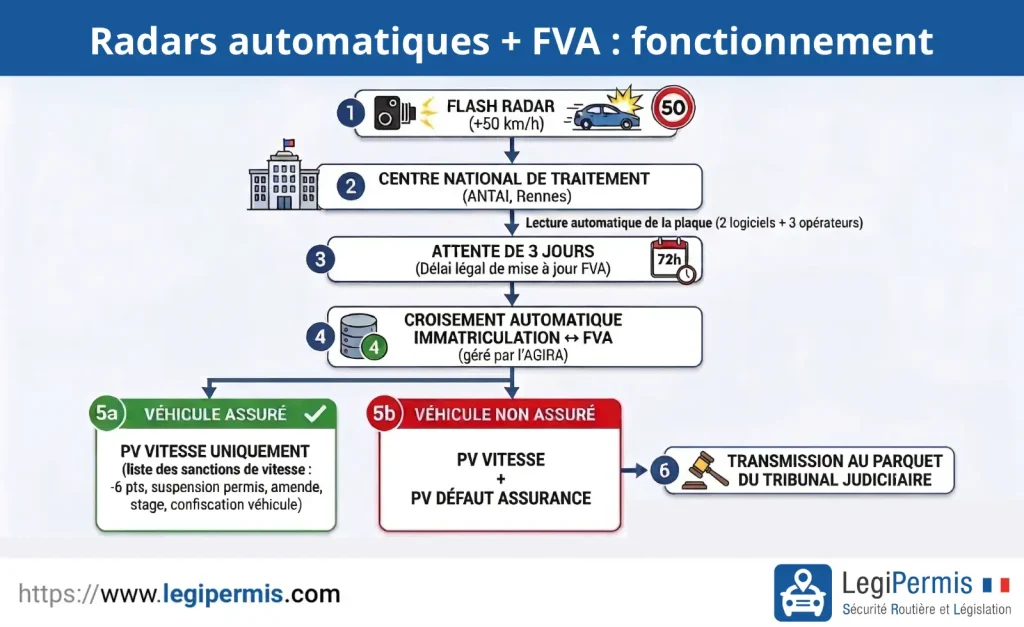
If the vehicle cannot be located in the database at the time of the offense, a preliminary suspicion of uninsured driving is logged. The digital file or police report is subsequently forwarded to the competent public prosecutor, who evaluates the case and determines the legal outcome. Consequently, penalties are not blindly or automatically issued without human judicial oversight.
How to Check Your Vehicle’s FVA Status
To prevent false alarms or administrative discrepancies, motorists can verify their insurance registration using three official channels:
- Online Portal: Access consultation-fva.fr using your vehicle registration plate (numéro d’immatriculation) and the form number (numéro de formule) found on your vehicle registration certificate (carte grise). The platform displays whether the vehicle is officially registered as insured, along with the insurer’s name and validity dates.
- Telephone Server: Call the dedicated voice server at
01 83 64 32 22during business hours to verify registration using the same identification numbers. - Your Insurance Provider: Contact your insurance carrier to confirm that your contract has been successfully forwarded to AGIRA. For newly signed policies, always retain your Mémo Véhicule Assuré (MVA), which grants a legal presumption of insurance validity during the first 15 days of coverage.
Supporting Data: The Scale of Uninsured Driving in France
Statistical data released by the National Interministerial Observatory for Road Safety (ONISR) and the Guarantee Fund for Compulsory Insurance (FGAO) highlights the severe societal impact of driving without insurance.
| Indicator | Data / Figure |
|---|---|
| Estimated uninsured drivers in France | ~515,000 (ONISR 2024 estimate) |
| Uninsured vehicles circulating on roads | ~680,000 (ONISR 2022 estimate) |
| Fatalities in accidents involving an uninsured driver (2024) | 216 deaths (including 156 inside the uninsured vehicle) |
| Share of total French road fatalities | 7% |
| Share of uninsured drivers in bodily-injury accidents | 4.8% (compared to 2.5% in 2013) |
| Victims compensated by the FGAO (2024) | ~8,000 victims |
| Total indemnities paid out by the FGAO (2024) | €123 million |
| Funds successfully recovered from responsible parties | €12.1 million (less than 10% of total payouts) |
| Excess risk of a fatal accident (cars) | 4x higher compared to insured drivers |
| Excess risk of a fatal accident (two-wheelers) | 2.5x higher |
The Typical Profile of an Uninsured Driver
FGAO and ONISR studies indicate that uninsured motorists are disproportionately young males, frequently facing economic precarity, living in peri-urban or rural areas where public transit is limited, and often driving older, poorly maintained vehicles.
Financial Penalties and Legal Implications
When an automated speed check uncovers a concurrent lack of insurance, motorists face severe cumulative legal and financial consequences.
Cumulative Fines: Speeding + Lack of Insurance
| Infraction Type | Standard Fixed Fine | Discounted Fine (Paid within 15 days) | Majorated Fine (Paid after >45 days) | Maximum Court Penalty |
|---|---|---|---|---|
| Major Speeding (+50 km/h or more) | €300 | €250 | €600 | €3,750 + 3 months imprisonment |
| Driving Without Insurance (1st offense) | €500 | €400 | €1,000 | €3,750 |
| FGAO Contribution (50% of insurance fine) | €250 | €200 | €500 | €1,875 |
| Total Combined Cost | €1,050 | €850 | €2,100 | €9,375 + 3 months imprisonment |
Note on License Points: Driving without insurance does not result in any point deductions on the French driving license. However, the associated major speeding infraction results in an immediate loss of 6 points.
The Ultimate Financial Risk: Accidents Without Insurance
Beyond administrative fines, causing an accident while uninsured carries devastating financial repercussions. Under French law, if an uninsured driver causes a crash, they must reimburse the FGAO in full for every euro of compensation paid out to victims, plus a mandatory 10% surcharge.

Because severe bodily injuries can involve medical and rehabilitation costs scaling into hundreds of thousands or millions of euros, these debts can burden an individual for decades. In 2024 alone, over 15,400 uninsured individuals were registered debtors to the FGAO.
How to Contest a False Positive
If your vehicle was properly insured at the time of the infraction but failed to appear in the FVA due to a data transfer delay or administrative glitch:
- Do not pay the fine immediately (payment constitutes legal admission of guilt).
- Submit a formal contestation to ANTAI online or via mail, including an official insurance certificate (attestation d’assurance) valid on the exact date of the infraction.
- Contesting a flat-rate fine for driving without insurance does not require depositing the mandatory financial guarantee (consignation) of €500.
Official Responses and Stakeholder Perspectives
The deployment of automated FVA cross-referencing has sparked significant debate among road safety advocates, insurers, and civil liberties organizations.
- Road Safety Authorities (Sécurité Routière / ONISR): Officials maintain that targeting uninsured motorists is a vital public safety imperative. Uninsured drivers represent an extreme financial burden on society and exhibit reckless behavioral traits, driving vehicles that pose a disproportionate risk to other road users.
- The Insurance Sector (France Assureurs / AGIRA): Insurance representatives support digital integration and praise the abolition of the green sticker, noting that real-time digital databases modernize enforcement. However, insurers emphasize the necessity of maintaining strict compliance with the 72-hour update window to minimize administrative errors and false positives for policyholders.
- Civil Liberties and Privacy Advocates: Questions regarding proportionality remain central to the debate. Privacy watchdogs, including the CNIL (National Commission on Informatics and Liberty), continuously monitor how automated infrastructure transitions from targeted traffic safety monitoring (speed enforcement) into broad administrative surveillance tools.
Future Outlook: Expansion to All Speed Infractions
At present, the automated cross-referencing of the FVA is strictly restricted to major speeding infractions exceeding the limit by 50 km/h or more. However, the stated official objective of the government is to gradually extend this cross-checking system to all speed violations captured by radars, regardless of severity.
While no official timeline or calendar has been published by the government, stakeholders across the transport sector anticipate a phased rollout as technical infrastructure and database reliability improve. Until then, motorists are strongly advised to regularly check their vehicle status via official channels to ensure seamless compliance with French insurance regulations.