

By the Editorial Team | June 30, 2026
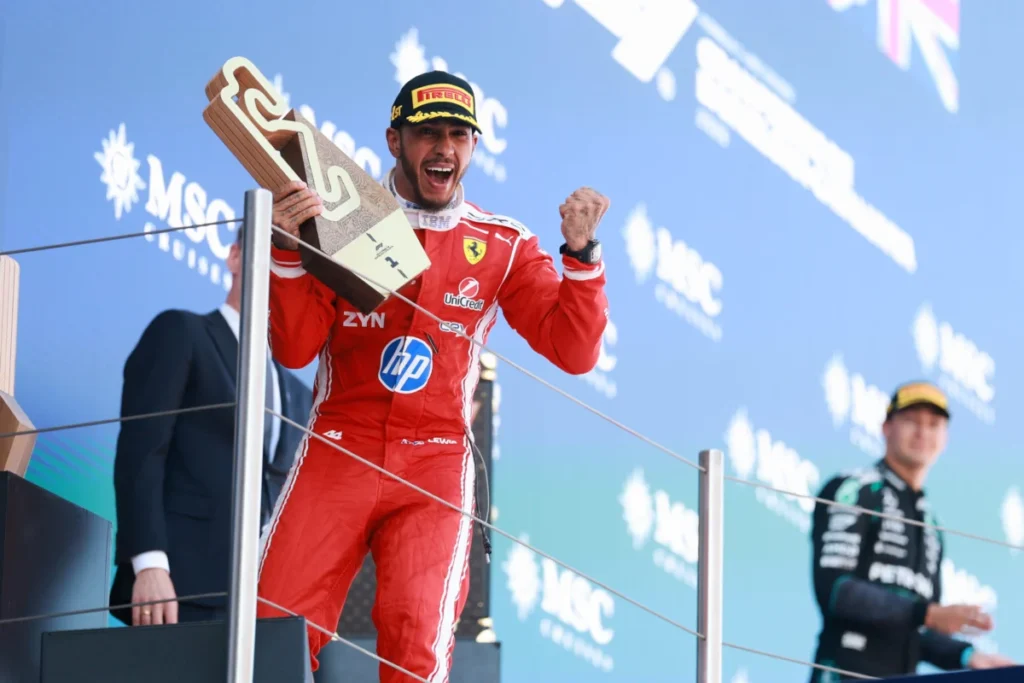
The 2026 Formula 1 season reached a fever pitch this Sunday at the Circuit de Barcelona-Catalunya. In a race defined by blistering track temperatures, extreme tire degradation, and a high-stakes tactical gamble, Lewis Hamilton secured his maiden victory in Ferrari scarlet. The triumph not only ended Mercedes’ dominant start to the campaign but also signaled a seismic shift in the momentum of the Drivers’ Championship, following a dramatic late-race retirement for the championship leader, Kimi Antonelli.
The Crucible of Catalonia: A Tactical Masterpiece
The weekend had been painted in Silver Arrows grey from the outset. George Russell had snatched pole position by a razor-thin margin of just 0.064 seconds, seemingly confirming Mercedes’ technical superiority on the high-downforce Spanish circuit. As the lights went out, the initial phase of the race suggested a straightforward procession. Russell held his nerve, successfully rebuffing an aggressive start from Hamilton, who had opted for the softer compound tires in a bid to seize the initiative immediately.
However, the Barcelona asphalt—sweltering under temperatures exceeding 50°C—soon transformed the contest into a brutal exercise in thermal management. With the track surface acting like sandpaper on the Pirelli rubber, the field was forced into a desperate scramble for longevity. By the twelfth lap, the leaders were already diving into the pits, as radio traffic became dominated by cries of distress. Lando Norris lamented that he was "sliding everywhere," while Max Verstappen noted that his Red Bull was unstable even on the straights.
It was in this chaotic atmosphere that Ferrari’s command pit wall executed the masterstroke of the season. At the 23rd lap, the Scuderia pulled Hamilton in for an early switch to medium tires, signaling their intent to commit to an audacious three-stop strategy. While Mercedes hesitated, caught between the conflicting interests of Russell and the rapid Kimi Antonelli, Hamilton unleashed a flurry of blistering laps, effectively "undercutting" the leaders to seize the virtual lead.
Chronology of a High-Speed Chess Match
The race rhythm was defined by two distinct phases: the struggle for tire preservation and the tactical chaos induced by a late-race Virtual Safety Car (VSC).
Phase 1: The Opening Stint and Degradation
The start saw little movement in the top five, though Charles Leclerc, starting tenth after a disastrous Q3, displayed flashes of brilliance by carving through the field to reach the top seven by the end of the opening lap. As the laps ticked by, the blistering heat proved to be the great equalizer. The degradation rates were higher than anticipated, forcing the front-runners into a defensive stance. Russell, managing the gap to his teammate Antonelli, found himself in a delicate position; the young Italian was visibly faster but was also dancing on the edge of track-limit penalties. The internal friction within Mercedes was palpable, with the pit wall forced to intervene, urging their drivers not to compromise their collective progress through infighting.
Phase 2: The Ferrari Gambit
The pivot point of the Grand Prix occurred when Fernando Alonso’s Aston Martin suffered a terminal failure, necessitating a VSC. Ferrari, reacting with surgical precision, immediately pitted Hamilton. The VSC period allowed the British legend to take his final set of hard tires with minimal time loss, granting him a track position advantage that he would not relinquish. With 24 laps remaining, Hamilton held a three-second buffer over Russell, but his superior tire life allowed him to manage the gap with the clinical efficiency of a veteran.
Phase 3: The Late-Race Collapse
The final ten laps were a war of attrition. Antonelli, having finally maneuvered past Russell for second, pushed too hard in a desperate attempt to hunt down the leading Ferrari. His pursuit ended in catastrophe; a structural failure of the front wing sent the championship leader into the grass, forcing his retirement. Almost simultaneously, Charles Leclerc’s Ferrari succumbed to a steering failure, bringing his recovery drive to a premature and frustrating halt.

Statistical Breakdown: A Historic Podium
When the checkered flag fell, Hamilton crossed the line 19.561 seconds ahead of George Russell, a testament to his flawless execution. Lando Norris claimed third, completing an all-British podium—a feat not seen in the sport since the 1968 season.
Final Standings Highlights:
- 1st: Lewis Hamilton (Ferrari): 1:32:28.105
- 2nd: George Russell (Mercedes): +19.561s
- 3rd: Lando Norris (McLaren): +23.719s
- 4th: Max Verstappen (Red Bull Racing): +40.497s
The race was defined by the high rate of attrition. Of the 22 starters, only 14 were classified. The combination of extreme heat and high-speed cornering put unprecedented stress on the cars, exposing the fragility of the 2026 regulations. The classification of Franco Colapinto (who crossed the line 8th but was demoted to 10th following a post-race penalty) underscored the high level of officiating scrutiny in what was perhaps the most demanding race of the year.
Official Responses and Team Dynamics
In the post-race press conference, a visibly moved Lewis Hamilton praised the Scuderia. "This wasn’t just a win for me; it was a win for the process. We have been building towards this, and to finally unlock the potential of the car in these conditions is a testament to the team in Maranello," he stated.
Conversely, the atmosphere at Mercedes was somber. Team Principal Toto Wolff acknowledged the internal tension: "We had a strategy, but when you have two drivers fighting for the championship, the margins become razor-thin. We lost too much time at the mid-point, and that opened the door for Lewis. Kimi’s retirement is a difficult pill to swallow, but that is racing."
Red Bull Racing, while disappointed not to challenge for the win, found solace in a solid fourth-place finish for Max Verstappen. "We are in the fight, but we need more pace," admitted Christian Horner. "Barcelona exposed some of our thermal management issues, and we will need to address that before the next round."
The Implications: A Title Fight Reborn
The implications of the Spanish Grand Prix are far-reaching. For Ferrari, this victory is a psychological breakthrough. It proves that their car is not only competitive but also capable of superior race-craft under extreme conditions. Hamilton, having broken his winless streak, is now firmly entrenched in the conversation for the 2026 crown.
For Kimi Antonelli and Mercedes, the weekend serves as a brutal reality check. The young prodigy’s lead in the championship has been slashed, and the incident at the end of the race will likely prompt difficult internal discussions regarding team orders and driver management. The "Silver Arrows" no longer have the luxury of a comfortable cushion; they are now under direct fire from both Ferrari and an increasingly consistent McLaren outfit.
As the paddock prepares to pack up and head to the next destination, one thing is certain: the 2026 season has transitioned from a Mercedes-dominated narrative into a wide-open, multi-team dogfight. The, summer heat of Barcelona has set the stage for a dramatic second half of the year, where strategy, reliability, and the sheer grit of the drivers will determine who wears the crown in December. The sport has been re-energized, and for the first time in years, the Tifosi can legitimately dream of a world title.
