

Main Facts: The Elite French Flagship With Ministerial Roots
In the pantheon of French automotive history, few vehicles evoke the high-tech optimism and state-sponsored ambition of the 1980s quite like the Renault 25. Yet, sitting proudly at the apex of the R25 family is an artifact so rare, so exclusive, and so distinctly political that it has largely faded into automotive folklore: the Renault 25 Limousine Heuliez.
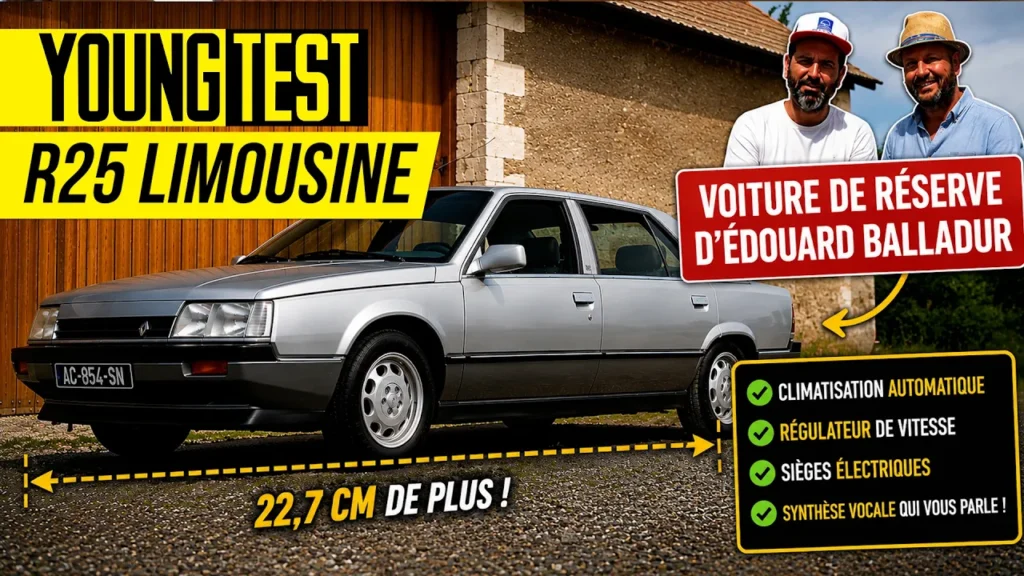
In a special feature by Youngtimers La Chaîne, automotive journalists Nicolas Schumacher and François-Xavier Basse take viewers behind the wheel of an ultra-rare piece of French history. Produced in a microscopic run of just 832 units, this particular car is no ordinary R25 stretch. It boasts a prestigious pedigree as the official reserve vehicle utilized by Édouard Balladur during his tenure as France’s Minister of Economy, Finance, and Privatization.
Long before French political figures routinely transitioned to sleek, armored DS automobiles or imported German flagships, Renault attempted to capture the hearts, minds, and chauffeurs of the nation’s highest-ranking ministers, corporate titans, and state dignitaries. The R25 Limousine was the diamond tip of that spear. Developed in collaboration with the renowned coachbuilder Heuliez, the vehicle offered high-ranking officials a domestic alternative to the Mercedes-Benz S-Class and BMW 7 Series.
Today, finding one in running condition is an exercise in archaeological patience. This specific model, owned by an enthusiast named Nicolas, serves as a rolling time capsule. It combines the avant-garde electronics of 1980s French engineering with the opulent, leather-lined rear quarters of a rolling boardroom. From its talking voice synthesizer to its mind-bogglingly expensive "Executive Pack"—which cost roughly the same as an entire entry-level Renault Super 5—the R25 Limousine represents a fascinating, albeit commercially ill-fated, chapter in French industrial history.
Chronology: From Boardroom Ambitions to Collector’s Item
The Genesis of the R25 (1984)
When Renault launched the standard Renault 25 in 1984, it was heralded as a technological tour de force. Designed to replace both the aging R20 and the unsuccessful executive-class R30, the R25 was penned by Robert Opron. It featured a revolutionary hatchback layout disguised as a traditional three-box sedan, an aerodynamic drag coefficient (Cd) of just 0.28, and a futuristic, spaceship-like interior dashboard designed by Marcello Gandini.
The Heuliez Partnership and the Stretch (1985–1988)
Recognizing a gap at the very top of the market for a dedicated state and corporate limousine, Renault turned to master coachbuilder Heuliez based in Cerizay. Heuliez had a long-standing reputation for turning production cars into wagons, convertibles, and stretched variants.
The formula for the R25 Limousine was simple yet ambitious: take a standard phase-1 or phase-2 R25, slice it down the middle, and extend the wheelbase by a massive 22.7 centimeters. This elongation was executed with factory-level precision, completely hidden behind redesigned rear doors that retained the car’s structural integrity and sophisticated aerodynamic profile. Production commenced in modest numbers, ultimately culminating in just 832 total units built over the vehicle’s lifespan.
Ministerial Service under Édouard Balladur (Late 1980s)
Because of its elite positioning, the R25 Limousine quickly found favor within French government ministries and semi-public institutions. The exact chassis featured in the Youngtimers test drive was pressed into active service as the official reserve vehicle for Édouard Balladur. As a heavyweight figure in French politics who later served as Prime Minister (1993–1995), Balladur required discreet, comfortable, and patriotic transport. This machine served as his confidential conveyance, ferrying policy-makers through the streets of Paris away from the prying eyes of the tabloid press.
Commercial Decline and Obsolescence (1990s)
Despite its high-profile adopters, the R25 Limousine struggled to sustain commercial momentum. The market for ultra-luxurious domestic limousines in France was chronically small, and corporate buyers increasingly gravitated toward German engineering. By the time the R25 was replaced by the Renault Safrane in 1992, the limousine variant was quietly retired, leaving behind a legacy of rarity that modern collectors spend decades trying to unearth.
Supporting Data: Specifications and Luxury Appointments
To truly understand why the Renault 25 Limousine Heuliez commanded respect—and a staggering price tag—one must examine the technological and comfort-oriented specifications that separated it from standard production models.
Dimensions and Engineering
- Wheelbase Extension: +22.7 cm over the standard R25.
- Total Production: 832 units globally.
- Body Style: Four-door, three-box styled notchback configuration masking a heavily reinforced chassis built by Heuliez.
The Prestige "Executive Pack"
The interior of the R25 Limousine was divided into a forward cockpit for the chauffeur and a rear sanctuary for the principal passenger. The highlight of the options list was the legendary Pack Executive, an add-on whose price point remains legendary among automotive historians:
- Cost Factor: The Executive Pack alone cost approximately the same as an entry-level Renault Super 5 city car.
- Rear Seating: Two independent, fully electric reclining armchairs upholstered in fine leather, allowing dignitaries to work or sleep in absolute tranquility.
- Amenities: Dedicated reading lights, integrated ashtrays, custom wood-veneer accents, and high-end privacy provisions.
Technological Marvels of the 1980s
The R25 was famous for packing cutting-edge electronics that felt straight out of a science fiction film. The limousine variant amplified these features:
- Voice Synthesizer: A famously persistent synthetic voice that alerted the driver to open doors, low fluid levels, and handbrake status.
- Infotainment: A state-of-the-art hi-fi audio system complete with an integrated graphic equalizer, providing concert-hall acoustics in the stretched cabin.
- Comfort Control: Advanced automatic climate control and full electrical adjustments for seats and windows—a rarity for European executive cars in the mid-1980s.
Official Responses: Perspectives from the Road and the Restoration Scene
When evaluating a vehicle as obscure as the R25 Limousine, contemporary insights come not from corporate PR offices, but from automotive journalists, historians, and passionate private custodians.
During their deep-dive review on Youngtimers La Chaîne, Nicolas Schumacher and François-Xavier Basse explored the paradox of the car. "You are looking at a machine built to project absolute state authority, yet it retains the quirky, endearing electronic soul of an everyday 1980s family hatchback," noted Schumacher during the road test. The juxtaposition of high-level diplomatic utility with quirky French engineering features—such as the synthesized voice alerts—creates an undeniable charm.
Equally compelling is the perspective of Nicolas, the private owner who rescued and restored the Balladur-associated limousine. Driven by a deep-seated passion for forgotten French classics, his journey to find, authenticate, and preserve the vehicle was fraught with challenges. Parts uniqueness, particularly regarding the Heuliez-specific body panels and interior trim extensions, makes maintenance a painstaking endeavor. Yet, according to the owner, the reward of gliding down the highway in a rolling piece of French political history outweighs the logistical hurdles.
When asked about why the car remains obscure, automotive historians point to the deep-rooted cultural cringe that sometimes plagues domestic executive cars in France. While German executives proudly drove Mercedes-Benz flagships, French elites have historically had a complicated relationship with homegrown luxury—a dynamic that ultimately sealed the fate of Renault’s grand limousine ambitions.
Implications: Where the R25 Limousine Fits in Automotive History
The story of the Renault 25 Limousine Heuliez extends far beyond a simple review of a rare vintage car; it serves as a case study in the evolution of corporate prestige, national manufacturing pride, and the shifting dynamics of the executive car market.
1. The End of an Era for Coachbuilt French Sedans
The collaboration between Renault and Heuliez represents one of the final chapters in traditional French coachbuilding. Today, coachbuilders rarely modify modern unibody sedans due to stringent safety regulations, complex electrical architectures, and the prohibitive cost of low-volume manufacturing. The R25 Limousine stands as a monument to an era when independent coachbuilders like Heuliez could still alter factory blueprints to create bespoke transport for heads of state.
2. Shifting Perceptions of "Youngtimers"
As vehicles from the 1980s and 1990s transition from used cars to treasured "youngtimers," models like the R25 Limousine are undergoing a massive reassessment. Once viewed merely as depreciation-ravaged fleet vehicles, they are now recognized as cultural artifacts. Collectors are beginning to value the quirky innovations of this period—such as early digital dashboards and voice synthesizers—over the sterile perfection of modern computer-managed automobiles.
3. The Eternal Battle for the Executive Segment
The failure of the R25 Limousine to capture long-term market share from German competitors underscores a stubborn truth in the global automotive industry: prestige cannot be manufactured overnight. While Renault proved it could engineer a car capable of carrying a government minister in supreme comfort, altering the deep-seated status symbols of the global elite proved insurmountable.
Ultimately, whether viewed alongside a Mercedes-Benz S-Class or a BMW 7 Series, the Renault 25 Limousine Heuliez remains an audacious reminder of what happens when French engineering aims for the stars—and occasionally lands in the presidential motorcade.
