

By: The Editorial Desk | June 30, 2026
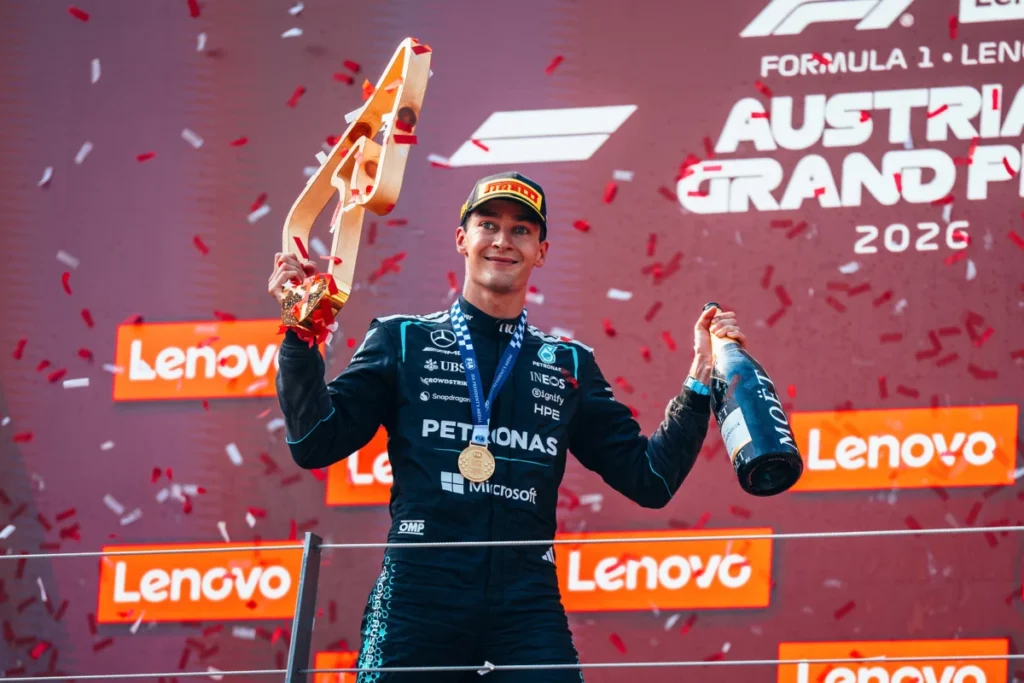
The 2026 Formula 1 season, which promised a revolution of technical regulations and a shift in the established order, delivered its most compelling narrative yet at the Red Bull Ring. In a high-stakes, physically demanding Austrian Grand Prix, George Russell reminded the paddock why he is considered one of the sport’s elite, converting a hard-fought pole position into his seventh career victory.
Under the scorching Styrian sun, Russell navigated a minefield of technical challenges, tire degradation, and a relentless, late-race charge from Max Verstappen. While the headlines will belong to the Briton, the race was a microcosm of the 2026 season: volatile, strategically complex, and defined by the fine margins between glory and mechanical failure.
The Race Unfolded: A Masterclass in Defensive Driving
From the moment the lights extinguished, the tone for the afternoon was set. Russell, starting from pole, executed a clinical launch, immediately establishing a rhythm that kept the field at bay. While his teammate and championship leader, Kimi Antonelli, struggled with the opening laps—evidenced by several excursions beyond track limits that drew the scrutiny of the stewards—Russell remained serene, managing his Pirelli rubber with surgical precision.
The Mid-Race Pivot
The narrative shifted significantly during the first round of pit stops. As temperatures climbed, track surface overheating became the primary antagonist. Russell was heard over the radio, calmly diagnosing the situation: "I think it’s just surface overheating," he remarked, a testament to his ability to manage the car while maintaining a competitive pace.
However, the race was far from a procession. The emergence of a Virtual Safety Car (VSC), triggered by the stranded Williams of Carlos Sainz in the main straight, threw a wrench into the strategic plans of many. Antonelli, unfortunately, had committed to his pit stop mere moments before the VSC was deployed, effectively negating any potential "free" stop advantage and forcing the young Italian to fight his way back into contention through pure pace.
The Verstappen Factor
Max Verstappen, starting fifth after a bruising Saturday qualifying session, once again demonstrated why he is the master of recovery. His duel with Lewis Hamilton—now in Ferrari scarlet—provided the visual highlight of the afternoon. The two titans of the sport traded paint and position in a series of aggressive maneuvers that saw the Dutchman eventually assert his dominance, clearing the way to hunt down the leading Mercedes.
Technical Turmoil: When Engineering Meets Endurance
The 2026 Austrian Grand Prix was not just a battle of drivers; it was a war of attrition against machinery pushed to its absolute limits. The retirement list read like a roll call of bad luck and mechanical gremlins.
Cadillac endured a disastrous Sunday, with both Valtteri Bottas and Sergio Perez forced to retire within the first four laps due to catastrophic brake overheating. The trend of technical failure continued with Lance Stroll, whose Aston Martin succumbed to an ERS (Energy Recovery System) malfunction, and Carlos Sainz, whose immobile Williams forced the crucial VSC that reshuffled the pack.
For those who remained, the battle was internal. Kimi Antonelli, despite his blistering pace, spent the latter half of the race wrestling with a brake bias imbalance. His frantic radio communication—"What is going on with the brakes?"—highlighted the volatility of the 2026 cars, which require constant micro-adjustments to keep within their operating windows.

The Climax: A Final Lap for the Ages
As the race entered its final ten laps, the Red Bull Ring was electric. Russell’s five-second cushion had evaporated, with Verstappen closing in at a rate that suggested a potential overtake for the lead. Behind them, Antonelli had recovered from his earlier tactical misfortune, carving through the field to join the battle for the win.
With two laps remaining, the gap between the lead trio was less than a second. The final lap was a masterclass in defensive pressure. Russell, maintaining impeccable lines, refused to give an inch. As the flag dropped, the gap between Russell and Verstappen was a mere 1.611 seconds, with Antonelli only 0.375 seconds behind the Dutchman. It was a photo finish that encapsulated the parity of the current grid.
Championship Implications: A Shifting Landscape
The victory is more than a trophy for George Russell; it is a declaration of intent. By climbing to second in the Drivers’ Championship, he has effectively split the title narrative, proving that the championship is not a foregone conclusion for his teammate.
The Standings Overview
- Kimi Antonelli (Mercedes): Remains the points leader with a 40-point buffer, but his "less-than-limpid" race in Austria shows cracks in the armor that challengers will look to exploit.
- George Russell (Mercedes): His win proves that Mercedes has two world-class cards to play in the championship poker game.
- Max Verstappen (Red Bull): By salvaging a second-place finish from a fifth-place start, Verstappen proves that even on "bad" days, he remains the most consistent threat in the field.
Ferrari’s performance, conversely, was a disappointment. Despite high expectations, the Scuderia struggled with tire degradation, leaving Lewis Hamilton in fifth and Charles Leclerc in eighth. Leclerc’s frustrated radio outburst—*"These tires are ***"—underscored the team’s inability to match the race pace of the Silver Arrows and the Red Bulls on a hot, high-deg surface.
Official Perspectives and Post-Race Analysis
In the post-race press conference, the atmosphere was one of calculated relief. George Russell emphasized the mental toll of the race, stating, "It wasn’t just about speed; it was about knowing when to push and when to preserve. The team gave me a perfect car, but the conditions made every lap feel like a qualifying run."
Max Verstappen, while clearly disappointed to miss the top step, was philosophical. "We recovered well from yesterday. The car felt good, but we were just a few laps short of having a real crack at George. It’s a solid haul of points."
Kimi Antonelli, reflecting on his third-place finish, was humble: "I made some mistakes early on, and the strategy didn’t fall our way with the VSC. But to come away with a podium despite a car that felt like it was fighting me, I’ll take it. We learn, we move on."
Final Classification: The 2026 Austrian Grand Prix
| Pos | Driver | Team | Laps | Gap | Points |
|---|---|---|---|---|---|
| 1 | George Russell | Mercedes | 71 | – | 25 |
| 2 | Max Verstappen | Red Bull | 71 | +1.611s | 18 |
| 3 | Kimi Antonelli | Mercedes | 71 | +1.986s | 15 |
| 4 | Oscar Piastri | McLaren | 71 | +21.809s | 12 |
| 5 | Lewis Hamilton | Ferrari | 71 | +26.393s | 10 |
| 6 | Isack Hadjar | Red Bull | 71 | +29.399s | 8 |
| 7 | Lando Norris | McLaren | 71 | +31.505s | 6 |
| 8 | Charles Leclerc | Ferrari | 71 | +45.659s | 4 |
| 9 | Liam Lawson | Racing Bulls | 70 | +1 lap | 2 |
| 10 | Arvid Lindblad | Racing Bulls | 70 | +1 lap | 1 |
Note: Drivers ranked 11th and below finished outside the points. Retirements included Lance Stroll (ERS), Carlos Sainz (Technical), and both Cadillac drivers (Brake failure).
Conclusion: The Road Ahead
As the circus leaves Spielberg, the 2026 season enters its next phase with more questions than answers. Is the Mercedes dominance sustainable, or was this a track-specific victory? Can Ferrari rectify their tire management woes before the next race? And, most importantly, will the internal rivalry between Russell and Antonelli boil over as the championship fight intensifies?
One thing is certain: the parity brought about by the 2026 regulations has turned Formula 1 back into a sport of fine margins. For fans, this is the golden age. For the drivers, it is a relentless, high-speed chess match where one wrong move means the difference between a podium and a gravel trap. George Russell has played his move, and the rest of the grid is now scrambling to respond.
