

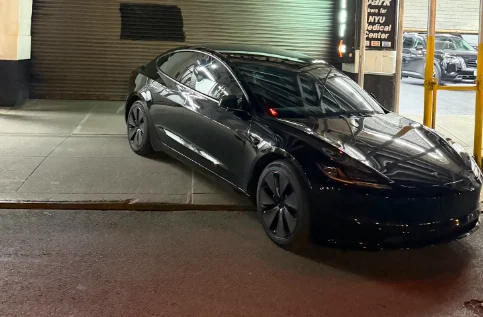
A remarkable claim of a Tesla Model 3 completing a 4,559 km journey across the United States in under 50 hours with zero reported human intervention has reignited the debate surrounding the true capabilities and limitations of advanced driver-assistance systems (ADAS). While the feat highlights significant technological progress, experts caution against equating it with true self-driving, emphasizing the continued critical role of human supervision and responsibility.
The Astonishing Claim: A New Benchmark in Assisted Driving
In April 2026, a Tesla Model 3, reportedly driven by an American enthusiast named Zack, embarked on an audacious journey that has captured the attention of the automotive world. The driver claims to have traversed the vast expanse of the United States, a distance of 4,559 kilometers (2,833 miles), in an astonishing 49 hours and 55 minutes, all while relying solely on Tesla’s Full Self-Driving (FSD) software. This purported achievement, which traces the legendary Cannonball Run route from New York to California, has shattered previous records for autonomous driving attempts and has ignited a firestorm of discussion about the evolving landscape of vehicle technology.
The reported feat is particularly noteworthy for its claim of "zero disengagements," meaning the driver allegedly did not have to intervene and take manual control of the vehicle at any point during the entire 4,559 km journey. This includes managing the vehicle’s navigation, acceleration, braking, steering, and even the crucial task of aligning the car for rapid charging at Tesla Supercharger stations. If verified, this represents a significant leap forward in the operational capabilities of advanced driver-assistance systems, pushing the boundaries of what was previously thought possible without direct human input.
A Legacy of Speed and Innovation: The Cannonball Run Reimagined
The journey undertaken by Zack echoes the spirit of the Cannonball Run, an unofficial, and indeed illegal, motorsport that emerged in the 1970s. The original goal was simple: to drive from New York to Los Angeles as quickly as possible, challenging the limits of both drivers and their vehicles. While the modern iteration, as demonstrated by Zack, incorporates advanced technology, the underlying ambition to conquer vast distances in record time remains.
This latest claim surpasses a previous record set in January 2026 by Alex Roy and his team. In that instance, a Tesla Model S completed a similar cross-country route from Los Angeles to New York in 58 hours and 22 minutes, covering approximately 4,958 km (3,081 miles) using FSD version 14.2.2.3. Zack’s reported achievement not only reduces the time by over eight hours but also accomplishes it over a slightly shorter distance, showcasing an incremental yet significant improvement in the efficiency and capability of the FSD system.
Deconstructing the Achievement: The Technology Behind the Drive
The Tesla Model 3 utilized in this record attempt was equipped with Tesla’s FSD (Full Self-Driving Supervised) software, specifically version 14.3.2. This advanced system, while bearing the ambitious name "Full Self-Driving," is officially classified as an advanced driver-assistance system (ADAS) and operates at Level 2 on the SAE International’s scale of driving automation. Level 2 systems are capable of controlling steering and acceleration/deceleration simultaneously under certain circumstances, but they crucially require the human driver to remain vigilant and ready to intervene at any moment.
According to reports from specialized outlets like FSD Update, the specific software version employed in this run boasts several key enhancements. Version 14.3.2 is said to improve low-light vision capabilities, reduce system reaction times by approximately 20%, and enhance the precision of parking maneuvers. The latter is particularly critical for autonomously aligning a vehicle with charging stations, a complex task that requires accurate spatial awareness and precise control.
The meticulously planned nature of the journey is also a significant factor. Zack’s team reportedly spent considerable time preparing the route and optimizing charging stops at Tesla Supercharger locations. The chosen path was largely composed of highways, environments where ADAS systems tend to perform optimally due to predictable traffic patterns, clear lane markings, and fewer complex intersections. This context is crucial: the record demonstrates the software’s proficiency under its most favorable conditions, rather than its capability in diverse and challenging driving scenarios.
The Nuance of "Supervised" Driving: Responsibility Remains Paramount
Despite the impressive headline of "zero intervention," it is imperative to understand what this truly means within the context of current automotive technology. The "Supervised" in Full Self-Driving is not merely a marketing term; it underscores the fundamental requirement for human oversight. Even with the advanced capabilities of FSD, the driver is legally and ethically responsible for the vehicle’s operation at all times.
This means that while the software can manage steering, acceleration, and braking, the driver must remain actively engaged, monitoring the surroundings and being prepared to take immediate control if the system encounters a situation it cannot handle or if unexpected events occur. The claim of "zero disengagements" in this context likely refers to a lack of necessary manual intervention to prevent an accident or maintain forward progress, rather than an absence of the driver’s attentive presence.
This distinction is critical for public understanding and safety. The impressive performance of FSD on highways, particularly in well-defined scenarios, should not be misinterpreted as a step towards fully autonomous vehicles that can operate without human supervision. The technology is designed to assist, not replace, the driver.
The Road Ahead: Regulatory Hurdles and Future Implications
The proliferation of such advanced driver-assistance systems, and the remarkable feats they enable, are naturally attracting the attention of regulatory bodies worldwide. In Europe, for instance, the FSD system faces a rigorous approval process. The Flemish administration has reportedly requested additional testing before FSD can be authorized on the continent. The matter is slated for review by the European Technical Committee for Motor Vehicles, with a session scheduled for June 30, 2026. Until this hurdle is cleared, European drivers will not be able to legally activate FSD in its full configuration.
For drivers in France and other European countries, current ADAS features should be viewed as sophisticated assistants, not autonomous pilots. The temptation to relinquish control, even for brief moments, on long journeys, especially in vehicles equipped with advanced electronic systems, can be significant. However, the legal and safety ramifications of doing so remain substantial. Drivers must remain acutely aware of their responsibilities, understanding that their vigilance is the ultimate safeguard, regardless of the sophistication of the technology at their disposal.
What This Record Means for the Average Driver
While the cross-country record is a testament to technological advancement, its immediate implications for the average motorist are nuanced. It signals the growing maturity of driver-assistance systems, particularly on highways, where they can significantly enhance comfort and reduce driver fatigue. However, it also highlights the current limitations of these systems. They excel in predictable environments but can struggle with unpredictable scenarios, complex urban driving, or adverse weather conditions.
The record serves as a powerful indicator of what FSD can achieve under optimal circumstances. It suggests that the software is becoming increasingly adept at navigating the complexities of long-distance highway driving, including managing charging stops. This progress is encouraging for the future of autonomous driving, but it also underscores the need for continued development and rigorous testing to ensure safety and reliability across a wider range of driving conditions.
Ultimately, the purported 4,559 km journey in a Tesla Model 3 is a spectacular demonstration of human ingenuity and technological progress. It pushes the boundaries of what we expect from our vehicles and offers a glimpse into a future where driving might be significantly more automated. However, it is crucial to maintain a clear-eyed perspective: this is a feat of assisted driving, a highly sophisticated form of assistance, but one that still relies on the ultimate oversight and responsibility of a human driver. The journey to true, unsupervised autonomous driving is ongoing, and milestones like this, while impressive, are steps along a longer, more complex path.
