

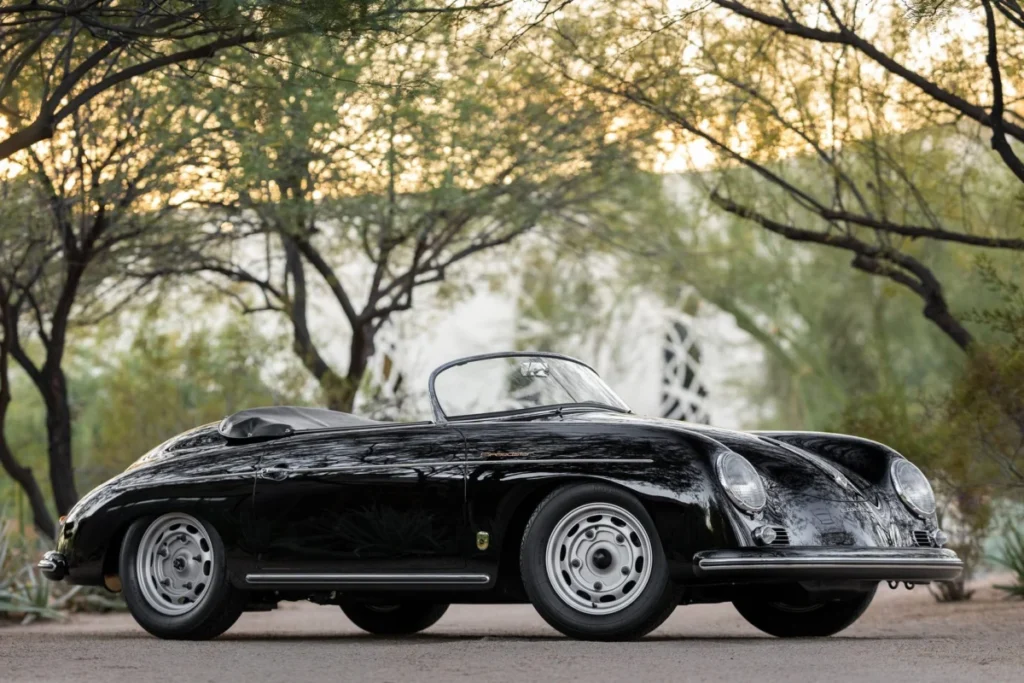
In the echelon of vintage motoring, few silhouettes evoke the romanticism, mechanical purity, and cultural cachet of the Porsche 356A Speedster. When finished in its factory-correct coat of Black (5801)—an exceptionally rare shade accounting for only a fraction of the roughly 141 examples configured in this colorway—the car transcends its status as a mere collector’s item and becomes a rolling work of art.
This particular 1958 Porsche 356A Speedster has been subjected to a no-expense-spared, highly sophisticated rotisserie restoration and mechanical transformation completed in 2022 by the renowned marque specialists at Willhoit Auto Restoration of Long Beach, California. Rather than serving as a static museum piece destined to languish in a climate-controlled vault, this Speedster has been engineered to be driven hard, blending mid-century aesthetic grace with modern-day motorsport performance.

At the heart of the build lies a bespoke 2.2-liter flat-four engine handcrafted by Willhoit, paired with a modern WEVO five-speed manual transaxle utilizing 901 AFMSZ gear sets. To harness this added power, the chassis has been comprehensively upgraded with four-wheel CSP disc brakes, Spax adjustable gas shocks, adjustable rear spring plates equipped with 25mm torsion bars, and a 17.5mm front sway bar. It rides on period-correct yet purposeful 15×5-inch Tecnomagnesio wheels wrapped in sticky Pirelli rubber.
Finished over an understated yet striking black leather and corduroy interior, this machine is accompanied by a copy of the factory Kardex, a Reutter Certificate of Production, an extensive photographic record of the restoration process, and a clean Arizona title. Its pedigree was further solidified when it was featured prominently in the September 2022 issue of Excellence magazine. Currently sitting on dealer consignment after being acquired by the current owner in 2023, the five-digit odometer displays roughly 600 miles—approximately 100 of which have been added since the previous purchase, reflecting careful testing and enjoyment.

Chronology: From Zuffenhausen Production to Long Beach Renaissance
1958: Birth in Stuttgart
The story of this 356A Speedster begins in 1958 during the golden era of Porsche’s early manufacturing run. Built by Karosserie Reutter, the car was specified with the desirable Speedster bodywork—characterized by its low, raked windshield, minimal weather equipment, and purposeful bucket seats. Originally dispatched from the factory wearing code 5801 Black paint, it was one of roughly 141 units to leave the facility in this dramatic, understated hue. For decades, the car lived the standard life of a vintage sports car, passing through various caretakers before its structural and mechanical fatigue necessitated a total intervention.
2022: The Willhoit Auto Restoration Masterclass
Recognizing the intrinsic value and potential of the rare chassis, the car was sent to Willhoit Auto Restoration in Long Beach, California, widely regarded as a premier authority on vintage Porsche engineering. The car was stripped down to its bare shell, mounted to a rotisserie, and meticulously metal-worked before being resprayed in its original black finish.

During this exhaustive two-year window, Willhoit built a potent 2.2-liter flat-four engine specifically tailored for the lightweight Speedster platform. The electrical system was upgraded to 12 volts for modern reliability, a custom stainless-steel exhaust system was fabricated, and an electric fuel pump was fitted. Upon completion of the work, the car’s triumphant return to the road was documented in the pages of Excellence magazine’s September 2022 issue.
2023–Present: Refinement and Current Offerings
Following its feature in Excellence, the Speedster found a new owner in 2023. Under this current ownership, further mechanical refinements were made, including the installation of a four-wheel CSP disc brake system paired with a dual-circuit master cylinder, Spax adjustable gas shocks, and revised suspension geometry to maximize lateral grip and high-speed stability. Today, the car sits on dealer consignment, representing a meticulously sorted, turnkey driver’s car that bridges the gap between vintage charm and contemporary track-day capability.

Supporting Data: Specifications and Equipment Breakdown
To understand the magnitude of this build, one must examine the specific mechanical and aesthetic components that elevate this 1958 Speedster far beyond a factory-spec restoration:
- Engine: Willhoit Auto Restoration-built 2.2L flat-four engine, featuring upgraded internal components designed for enhanced torque and horsepower delivery across the rev range.
- Fuel & Induction: Fitted with high-flow carburation, a performance-oriented stainless-steel exhaust system that produces an intoxicating air-cooled flat-four wail, and an electric fuel pump for reliable cold and hot starts.
- Transaxle: WEVO five-speed manual transaxle utilizing 901 AFMSZ gear ratios, dramatically improving drivability on modern highways compared to the original four-speed unit.
- Electrical System: Upgraded to a modern 12-volt architecture, ensuring reliable lighting, charging, and auxiliary electronics.
- Chassis & Suspension:
- Spax adjustable gas shocks.
- Adjustable rear spring plates with 25mm torsion bars.
- 17.5mm front sway bar to neutralize understeer.
- Braking System: Four-wheel CSP disc brakes paired with a modern dual-circuit master cylinder for vastly superior stopping power compared to the factory drum setup.
- Wheels & Tires: 15×5-inch Tecnomagnesio alloy wheels finished to complement the exterior, shod in high-grip Pirelli tires.
- Exterior Appointments: Black (5801) paint applied over a rotisserie-restored body, removable black canvas soft top, removable side curtains, body-color painted bumpers, and the distinct factory-style deletion of windshield wipers for a clean, aerodynamic look.
- Interior Appointments:
- Fixed-back bucket seats reupholstered in black leather with corduroy inserts.
- Charcoal square-weave carpets.
- Body-color painted dashboard framing a central 6,000-rpm electronic tachometer, a 120-mph speedometer, and an oil temperature/pressure combination gauge.
- Latch-and-link lap belts, a passenger-side grab handle, and a discreetly integrated USB and 12-volt charging port.
Official Documentation and Provenance
In the high-stakes world of classic Porsche collecting, provenance is currency. A pristine cosmetic restoration means little without the paperwork to substantiate the vehicle’s lineage. This 356A Speedster comes complete with an ironclad paper trail designed to give prospective buyers absolute peace of mind:

- Factory Kardex: A certified copy of the original factory production record, confirming the matching serial numbers, build specifications, and the rare Black (5801) factory paint code.
- Reutter Certificate of Production: Verifying the authenticity of the coachbuilt bodywork supplied by Karosserie Reutter during an era when Porsche outsourced much of its body construction to specialized artisans.
- Restoration Portfolio: A comprehensive binder containing photographs taken during the rotisserie restoration process at Willhoit Auto Restoration, documenting the metalwork, painting, and mechanical assembly.
- Media Recognition: Inclusion in the September 2022 issue of Excellence magazine, providing independent journalistic validation of the quality and craftsmanship of the build.
- Legal A clean Arizona title held in the current consignor’s possession, ensuring a smooth and straightforward transfer of ownership.
Implications: The Restomod Trend in Vintage Air-Cooled Porsches
The offering of this Willhoit-built 1958 Porsche 356A Speedster highlights a fascinating and ongoing evolution in the classic car market: the rising acceptance and celebration of "outlaw" and high-performance restomods.
For decades, the collector car community operated under a strict dogma of numbers-matching preservation. Originality was king, and any deviation from factory specifications—even upgrades designed to improve safety or usability—was often penalized by judges and purists alike. However, as younger generations of enthusiasts enter the market, priorities have shifted. Today’s collectors increasingly value usability, reliability, and dynamic performance over static historical accuracy.

Companies like Willhoit Auto Restoration sit at the vanguard of this movement. By injecting modern engineering—such as a 2.2-liter displacement bump, a five-speed WEVO gearbox, and disc brakes—into a featherlight 1950s chassis, they solve the inherent compromises of vintage motoring. An original 356A Speedster can be fragile, underpowered by modern standards, and equipped with notoriously vague drum brakes that require immense caution in modern traffic. This modified example effectively eliminates those anxieties, allowing the driver to experience the sublime steering feel and iconic styling of a 356 without the mechanical white-knuckle ride.
Furthermore, this car’s market positioning demonstrates that high-end modifications do not necessarily detract from value—provided the work is executed by a universally respected specialist. Because Willhoit is a gold-standard name in the Porsche community, their builds command immense respect and fierce bidding competition. As this Speedster heads to a new home via dealer consignment, it stands as proof that the ultimate expression of a vintage Porsche isn’t necessarily the one that sits frozen in time, but the one meticulously reimagined to conquer the open road.
