

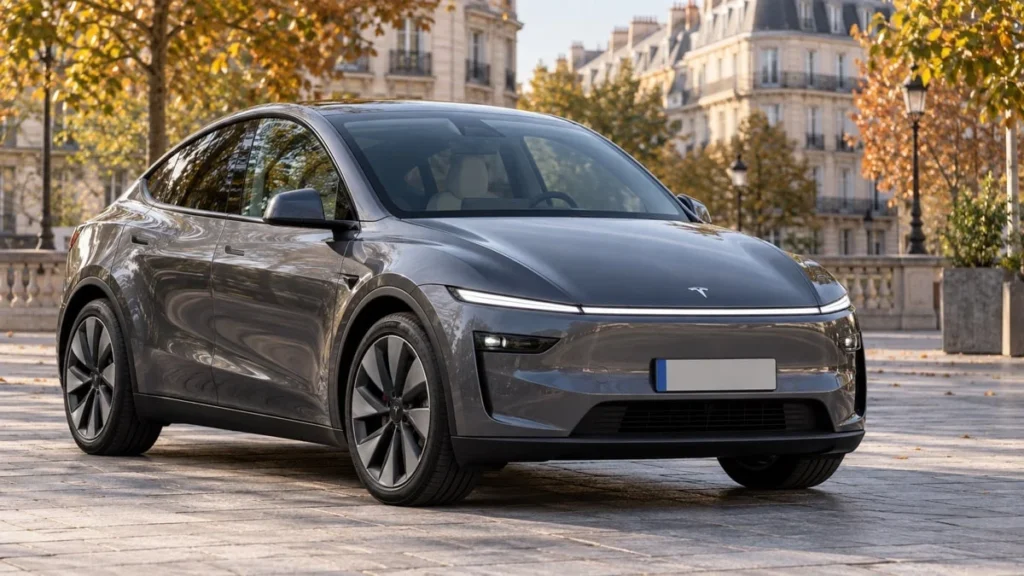
PARIS — In what automotive industry analysts are calling a watershed moment for the French car market, the American electric SUV, the Tesla Model Y, has claimed the crown as the best-selling new passenger car in France for September 2026. Surpassing traditional domestic favorites—namely the Peugeot 208 and the Renault Clio—the Model Y’s commanding performance underscores a seismic shift in consumer preferences, even as long-term market dynamics reveal a more nuanced battle for supremacy on French asphalt.
According to data compiled by Planète Renault and verified by automotive market authority AAA DATA, a total of 8,183 units of the Tesla Model Y were registered across France during the month of September. This impressive volume pushed the battery-powered SUV ahead of all internal combustion, hybrid, and electric competitors for the 30-day period, outstripping the perennial city-car champions that typically dominate the upper echelons of French registration charts.
Yet, while the monthly victory belongs undisputedly to Elon Musk’s crossover, the broader context of the French automotive ecosystem reveals a market in transition—one caught between aggressive electrification targets, government incentives, and the stubborn loyalty of motorists to homegrown brands.
Main Facts: A Historic Upset in the French Automotive Landscape
The primary takeaway from the September 2026 data is the sheer magnitude of Tesla’s monthly surge. Securing 8,183 registrations, the Model Y did not merely win the electric vehicle (EV) category; it dominated the entire passenger vehicle market, all motorizations combined.
The September 2026 Podium
- Tesla Model Y – 8,183 units
- Peugeot 208 – Runner-up
- Renault Clio – Third place
The achievement is striking on multiple fronts. For a relatively large, mid-size electric SUV to outsell agile, budget-friendly domestic city hatchbacks like the Peugeot 208 and Renault Clio in their home market is a rare feat. Analysts note, however, that these registration figures represent vehicles officially logged into the national database during the month—a metric reflecting a mix of prior corporate orders, fleet deliveries, and retail handovers rather than daily showroom transactions alone.
Nevertheless, the triumph of the Model Y highlights a structural evolution. Electric vehicles are no longer a niche luxury item or a secondary consideration for affluent early adopters; they are capturing mainstream volume in one of Europe’s most mature and fiercely contested automotive markets.
Chronology: How the Market Unfolded Through 2026
To understand the weight of Tesla’s September victory, one must look at the trajectory of the French car market over the first three quarters of 2026.
Q1 and Q2 2026: Steady Growth and Electric Momentum
The opening months of the year were characterized by steady implementation of state-backed incentives, including the continuation of France’s leasing social (social leasing) schemes and environmental bonuses aimed at making low-emission vehicles accessible to working-class households. While legacy manufacturers like Stellantis and Renault rolled out competitive electric offerings—such as the highly anticipated Renault 5—Tesla maintained consistent supply chains and competitive pricing strategies that kept the Model Y visible at the top of import charts.
September 2026: The Tipping Point
As summer ended, September delivered a massive wave of registrations. According to AAA DATA’s comprehensive report released on October 1, France recorded 156,629 new passenger car registrations in September alone. Of that total, an astounding 65,243 units were fully electric, pushing the market share of battery-electric vehicles (BEVs) to nearly 42%.
Hybrid vehicles—spanning mild, full, and plug-in variants—remained neck-and-neck with pure electrics, capturing roughly 43% of the monthly market. Together, electrified powertrains accounted for the overwhelming majority of new cars hitting French roads, relegating traditional pure-combustion petrol and diesel vehicles to a rapidly shrinking minority.
Within the EV segment specifically, the Tesla Model Y crushed its closest direct challenger, the new Renault 5. AAA DATA figures place the Renault 5 at 5,224 registrations for September, leaving the Model Y with a comfortable lead of 2,959 vehicles over its nearest electric rival on a single-month basis.
The Long-Game Reality: Peugeot Holds the Fort
Despite the headlines generated by Tesla’s September blitz, industry stakeholders were quick to contextualize the monthly anomaly against year-to-date figures. In an official press release issued on October 1 by Stellantis, the automotive conglomerate confirmed that the Peugeot 208 securely retains its position as the best-selling vehicle in France for the cumulative period of January through September 2026.
| Observation Period | Market Leader | Key Takeaway |
|---|---|---|
| September 2026 (Monthly) | Tesla Model Y (8,183 units) | Dominated total passenger car registrations; peak delivery month. |
| January – September 2026 (Year-to-Date) | Peugeot 208 | Retains overall volume leadership across the first three quarters. |
Thus, a dual narrative emerges: Tesla owns the sprint, but Peugeot is winning the marathon. The monthly triumph of an American-engineered electric SUV does not erase the deep-seated consumer preference for accessible, compact French hatchbacks over a nine-month horizon.
Supporting Data: Numbers Behind the Shift
The transformation of the French car market is grounded in hard statistics published by transport data agencies and manufacturers. Analyzing these metrics illuminates the underlying currents driving consumer behavior in late 2026.
- Total September Market Volume: 156,629 new passenger cars registered.
- BEV Volume & Share: 65,243 units, capturing nearly 42% of total monthly registrations.
- Hybrid Powertrains Share: Approximately 43% across all hybrid categories.
- Tesla Model Y September Volume: 8,183 units.
- Renault 5 September Volume: 5,224 units (yielding a 2,959-unit gap in Tesla’s favor within the EV bracket).
- Cumulative Leader: Peugeot 208, maintaining its number-one spot in total registrations from January 1 to September 30, 2026.
These figures illustrate a market pivoting aggressively toward electrification. The nearly 42% market share for pure EVs in a single month represents a milestone that would have seemed overly optimistic just a few years prior. Analysts point out that this acceleration is heavily propelled by systemic policy shifts, corporate fleet decarbonization mandates, and targeted financial incentives designed to spur domestic and European EV adoption. However, market analysts also caution against extrapolating a single month’s logistical delivery peaks into a permanent structural baseline.
Official Responses and Industry Reactions
The release of the September data elicited swift commentary from automotive associations, manufacturing groups, and market analysts.
Representatives for Stellantis, speaking through their October 1 market summary, emphasized the resilience of their multi-energy strategy. While acknowledging Tesla’s formidable monthly push in the BEV sector, Stellantis executives highlighted that the Peugeot 208’s enduring year-to-date dominance proves that French consumers continue to value localized production, varied powertrain choices, and affordable price points tailored to everyday European commuting needs.
Meanwhile, representatives from AAA DATA pointed to the broader macro-environmental factors influencing the September spike. In their official market briefing, data analysts underscored the catalytic effect of public policy instruments:
"The sustained momentum in the electric vehicle segment cannot be fully understood without examining the compounding effects of state financial aids, corporate tax structures, and the ongoing rollout of social leasing programs. These mechanisms have successfully drawn a broader demographic of buyers into showrooms, shifting the baseline of what constitutes a mainstream volume vehicle in France."
Independent automotive economists noted that Tesla’s ability to orchestrate massive delivery waves at the end of quarters remains a hallmark of its logistics model. Shipments arriving from international or European gigafactories often concentrate registrations into specific monthly windows, creating spikes that contrast with the steadier, factory-to-dealer flow of legacy European manufacturers like Peugeot and Renault.
Implications: What This Means for Consumers and the Market
The events of September 2026 carry profound implications for the future of the French automotive sector, touching upon consumer choice, industrial strategy, and infrastructure demands.
1. The Normalization of Electric Mobility
The fact that a battery-electric SUV can top the entire sales chart—outselling every petrol, diesel, and hybrid competitor—signals that EVs have crossed a psychological threshold in France. They are no longer viewed merely as alternative vehicles for eco-conscious pioneers, but as primary family transport options capable of capturing broad market leadership.
2. Intensifying Competition in the Domestic Market
For French automotive champions like Renault and Peugeot, Tesla’s high-profile win serves as both a wake-up call and a validation of their own electric strategies. With the Renault 5 establishing itself strongly in the EV category (securing over 5,200 registrations in September) and affordable B-segment electrics expanding, domestic automakers are locked in an intense battle to defend their home turf against foreign incursions.
3. Affordability and the Multi-Energy Transition
Despite the success of the Model Y, market experts emphasize that comparisons between a mid-size premium crossover and compact city cars like the 208 and Clio are fundamentally asymmetric. They do not share price points, physical footprints, or typical use-case profiles. For the average French household navigating cost-of-living pressures, the accessibility of a subcompact hatchback remains vital. The fact that the Peugeot 208 still holds the nine-month crown demonstrates that affordability and traditional packaging remain paramount for long-term market volume.
Looking Ahead to Q4 2026
As the automotive world looks toward the final quarter of the year, all eyes will be on the October and November registration data. Industry watchers are eager to see whether Tesla can sustain its momentum or if the traditional year-end push by European legacy brands will reassert domestic dominance over the annual podium.
For now, the record books will show that in September 2026, the Tesla Model Y captured the imagination—and the garage space—of France in a historic display of electric dominance, even as the Peugeot 208 guards its hard-earned position at the top of the yearly table.
