

By the Automotive & Mobility Desk
Published: October 24, 2023
Main Facts: The Anatomy of a 30-Minute Electric Pit Stop
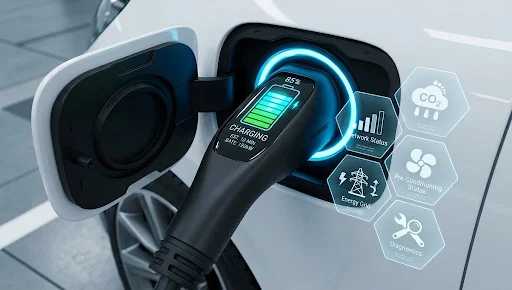
The cable clicks into place, the charging station’s LED indicator shifts from idle blue to active green, and the dashboard display projects an estimated time of completion. For modern electric vehicle (EV) drivers, a standard fast-charging session—averaging roughly 30 minutes—has transformed from an administrative hurdle into a distinct micro-window of downtime.
However, this half-hour reprieve is far from a universal constant. The actual duration required to replenish a battery depends on a complex interplay of variables:
- Charger Output: The maximum kilowatt (kW) delivery capacity of the pedestal.
- State of Charge (SoC): The entry and exit battery percentages.
- Thermal Management: The ambient and internal temperature of the lithium-ion pack.
- Vehicle Architecture: The maximum charging curve supported by the specific EV model.
Despite these technical nuances, a planned 30-minute stop offers a predictable interval to accomplish small administrative tasks, catch up on digital entertainment, or simply decompress without anxiously staring at a rising battery percentage. Industry experts emphasize that the golden rule of EV charging is structural framework: noting the target range required to reach the next waypoint, confirming parking conditions, and factoring in a safety margin before disconnecting.
Chronology: Navigating the Phases of an EV Charging Stop
Maximizing efficiency during a road trip requires mastering the chronology of a charging stop. Treating the stop as a structured timeline prevents common pitfalls, such as inadvertently blocking a high-demand stall or letting digital distractions delay your departure.
Phase 1: Arrival and Initialization (Minutes 0–5)
Upon pulling up to the charging stall, the primary objective is establishing a stable connection. Drivers must ensure energy is genuinely flowing into the battery pack rather than simply registering an "initiated" session on a mobile app. Cross-referencing the vehicle’s instrument cluster, the charger’s digital meter, and the provider’s application prevents unpleasant surprises.
During this initial window, drivers should set a mental or physical alarm for their departure time, anchoring it to the required range for the next leg of the journey rather than chasing a mindless "round number" like 100%. Overcharging past 80% on a fast charger yields diminishing returns in speed and blocks other motorists.
Phase 2: Utility and Digital Tasks (Minutes 5–15)
With the vehicle tethered, the first tranche of time is best dedicated to brief logistical needs: replying to urgent messages, confirming arrival times at a destination, or scouting a lunch stop. Keeping this task list deliberately concise prevents the charging session from devolving into an improvised remote office.
This is also the ideal moment to check real-time weather forecasts for the upcoming stretch of highway and verify that the next scheduled charging station remains operational and accessible.
Phase 3: Leisure, Entertainment, and Secondary Interfaces (Minutes 15–25)
Once essential tasks are cleared, drivers can pivot to passive entertainment or digital engagement. Whether it is reading a few chapters of a book, listening to a downloaded podcast, or tracking live sports updates, this window operates independently of local cellular network congestion.
For many motorists, this downtime serves as an opportunity to manage personal online platforms, engage with entertainment portals, or explore digital leisure interfaces. For instance, users navigating platforms like Melbet during a stationary interval often utilize the time to verify account details, review upcoming sporting fixtures, or evaluate live odds before finalizing any recreational selections. Because identity verifications and security prompts can occasionally experience latency, executing these steps while parked ensures they do not spill over into active driving time.
Phase 4: Departure and Disconnection (Minutes 25–30)
The final minutes require returning to the vehicle with ample time to safely terminate the charging session, stow the heavy high-voltage cable, and secure the charging port flap. Drivers must verify the final energy delivered, update their navigation system for the next segment, and ensure the cabin is ready for the road.
Supporting Data: Infrastructure Classifications and Charging Realities
Understanding the mechanics of public charging requires looking closely at how infrastructure is categorized. According to the Alternative Fuels Data Center (AFDC), a division of the United States Department of Energy, public charging is broadly split into distinct categories:
- Level 2 Charging (AC): Operating primarily on 208-to-240-volt circuits, Level 2 chargers are well-suited for overnight residential use, workplaces, or long-duration parking at retail centers and hotels. They replenish vehicles at a moderate pace, typically adding 10 to 25 miles of range per hour.
- DC Fast Charging (DCFC): Deployed predominantly along major highway corridors and interstates, Direct Current fast chargers bypass the vehicle’s onboard converter to feed high-voltage electricity directly into the battery pack. These units can often restore a battery from 10% to 80% in 20 to 40 minutes, making them the backbone of long-distance EV travel.
Charging Speeds vs. Real-World Variables
| Variable | Impact on Charging Time | Driver Mitigation Strategy |
|---|---|---|
| Battery Temperature | Cold batteries accept less current to protect cell longevity. | Use the vehicle’s onboard navigation to "pre-condition" (warm) the battery before arrival. |
| Charger Sharing | Power splitters reduce kW delivery if adjacent stalls are occupied. | Avoid stalls coupled with active vehicles when alternatives are available. |
| State of Charge (SoC) | Charging speeds taper off exponentially past 80% capacity. | Unplug when target range is reached rather than waiting for a full 100%. |
Official Responses and Industry Insights: The Evolution of Rest Stops
As electric vehicle adoption accelerates globally, transportation agencies, highway operators, and automotive manufacturers are rethinking the infrastructure surrounding charging hubs.
In recent policy briefs, transport authorities across Europe and North America have emphasized that the success of electrification depends heavily on the quality of the charging experience, not just the quantity of stalls. Major charging network operators—including Electrify America, Ionity, and Tesla—have increasingly partnered with commercial real estate developers to embed fast-charging plazas near amenities such as restaurants, grocery stores, and green spaces.
Dr. Aris Thorne, Senior Mobility Researcher at the International Council on Clean Transportation (ICCT), noted in a recent symposium:
"The psychological shift from fueling an internal combustion engine to charging an EV is profound. Drivers are no longer exchanging currency for liquid fuel in a three-minute transactional blur. They are parking for twenty to forty minutes. This creates an entirely new ecosystem where energy infrastructure, retail, digital services, and urban planning intersect."
Automotive manufacturers are also responding by integrating advanced trip planners directly into infotainment systems. These software suites automatically calculate required stops, predict station occupancy in real-time, and pre-condition the battery pack prior to arrival to optimize charging speeds.
Implications: The Psychological and Economic Shifts of EV Travel
The transition to scheduled, intermittent stopping points introduces fascinating implications for both consumer behavior and commercial markets.
1. The Redefinition of Travel Fatigue
Traditional road trips in fossil-fueled vehicles are often characterized by endurance driving—pushing through fatigue until a fuel light forces a hasty, functional stop. EV travel inherently mandates pacing. By imposing mandatory 30-minute intervals every two to three hours, safety advocates suggest that EV drivers experience lower rates of driver fatigue and highway hypnosis. The forced pause encourages stretching, hydration, and mental resets.
2. Commercial Real Estate Opportunities
Retailers situated near DC fast-charging hubs are seeing a measurable shift in customer foot traffic. Coffee shops, convenience stores, and fast-casual dining establishments located adjacent to charging plazas benefit from captive audiences with time to spare. Conversely, poorly maintained charging stations lacking basic amenities risk turning into frustrating bottlenecks for stranded motorists.
3. Digital Engagement and Connectivity
As vehicles evolve into rolling smart devices, the cabin during a charging stop becomes an extension of the living room or office. The proliferation of high-speed in-car Wi-Fi, streaming applications, and mobile browsing means that drivers utilize their downtime in increasingly diverse ways. However, industry watchdogs advise caution: digital multitasking must remain strictly partitioned to stationary periods. Once the charging cable is stowed and the vehicle is put into drive, the cockpit must instantly revert to an environment governed entirely by situational awareness and road safety.
Conclusion
The modern EV charging stop is far more than a technical pit stop; it is a microcosm of how our relationship with energy, time, and travel is evolving. By understanding the mechanics of fast chargers, establishing a structured timeline for downtime, and respecting the boundaries between digital engagement and active driving, motorists can turn the necessary pauses of electric mobility into the most relaxing segments of their journey.
