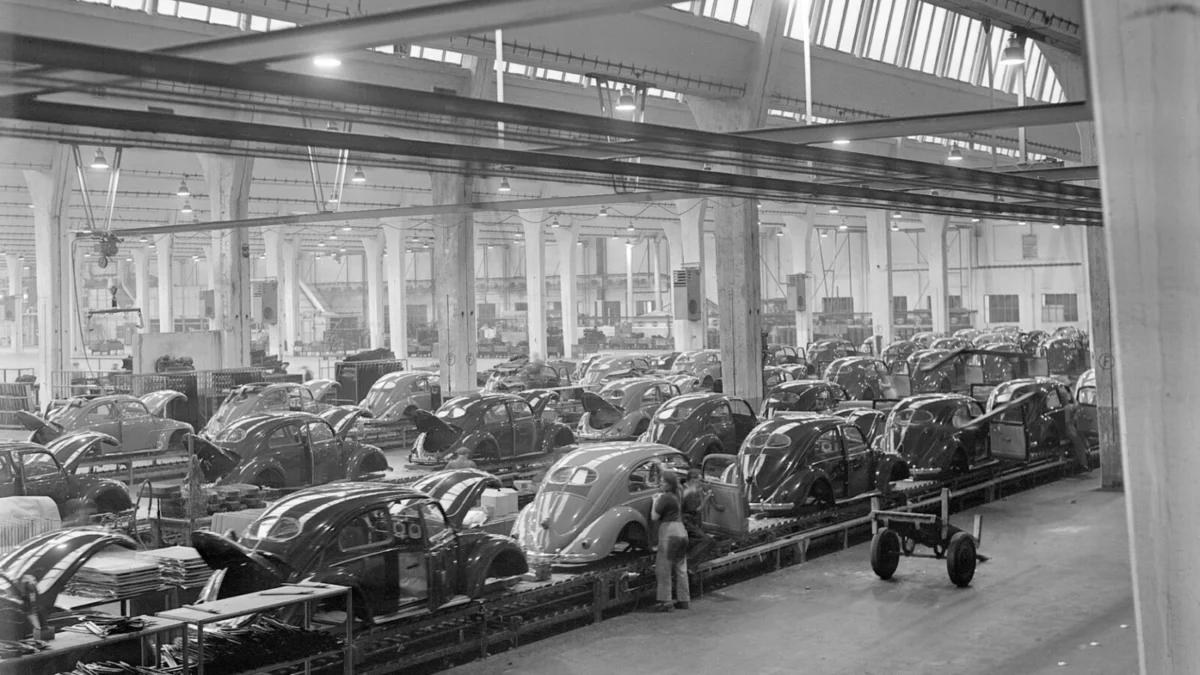
At the close of the winter of 1948, the industrial complex of Wolfsburg, sprawled along the Mittelland Canal in Lower Saxony, resembled a poisoned chalice. Amidst workshops scarred by Allied bombing—where tarpaulins substituted for shattered windows—a small contingent of British officers from the Royal Electrical and Mechanical Engineers (REME) was engaged in a desperate bid to maintain a survival-level production. Under the command of Major Ivan Hirst, the factory lines produced roughly a thousand small, rounded sedans per month. These vehicles served the occupation forces and the struggling postal service, with the raw bodywork often traded for coal from the Ruhr or flour to feed the refugees pouring in from the East.
Yet, in the hallowed halls of Whitehall, the British government’s patience had worn thin. An Empire bankrupted by the cost of global conflict and suffering under severe rationing viewed the German industrial combine not as an asset, but as a hemorrhaging liability. The order was issued to the military authorities: liquidate the facility, dismantle the tooling, and offload the designs for the "People’s Car" to any Western manufacturer capable of removing the burden from the British taxpayer—without asking for a single pound in subsidies.
A Chronology of Rejection
The history of the automobile industry is defined by "what ifs," but few chapters are as ironic as the year 1948, when the world’s leading automotive giants collectively walked away from the most successful car design in history.
- March 1948: Henry Ford II and his strategic advisor, Ernest Breech, travel to Germany. They are offered the entirety of the Wolfsburg facility for zero dollars. They decline, famously dismissing the venture as worthless.
- April 1948: Sir William Rootes, representing the British automotive establishment, conducts a formal inspection. His report deems the vehicle fundamentally flawed and a potential financial catastrophe.
- June 1948: The German Currency Reform introduces the Deutsche Mark, stabilizing the economy and providing the capital necessary for Volkswagen to pivot from survival to production.
- January 1949: Heinrich Nordhoff, the former Opel executive, begins his tenure as director, shifting the company’s focus from military utility to civilian export.
- August 1955: The one-millionth Beetle rolls off the assembly line, proving the skeptics of 1948 spectacularly wrong.
The Arrogance of the Coventry Establishment
The first to answer the call for potential suitors were the barons of the British motor industry. Sir William Rootes, the formidable head of the Rootes Group—which included Hillman, Humber, and Sunbeam—arrived at Wolfsburg with a retinue of engineers clad in bespoke three-piece suits. Their reception of the rear-engine machine was characterized by a profound, almost visceral condescension.
Educated in the rigid orthodoxy of the conventional sedan—characterized by a long trunk, heavy cast-iron front-mounted engines, and rigid axles—the industrialists from Coventry viewed the "Type 1" with the disdain of pre-war artisans. To them, the air-cooled, flat-four magnesium-and-aluminum engine was unacceptably noisy; the sparse, utilitarian cabin was deemed unworthy of a civilian buyer; and the "insect-like" silhouette was dismissed as incapable of seducing the public.
The official report submitted to the Foreign Office was brutal in its brevity: the vehicle did not conform to the basic technical requirements of a modern automobile. The commission warned that large-scale commercial production would be a financial black hole. Confident that the reliable, traditional Hillman Minx would dominate the European market, Rootes departed without even requesting a set of blueprints.
The Legal and Geopolitical Minefield
Following the British refusal, Allied diplomats turned toward the American titan, Ford. The meeting in Bad Homburg was a pivotal moment in corporate history. The British offered the keys to Wolfsburg to Henry Ford II for free. However, Ernest Breech, a ruthless financial strategist who had been headhunted from General Motors to rescue a near-bankrupt Ford, immediately identified the trap.
The Soviet Threat
Wolfsburg was situated just fifteen kilometers from the border of the Soviet occupation zone. In the shadow of the burgeoning Berlin Blockade, with Red Army convoys conducting regular, ominous maneuvers at Helmstedt, the prospect of investing millions into a factory sitting in the crosshairs of Stalin’s armored divisions was viewed as "Russian roulette."
The "KdF" Legal Liability
Beyond the military risk, there was a legal nightmare. The factory had been financed by the German Labour Front (DAF) using assets seized from suppressed trade unions. More importantly, over 330,000 German citizens had spent years pasting savings stamps into their "KdF-Wagen" booklets, fueled by Nazi propaganda promising them a car. Any foreign entity taking over the factory faced an immediate tidal wave of civil litigation from thousands of citizens demanding their vehicles.
As he walked out of the meeting, Breech offered a final assessment to Henry Ford II: "Mr. Ford, I don’t think what we’re being offered is worth a damn."
The Strategic Shift: Nordhoff and the Air-Cooled Engine
Having been spurned by Citroën, Peugeot, and Fiat—whose president, Vittorio Valletta, feared the Beetle would cannibalize sales of the small Topolino—Major Hirst turned to a "pariah" of the industry. Heinrich Nordhoff, the former director of the massive Opel military truck factory in Brandenburg, had been blacklisted by American authorities under de-nazification laws. Forbidden from working in Rüsselsheim, Nordhoff accepted Hirst’s offer and assumed control of Wolfsburg on January 1, 1948.
Nordhoff brought a fresh perspective, unburdened by the British bias toward water-cooled, complex systems. He immediately grasped the genius of Ferdinand Porsche’s design: the total absence of a liquid cooling circuit. In a post-war Europe defined by harsh winters, a chronic lack of antifreeze, and a crumbling infrastructure, an engine that could neither freeze in winter nor boil over in summer was a masterstroke of reliability.
Implications: The Triumph of Common Sense
The success of the Volkswagen Beetle represents one of the most significant miscalculations in the history of global business. While the British motor industry remained shackled to its "water-cooled" prestige and traditionalist manufacturing, Nordhoff focused on incremental improvement and global export.
By the mid-1950s, the Beetle had become a symbol of the German "Wirtschaftswunder" (economic miracle). Its simplicity, low cost of maintenance, and air-cooled durability allowed it to penetrate markets that were inaccessible to the complex, heavy vehicles produced by Rootes or Ford’s European subsidiaries.
Conversely, the British manufacturers who had turned their noses up at the Beetle found themselves spiraling into a cycle of labor unrest, structural rust, and mechanical failure. By the 1960s, the once-mighty Rootes Group was in a state of terminal decline, eventually sold off at a fraction of its value to Chrysler.
The lesson of 1948 is one that continues to resonate: in industrial design, the pragmatic utility of a simple, robust concept will almost always eventually dismantle the arrogance of legacy experts. The British and American refusal did not destroy the Volkswagen; it merely cleared the stage for a machine that would eventually sell over 21 million units, proving that the most valuable assets are often those that others are too proud to recognize.