
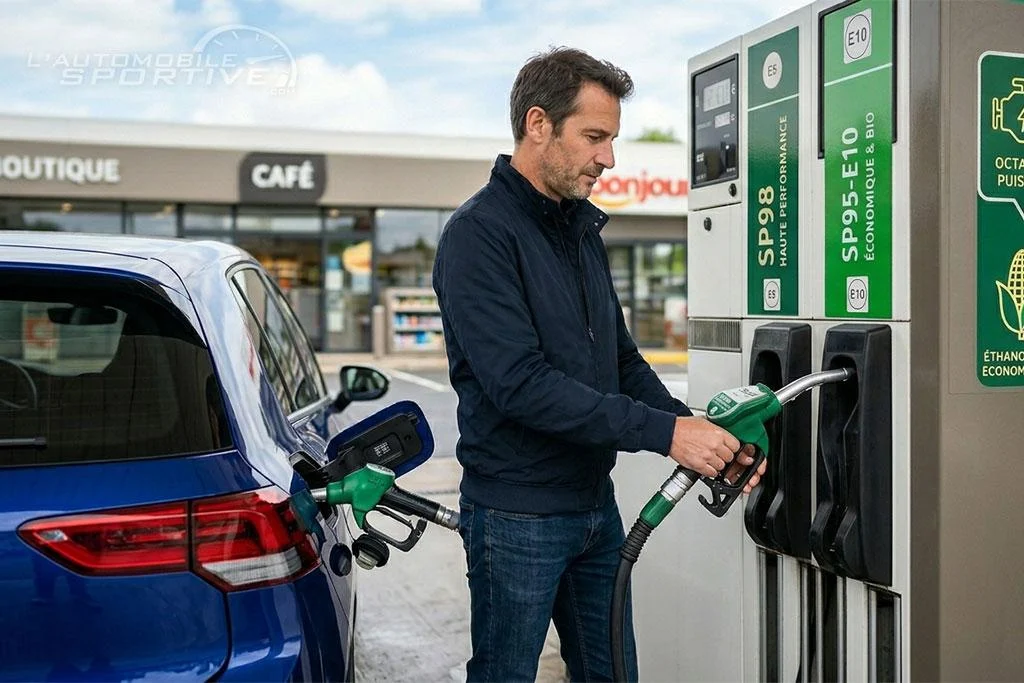
PARIS – As the automotive landscape undergoes a radical transformation toward electrification, the enthusiasts of internal combustion engines (ICE) find themselves navigating an increasingly complex and expensive environment. By May 2026, the simple act of refilling a fuel tank has evolved from a routine chore into a calculated strategic decision. With the price of premium fuels consistently breaching the €2.00 per liter mark, a growing number of sports car owners are facing a tempting, yet potentially hazardous, proposition: switching to the cheaper SP95-E10.
However, as fuel prices soar and the chemical composition of what we pump into our vehicles changes, experts warn that the "savings" found at the nozzle may result in long-term mechanical degradation and immediate performance loss. This report explores the technical, economic, and practical realities of the SP98 versus SP95-E10 debate in the current high-inflation era.
1. Main Facts: The Chemistry of Performance
At the heart of the debate are two primary factors: the octane rating and the type of renewable components used in the fuel blend. While the casual driver might see "95" and "98" as mere numbers, for a high-performance engine, they represent the threshold between optimal efficiency and catastrophic "knocking."
The Octane Myth
A common misconception is that a higher octane rating (RON 98 vs. RON 95) equates to more "explosive power." In reality, octane is a measure of a fuel’s stability and its resistance to premature ignition. In high-compression sports car engines, the air-fuel mixture is subjected to intense pressure. If the fuel is not stable enough, it can ignite before the spark plug fires—a phenomenon known as "knocking" or "pinking."
SP98 (Super Sans Plomb 98) provides a higher buffer against this uncontrolled combustion. Modern Electronic Control Units (ECUs) can detect lower-grade fuel and retard ignition timing to protect the engine, but this comes at the direct cost of horsepower and torque.
Ethanol vs. ETBE
The "E10" in SP95-E10 signifies that the fuel contains up to 10% agricultural bioethanol. While marketed as a "green" alternative, ethanol is hygroscopic, meaning it attracts water from the atmosphere. In sports cars that are often driven sporadically or stored during winter months, this can lead to phase separation and corrosion in the fuel system.
![[Technique] SP98 vs SP95-E10 : face au prix, faut-il vraiment h?siter ?](https://www.automobile-sportive.com/images/news/comparatif-sp98-sp95e10-avantages-inconvenients-2026.jpg)
In contrast, SP98 also contains renewable content, but often in the form of ETBE (Ethyl Tert-Butyl Ether). ETBE is synthesized from ethanol but does not share its corrosive or water-attracting properties. It is more expensive to produce but offers superior stability and compatibility with high-performance fuel lines and gaskets.
2. Chronology: The Evolution of European Fuel Standards
To understand the 2026 fuel crisis, one must look at the decade-long shift in European energy policy.
- 2009-2011: The European Union introduces the Fuel Quality Directive, paving the way for the rollout of E10. The goal was to reduce greenhouse gas emissions by integrating 10% renewable energy into the transport sector.
- 2018-2022: As environmental regulations tightened, SP95 (E5) began to disappear from French and European forecourts, replaced almost entirely by SP95-E10. SP98 was maintained as a "protection grade" for older vehicles and high-performance engines.
- 2024-2025: Geopolitical instability and increased carbon taxes on fossil fuels drove the price of crude oil upward. Refineries began prioritizing E10 production due to government subsidies for biofuels, causing the price gap between E10 and SP98 to widen significantly.
- May 2026: The price of SP98 officially stabilizes above €2.10 per liter in most urban centers. Consumer data shows a 15% uptick in sports car owners attempting to run their vehicles on E10 to mitigate the cost of "Sunday drives."
3. Supporting Data: The "False Economy" of E10
The primary driver for the switch to E10 is the price difference, which in May 2026 averages roughly €0.12 to €0.15 per liter. However, raw data from automotive engineers suggests that the "savings" are largely illusory due to the Lower Heating Value (LHV) of ethanol.
The Calorific Deficit
Ethanol contains approximately 33% less energy by volume than pure gasoline. Therefore, a blend containing 10% ethanol (E10) has a lower energy density than SP98.
- Consumption Increase: On average, a vehicle running on SP95-E10 will consume between 3% and 5% more fuel to cover the same distance as it would on SP98.
- The Breakeven Point: If SP98 is €2.10 and E10 is €1.98, the price difference is 5.7%. If the car’s consumption increases by 5% on E10, the actual financial saving is a negligible 0.7%—roughly €0.40 saved on a full 60-liter tank.
Long-Term Maintenance Costs
For the owners of "youngtimers" (sports cars from the 1990s and early 2000s) or modern high-strung turbocharged engines, the risks go beyond fuel economy:
- Seal Degradation: Older elastomers and rubbers used in fuel pumps and injectors can be degraded by the high solvent properties of ethanol.
- Oxidation: Ethanol oxidizes more quickly than ETBE-based fuels. For a sports car that sits in a garage for three weeks between drives, the fuel in the tank can begin to "sour," leading to gum deposits in the injectors.
4. Official Responses and Industry Perspectives
The debate has prompted responses from both the petroleum industry and automotive manufacturers.
![[Technique] SP98 vs SP95-E10 : face au prix, faut-il vraiment h?siter ?](https://www.automobile-sportive.com/images/newsmini/Adamastor-Furia-proto-hypercar-2026.jpg)
The French Petroleum Industry Association (UFIP):
"While we support the transition to biofuels, we recognize that SP98 remains an essential technical requirement for a specific segment of the fleet. The production of ETBE-heavy premium fuels is more energy-intensive, which explains the price premium. However, for high-performance applications, the stability of SP98 is unmatched."
Engine Calibration Lead at a Major European Performance Brand:
"Our engines are mapped specifically to take advantage of 98-octane fuel. When a customer uses E10, the knock sensors detect the lower octane almost immediately. The ECU pulls back ignition timing to prevent engine damage. While the car remains ‘drivable,’ the owner is effectively losing 5-10% of their advertised horsepower and increasing their exhaust gas temperatures (EGTs), which can stress the turbochargers over time."
Consumer Advocacy Groups:
Some groups have argued that the government should cap the tax on "protection grade" fuels like SP98 to prevent the "mechanical exclusion" of enthusiasts and owners of older vehicles who cannot safely run E10.
5. Implications: The Future of the Internal Combustion Hobby
The fuel crisis of 2026 is accelerating several trends within the enthusiast community.
The Rise of "Daily" vs. "Weekend" Fuel Strategies
Owners are increasingly adopting a bifurcated strategy. For modern "daily drivers" with flexible fuel maps, E10 is becoming the standard. However, for the "pleasure vehicle"—the Porsche 911, the Alpine A110, or the Megane RS—SP98 remains non-negotiable. The consensus among the community is that if one can afford the insurance and maintenance of a sports car in 2026, the extra €5 per tank for SP98 is a necessary "insurance policy" for the engine.
The Aftermarket Response
We are seeing a surge in the "Flex-Fuel" conversion market, but with a twist. Rather than just converting to E85 (Superethanol), owners are installing sophisticated sensors that allow the ECU to adjust in real-time to any blend of fuel. However, even with these conversions, the mechanical hardware (fuel lines and injectors) often requires expensive upgrades to handle the corrosive nature of high-ethanol blends.
![[Technique] SP98 vs SP95-E10 : face au prix, faut-il vraiment h?siter ?](https://www.automobile-sportive.com/images/newsmini/evolution-augmentation-prix-carburant-sp98-2026.jpg)
Market Polarization
The high cost of premium fuel is also affecting the second-hand market. Sports cars that are "E10-compatible" are holding their value better than older, more sensitive models. Conversely, the "purist" market continues to value cars that have been exclusively fed a diet of SP98, with service histories now frequently including fuel receipts as proof of meticulous care.
Conclusion: A Strategy for the Modern Enthusiast
In 2026, the choice at the pump is a reflection of the owner’s philosophy. While the SP95-E10 nozzle offers the allure of a lower immediate cost, the technical reality remains unchanged: high-performance machinery requires high-performance fuel.
For the sports car owner, the SP98 is not just a fuel; it is a component of the engine’s design. The combination of higher octane stability, the protective qualities of ETBE, and the superior energy density makes it the only logical choice for those looking to preserve both the performance and the longevity of their vehicles. As the "Automobile Sportive" dossier concludes, the "savings" offered by E10 are a trap—a false economy that trades pennies today for thousands of euros in repair bills tomorrow. In the world of high-performance driving, some corners simply cannot be cut.
For more technical insights, visit our complete dossier: SP98 vs SP95-E10: The Definitive Guide.
